

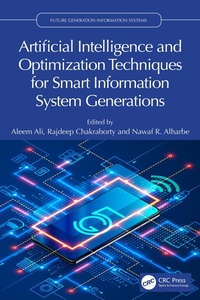
Artificial Intelligence and Optimization Techniques for Smart Information System Generations
1st Edition
Published on 28. March 2025
318 pages
978-1-040-31256-8 (ISBN)
Description

The text comprehensively focusses on the use of artificial intelligence and optimization techniques for creating smart information systems.
Focuses on extracting information from blockchain repository using artificial intelligence and machine learning algorithms
Presents deep learning models to identify and locate objects within images and videos, making it possible for machines to perform tasks such as self-driving cars, surveillance, and robotics
Discusses artificial intelligence and optimization techniques for geographic information system (GIS) generation such as spatial data processing
Covers artificial intelligence algorithms such as dimensionality, distance metrics, clustering, error calculation, hill climbing, and linear regression
Illustrates topics such as image recognition, natural language processing, fraud detection, information system security, and intrusion detection system
Focuses on extracting information from blockchain repository using artificial intelligence and machine learning algorithms
Presents deep learning models to identify and locate objects within images and videos, making it possible for machines to perform tasks such as self-driving cars, surveillance, and robotics
Discusses artificial intelligence and optimization techniques for geographic information system (GIS) generation such as spatial data processing
Covers artificial intelligence algorithms such as dimensionality, distance metrics, clustering, error calculation, hill climbing, and linear regression
Illustrates topics such as image recognition, natural language processing, fraud detection, information system security, and intrusion detection system
More details
Series
Edition
1. Auflage
Language
English
Place of publication
London
United Kingdom
Publishing group
Taylor & Francis Ltd
Target group
College/higher education
Professional and scholarly
Illustrations
32 Tables, black and white; 85 Line drawings, black and white; 18 Halftones, black and white; 103 Illustrations, black and white
File size
45,12 MB
ISBN-13
978-1-040-31256-8 (9781040312568)
Copyright in bibliographic data and cover images is held by Nielsen Book Services Limited or by the publishers or by their respective licensors: all rights reserved.
Schweitzer Classification
Other editions
Additional editions

Aleem Ali | Rajdeep Chakraborty | Nawaf Alharbe
Artificial Intelligence and Optimization Techniques for Smart Information System Generations
Book
approx. 06/2026
1st Edition
CRC Press
€69.00
Not yet published
Aleem Ali | Rajdeep Chakraborty | Nawaf Alharbe
Artificial Intelligence and Optimization Techniques for Smart Information System Generations
Book
03/2025
1st Edition
CRC Press
€232.20
Shipment within 10-20 days
Persons
Aleem Ali is presently working as a professor, in the Department of Computer Science and Engineering, at Chandigarh University, Punjab, India. He has published more than forty research papers in journals and conferences of national and international repute. His areas of research interest include the Internet of Things, machine learning techniques, wireless networks, network security, cryptography, and data mining.
Rajdeep Chakraborty is currently working as a professor, in the Department of Computer Science and Engineering, at Medi-Caps University, Indore, MP, India. He has more than twenty years of research and academic experience. He has publications in reputed international journals and conferences. He also has written an authored book on hardware cryptography. His field of interest is mainly in cryptography and computer security.
Nawaf R. Alharbe is presently working as a professor, college of computer science and engineering, dept. of AI & DS, at Taibah University, Madinah, Saudi Arabia. He is an esteemed visiting professor, in the faculty of computing, engineering, and sciences, at Staffordshire University, United Kingdom. He has published research papers in journals and conferences of national and international repute. His areas of research interest include the Internet of Things, network communication, sensor technology, network security, wireless communications, computer networking, and cloud computing.
Rajdeep Chakraborty is currently working as a professor, in the Department of Computer Science and Engineering, at Medi-Caps University, Indore, MP, India. He has more than twenty years of research and academic experience. He has publications in reputed international journals and conferences. He also has written an authored book on hardware cryptography. His field of interest is mainly in cryptography and computer security.
Nawaf R. Alharbe is presently working as a professor, college of computer science and engineering, dept. of AI & DS, at Taibah University, Madinah, Saudi Arabia. He is an esteemed visiting professor, in the faculty of computing, engineering, and sciences, at Staffordshire University, United Kingdom. He has published research papers in journals and conferences of national and international repute. His areas of research interest include the Internet of Things, network communication, sensor technology, network security, wireless communications, computer networking, and cloud computing.
Content
1. Unveiling the Power of Prediction: A Comprehensive Guide to Machine Learning Techniques, from Data Preparation to Model Interpretability for Early Prediction of Diabetes and Effective Management.
2. Digital Image Forgery Techniques for Smart Information Generations.
3. Artificial Intelligence(AI) and optimization for Health Information System(HIS) generation.
4. Agricultural Information Systems emphasizing Agro Robots towards Digital and Sustainable Agriculture.
5. Smart Agriculture based on Artificial Intelligence in Africa Region: Open Challenges, Solutions.
6. Synergizing Artificial Intelligence and Optimization Techniques for Enhanced Public Services.
7. Architectural Pattern for Implementing XAI as a Service for Container Orchestrated Machine Learning Model Deployments.
8. Quantum Machine Learning (QML) Algorithms for Smart Biomedical Applications.
9. Artificial Intelligence for Information System Security.
10. Optimized Image Recognition for Smart Information Generations: A Comprehensive Evaluation of Image Processing Techniques.
11. Machine Learning based Security Algorithms for Cloud Computing: A Comprehensive Survey.
12. Securing Information in Transit: Leveraging AI/ML for Robust Data Protection.
13. Optimizing Medical Image Compression for Efficient Information System Integration: A Comprehensive Review.
14. FaceTrack: A Face Recognition-based Real-time Attendance Marking Approach using Haar Cascade and Machine Learning.
15. Optimizing Information Systems for Green Computing in Higher Education: From Awareness to Action.
16. Evaluating Thin Client Solutions: A Sustainable and Energy-Efficient Alternative to Traditional Classroom PCs
2. Digital Image Forgery Techniques for Smart Information Generations.
3. Artificial Intelligence(AI) and optimization for Health Information System(HIS) generation.
4. Agricultural Information Systems emphasizing Agro Robots towards Digital and Sustainable Agriculture.
5. Smart Agriculture based on Artificial Intelligence in Africa Region: Open Challenges, Solutions.
6. Synergizing Artificial Intelligence and Optimization Techniques for Enhanced Public Services.
7. Architectural Pattern for Implementing XAI as a Service for Container Orchestrated Machine Learning Model Deployments.
8. Quantum Machine Learning (QML) Algorithms for Smart Biomedical Applications.
9. Artificial Intelligence for Information System Security.
10. Optimized Image Recognition for Smart Information Generations: A Comprehensive Evaluation of Image Processing Techniques.
11. Machine Learning based Security Algorithms for Cloud Computing: A Comprehensive Survey.
12. Securing Information in Transit: Leveraging AI/ML for Robust Data Protection.
13. Optimizing Medical Image Compression for Efficient Information System Integration: A Comprehensive Review.
14. FaceTrack: A Face Recognition-based Real-time Attendance Marking Approach using Haar Cascade and Machine Learning.
15. Optimizing Information Systems for Green Computing in Higher Education: From Awareness to Action.
16. Evaluating Thin Client Solutions: A Sustainable and Energy-Efficient Alternative to Traditional Classroom PCs
