

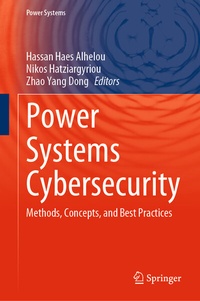
Power Systems Cybersecurity
Description

This book covers power systems cybersecurity.
In order to enhance overall stability and security in wide-area cyber-physical power systems and defend against cyberattacks, new resilient operation, control, and protection methods are required. The cyberattack-resilient control methods improve overall cybersecurity and stability in normal and abnormal operating conditions. By contrast, cyberattack-resilient protection schemes are important to keep the secure operation of a system under the most severe contingencies and cyberattacks. The main subjects covered in the book are: 1) proposing new tolerant and cyberattack-resilient control and protection methods against cyberattacks for future power systems, 2) suggesting new methods for cyberattack detection and cybersecurity assessment, and 3) focusing on practical issues in modern power systems.
More details
Other editions
Additional editions
Persons
Zhao Yang Dong (Fellow, IEEE) received Ph.D. in electrical engineering from The University of Sydney, NSW, Australia. He is with Nanyang Technological University, Singapore. His previous roles include SHARP Professor of Energy Systems, Director of UNSW Digital Grid Futures Institute, the University of NSW (UNSW), Sydney, Australia; Director of ARC Research Hub for Integrated Energy Storage Solutions; Professor and the Head of the School of Electrical and Information Engineering, The University of Sydney, and the Ausgrid Chair and the Director of Ausgrid Centre for Intelligent Electricity Networks providing R&D support for the Smart Grid, Smart City national demonstration project of Australia. His research interests include power system planning, renewable energy systems, smart grid, smart cities, and the energy market. He has been serving as an editor/associate editor for a number of IEEE Transactions and IET journals.
Content
Chapter 1. A comprehensive review on cyber-attack detection and control of microgrid systems.- Chapter 2. Cyber Vulnerabilities of Modern Power Systems.- Chapter 3. Cyber-Physical Security in Smart Power Systems from a Resilience Perspective: Concepts and Possible Solutions.- Chapter 4. Cybersecurity Challenges in Microgrids: Inverter-Based Resources and Electric Vehicles.- Chapter 5. Improving Cybersecurity Situational Awareness in Smart Grid Environments.- Chapter 6. Hybrid Physics-Based and Data-driven Mitigation Strategy for Automatic Generation Control Under Cyber Attack.- Chapter 7. Data Driven Cybr Resilient Control of Wide Area Power Systems.- Chapter 8. Cyberattack-Resilient Control in Multi-Area Power Generation.- Chapter 9. Cyber-Security of Protection System in Power Grids - Part 1: Vulnerabilities and Counter-Measures.- Chapter 10. Cyber-Security of Protection System in Power Grids - Part 2: Case Studies on Securing Line Current Differential Relays.- Chapter 11. Semi-supervised deep learning-driven anomaly detection schemes for cyber-attack detection in smart grids.- Chapter 12. Vertical approach Anomaly Detection using Local Outlier Factor.- Chapter 13. A modular infrastructure for the validation of cyberattack detection systems.- Chapter 14. A novel self-learning cybersecurity system for smart grids.- Chapter 15. Cyber-resilience enhancement framework in smart grids.- Chapter 16. SOAR4DER: Security Orchestration, Automation, and Response for Distributed Energy Resources.- Chapter 17. A Study on Cyber-Physical System Architecture for Smart Grids and Its Cyber Vulnerability.- Chapter 18. A Study on Cybersecurity Standards for Power Systems.
