

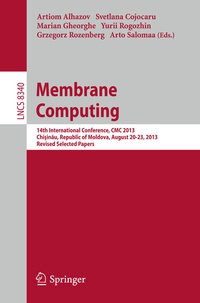
Membrane Computing
Description

This book constitutes the thoroughly refereed post-conference proceedings of the 14th International Conference on Membrane Computing, CMC 2013, held in Chisinau, Republic of Moldova, in August 2013.
The 16 revised selected papers presented together with 6 invited lectures were carefully reviewed and selected from 26 papers presented at the conference. Membrane computing is an area of computer science aiming to abstract computing ideas and models from the structure and the functioning of living cells, as well as from the way the cells are organized in tissues or higher order structures. It deals with membrane systems, also called P systems, which are distributed and parallel algebraic models processing multi sets of objects in a localized manner (evolution rules and evolving objects are encapsulated into compartments delimited by membranes), with an essential role played by the communication among compartments and with the environment.
More details
Other editions
Additional editions
Content
A Kernel P Systems Survey.- Roads to New Grand Challenges of Informatics.- Computational Complexity of P Systems with Active Membranes.- Some Open Problems about Catalytic, Numerical, and Spiking Neural P Systems.- Active Membranes, Proteins on Membranes, Tissue P Systems: Complexity-Related Issues and Challenges.- Using the Formal Framework for P Systems.- A P System for Annotation of Romanian Affixes.- Behavioural Equivalences in Real-Time P Systems.- Modelling of Surface Runoff Using 2D P Colonies.- Implementation of P Systems by Using Big Data Technologies.- On Counter Machines versus dP Automata.- Model Checking Kernel P Systems.- Flattening in (Tissue) P Systems.- Solving SAT by P Systems with Active Membranes in Linear Time in the Number of Variables.- On Communication Complexity of Some Hard Problems in ECPe Systems.- About One-Sided One-Symbol Insertion-Deletion P Systems.- Flattening and Simulation of Asynchronous Division less P Systems with Active Membranes.- Enzymatic Numerical P Systems Using Elementary Arithmetic Operations.- Communication Rules Controlled by Generated Membrane Boundaries.- Programming P Systems with Complex Objects.- In Search of a Structure of Fractals by Using Membranes as Hyper edges.- The Relevance of the Environment on the Efficiency of Tissue P Systems.
