

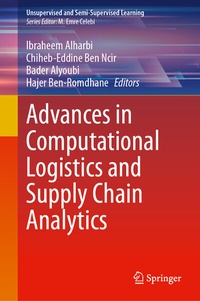
Advances in Computational Logistics and Supply Chain Analytics
Description

This book provides advances in computational logistics and supply chain analytics. The authors include innovative data-driven and learning-based approaches, methods, algorithms, techniques, and tools that have been designed or applied to create and implement a successful logistics and supply chain management process. This book highlights the state of the art and challenges related to the design and the application of computational methods to solve logistic and supply chain management problems. The authors present recent computational logistic methods and supply chain analytics techniques designed and applied to support managers in improving such complex processes. This book broadly covers recent computational methods and techniques applied to ensure continuous improvement of transport, logistic, and supply chain management processes. Readers can rapidly explore these new methods and their applications to solve such complex problems.
More details
Other editions
Additional editions
Persons
Ibraheem Alharbi is currently the dean of the College of Business at the University of Jeddah. He serves as Associate Professor in the MIS Department, College of Business, University of Jeddah. His research interests include business and information ethics, information privacy and electronic commerce.
Chiheb-Eddine Ben Ncir is currently Associate Professor at the University of Jeddah and a member of LARODEC laboratory, University of Tunis. His research interests concern machine learning methods with a special emphasis on Big data clustering.
Bader Alyoubi is currently the dean of the College of Sports Sciences at the University of Jeddah and serves as Professor of Management Information Systems at the same university. His research focuses on decision support systems and knowledge management techniques.
Hajer Ben-Romdhane is an Assistant Professor in the Department of Computer Science at Institut Supérieur de Gestion,University of Tunis, Tunisia, and a member of LARODC laboratory. Her research interests include modeling of complex problems and the design of decision support systems.
Content
Introduction.- Innovative logistic techniques and Tools in Industry 4.0.- Predictive analytics for quality control of logistic processes.- Artificial intelligence systems for smart logistics in the medicine sector.- Supply-Chain Management: Automating the purchase process based on machine learning techniques.- Multi Criteria Decision Making applications in Supply Chain Management.- Consumers' Acceptance of Drones for last-mile delivery in emerging economy.- Evaluation methods to mitigate the risks of price fluctuations on inventory in contemporary economies.- Overview of using augmented reality techniques in logistics.- Computational methods for scheduling problems.- Digitalization and automation of supply chain processes.- Reverse Logistics: Evaluation of practices in hospitals in Saudi Arabia.- Combining Global Optimization Algorithms with Live Google Maps for Solving the Vehicle Routing Problem.- Conclusion.
