

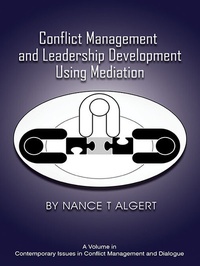
Conflict Management and Leadership Development Using Mediation
1st Edition
Published on 1. January 2021
121 pages
978-1-64802-261-6 (ISBN)
Description

Conflict management is an overlooked area in leadership development. Mediation as an intervention method to use in conflict management can be productive for building leadership capacity and organizational development in higher education. Adults average five conflicts per day and people in titled leadership spend over two-thirds of their time engaged in managing conflict. This workbook offers conflict management strategies, models, and processes to support college and university personnel in recognizing and managing conflicts and how to build skill sets that can enhance effective communication and address conflicts.
More details
Other editions
Additional editions
Nance T. Algert
Conflict Management and Leadership Development Using Mediation
Book
01/2021
Information Age Publishing
€105.40
Shipment within 3-4 weeks
Nance T. Algert
Conflict Management and Leadership Development Using Mediation
Book
01/2021
Information Age Publishing
€55.50
Shipment within 3-4 weeks
Content
- Front Cover
- Conflict Management and Leadership Development Using Mediation
- A Volume in Contemporary Issues in Conflict Management and Dialogue
- Series Editors:
- Nance T Algert, Texas A&M University Carla Liau-Hing Yep, The Center for Change and Conflict Resolution Kenita S. Rogers, Texas A&M University Christine A. Stanley, Texas A&M University
- Series Page
- Copyright Page
- CONTENTS
- Preface ix
- Introduction xi
- 1. Change and the Workplace 1
- 2. Conflict 5
- 3. Conflict Management 9
- 4. Conflict Engagement 17
- 5. Organizational Conflict 29
- 6. Mediation 35
- 7. Models of Mediation 53
- 8. Glossary 77
- 9. Appendix I: Ethical Guidelines for Mediators 83
- 10. Appendix II: Captured Conflict Management Phrases 89
- 11. Appendix III: Reading Reference List 95
- 12. About the Author 105
- Contemporary Issues in Conflict Management and Dialogue
- Conflict Management and Leadership Development Using Mediation
- By
- Nance T Algert
- Texas A&M University
- Information Age Publishing, Inc. Charlotte, North Carolina www.infoagepub.com
- Preface
- Nance T Algert
- The Center for Change and Conflict Resolution
- Introduction
- 1. present a brief perspective on change in the workplace and the stress and conflicts that often accompany change
- 2. share a framework for understanding conflict and typical behavior patterns when individuals are dealing with conflict. With this framework in mind, the reader can begin to understand the processes and role that a mediator should use to operate in ...
- 3. highlight several tools for the mediator to use in a mediation process
- and
- 4. identify aspects of a mediation training program for those striving to preempt the potential of costly conflicts by having known mediators available.
- CHAPTER 1
- Change and the Workplace
- Satir's Model of Individual Change
- Figure 1.1. Satir's model for individuals and organizations.
- Stress and Our Performance
- CHAPTER 2
- Conflict
- Importance of Managing Conflict
- Figure 2.1. Understanding how conflicts occur.
- Conflict Modes
- Figure 2.2. The Thomas-Kilmann conflict mode instrument.
- Conflict Escalation and DeEscalation
- Table 2.1. Conflict Escalation
- 1.
- 2.
- 3.
- 4.
- 5.
- 6.
- 7.
- 8.
- 9.
- CHAPTER 3
- Conflict Management
- What Is Alternative Dispute Resolution?
- A Brief History of ADR1
- The Characteristics of ADR Approaches
- 1. Informality: Fundamentally, ADR processes are less formal than judicial processes. In most cases, the rules of procedure are flexible, without formal pleadings, extensive written documentation, or rules of evidence. This informality is appealing a...
- 2. Application of Equity: Equally important, ADR programs are instruments for the application of equity rather than the rule of law. Each case is decided by a third party or negotiated between disputants themselves based on principles and terms that ...
- 3. Direct Participation and Communication Between Disputants: Other characteristics of ADR systems include more direct participation by the disputants in the process and design of settlements, more direct dialogue and opportunity for reconciliation b...
- Choosing an Intervention Approach for Conflict
- 1. The long-term relations and interactions of the disputants with each other and with the intervening party.
- 2. How much influence the disputants have in determining the process and resolution to the current conflict.
- 3. How much influence the intervening party has on the process and resolution.
- 4. How much effort, time and resources the approach will take.
- Figure 3.1. Styles of intervention management.
- Modeling
- Guiding
- Facilitating
- Mediating
- Negotiating
- Arbitrating
- Judging
- NOTE
- CHAPTER 4
- Conflict Engagement
- Figure 4.1. Having a different kind of conversation.
- Identifying the Conflict
- Developing a Conflict Management Plan
- When Developing a Conflict Management Plan
- To Effectively Use a Conflict Management Plan
- Conflict Management Plan Example
- 1. When I observe the following physiological responses, I will examine the thoughts surrounding them:
- 2. When I have the following feelings accompanying the physiological responses, I will examine the thoughts surrounding them:
- 3. Internal Responses
- 4. External Responses
- Conflict Styles
- Choosing Whether to Engage in a Conflict
- 1. How invested in the relationship are you?
- 2. How important is the issue to you?
- 3. Do you have energy for the conflict?
- 4. Are you aware of the potential consequences?
- 5. Are you ready for the consequences?
- 6. What are the consequences if you do not engage in the conflict?
- Nature of Conflicts
- 1. Relationship Conflicts
- Reason: Often about personal differences
- Intervention Techniques:
- 2. Data Conflicts
- Reason: Often an information deficiency
- Intervention Techniques:
- 3. Interest Conflicts
- Reason: Often related to equity issues
- Intervention Techniques:
- 4. Structural Conflicts
- Reason: Often environmental or personal stress
- Intervention Techniques:
- 5. Value Conflicts
- Reason: Sometimes role incompatibility
- Intervention Techniques:
- Establishing the Goals for Your Intervention
- CHAPTER 5
- Organizational Conflict
- Effects of Unresolved Conflict
- Figure 5.1. Impact of unmanaged conflict.
- Deciding When to Intervene
- Figure 5.2. Guide to personal intervention decision-making.
- Tips for Conflict Engagement
- 1. Know yourself-be self-aware and engage in self-reflection.
- 2. Get to know others-know that others operate from a mental model (see references for more information) different than yours. Know that others think differently than you.
- 3. Understand different intervention strategies.
- 4. Have multiple communication and conflict management tools-a subset of some of the important conflict management skill sets are listed below. Use these skill sets for more effective conflict engagement:
- 5. Avoid:
- 6. Know how conflicts get managed/resolved-self-awareness and reflection, have a desired outcome, identify common ground, take perspective.
- 7. Practice-start simple
- engage in small conflicts to develop your skills.
- 8. Care enough to engage-whether about you, someone else, the issue-and know the consequences of not engaging.
- 9. Be honest-don't lie.
- 10. Know that conflict is-it simply is.
- CHAPTER 6
- Mediation
- What Necessitates a Mediation Process?
- Table 6.1. Description of Two Categories of Conflict That May be Supported by Mediation
- Principles of Mediation
- 1. The desired outcome is two winners rather than one winner and one loser, or two losers.
- 2. To have two winners, there must be cooperation instead of competition.
- 3. To truly cooperate, the parties must have equal power in the mediation, regardless of any other status that they may have in their relationship.
- 4. While the past must be mutually understood, even if not agreed upon by all parties, the future is the primary focus.
- 5. To focus on the future, concentration must be on the interests and needs of the parties and not their current positions.
- 6. To truly understand needs, we must not only consider the facts and thoughts the parties can share, we must also consider their feelings and emotions.
- 7. An environment where facts, thoughts, feelings and emotions are to be shared must be based on openness and honesty.
- 8. To trust that this kind of environment is possible, the parties must choose to be positive rather than negative about the prospects of success.
- 9. Therefore, mediation must be a voluntary experience, not a mandated one.
- 10. The outcome must be a mutually agreed upon solution, not an order by which all must abide.
- 11. The mediators follow established ethical guidelines (see Appendix 1).
- The Mediation Process
- Stages of the Mediation Process
- Figure 6.2. Traditional mediation process framework.
- Mediation Process Outline
- 1. Preliminary Arrangements: In this stage, the disputants agree to mediation and upon a mediator (or mediators), time, place, et cetera. When strong emotions are involved in the conflict, it is often useful for the mediator to have interviews with t...
- 2. Introductory Statements: This marks the opening of the mediation session and, even if presented before, the roles and rules are presented to the disputants for them to agree to in the presence of each other.
- 3. Initial Statements: Each disputant has an uninterrupted opportunity to state his/her 'story' of the dispute. The order of presentation is determined during the introductory statement stage.
- 4. Two-Way Exchanges: The mediator helps the disputants share feelings and understand each other's viewpoints.
- 5. Issues and Problems Clarification: The mediator helps the disputants understand each other's needs and interests. The disputants clarify the issues and problems that prevent both parties' needs and interests from being met.
- 6. Generating Options and Finding a Solution: Disputants generate possible actions that will resolve the problems that are preventing the disputants' needs and interests from being met. The disputants agree upon a course of action to resolve the co...
- 7. MOU Writing: This stage involves laying out the solution in detail to assure that it can be implemented realistically and will potentially resolve the conflict.
- 8. Closure: The mediator affirms the disputants and closes the mediation process.
- Goals for Each Stage of the Mediation Process
- 1. Introductory Statement (Mediator very active):
- 2. Two-Way Exchange (Mediator very active):
- 3. Formulation of Issues and Clarification:
- 4. Option Generating and Finding Solutions
- 5. Writing and Reality Testing of MOU:
- 6. Closure
- Mediation Toolkit: Mediation Process Scripts
- Preliminary Arrangements: Getting Ready
- 1. Mediators meet separately with each of the disputants for a short meeting (10-15 min. or longer if necessary).
- 2. Introduce yourselves and explain the role of the mediators.
- or
- 3. Explain the mediation process.
- 4. Ask each disputant to tell his/her story/narrative.
- Repeat using your own words to summarize what was said and how they are feeling about it.
- 5. Get agreement to mediate.
- If they say yes, they are ready, prepare for the mediation. If they say no, ask them what they need in order to begin. Below are suggestions for helping the disputants agree to mediation if they are hesitant about mediating.
- Find out what alternatives they have if they don't mediate.
- Identify some of the advantages of mediation.
- 6. Explain the guidelines for behavior (Rules).
- 7. Ask if there are any questions.
- 8. Explain when and where the mediation will take place.
- Introductory Statements: Roles and Rules
- 1. Roles: Introduce yourselves and tell the role of the mediators.
- 2. Rules: Explain to get agreement to guidelines for behavior.
- 3. Ask if there are any questions.
- Initial Statements
- 1. Decide who will talk first. Ask the first person to describe how they see the situation and how they are feeling about it. Get the facts and feelings behind each issue.
- Restate the facts and feelings using your own words.
- 2. Ask the second person to tell how they see the situation and how they are feeling about it.
- Restate the facts and feelings using your own words.
- Two-Way Exchanges
- 1. Ask person #1 if he/she will respond to what the other side said.
- Restate each response using Active Listening.
- 2. Ask person #2 if he/she will respond to what the other side said.
- Restate each response using active listening.
- 3. Optional: Ask questions of each disputant to help clarify and to get more information. Possible questions:
- Use good teamwork if there are co-mediators.
- Issues and Problems Clarification
- 1. Ask parties to summarize each other's point of view and feelings about the problem. (Facts and feelings)
- 2. Ask the other person if the summary was correct.
- If the person misunderstood or didn't get all the facts and feelings, ask the other person to say it again.
- 3. Repeat Step 1 with the other party asked to speak.
- 4. Repeat Step 2 with the other person speaking.
- Summarize all the facts and feelings as each person said them.
- Find the things they have in common. For example:
- or
- 5. Identify issues and look for common ground.
- 6. Make sure that both persons have said everything that they need to say.
- Generating Options and Finding a Solution
- 1. Explain that you will now support them as they find a solution to their problem.
- 2. Ask the first person what he/she thinks is a fair solution to the problem.
- or
- Encourage them to come up with their own solutions. If they have difficulty thinking of something, you can say:
- If they still cannot think of a solution to the problem, remind them that they agreed to try and solve the problem. Only offer choices if necessary, for example,
- 3. Restate what the person needs in order to solve the problem. Encourage each person to come up with more than one idea. Do not allow the other party to judge the possible solutions.
- 4. Ask the second party what she/he thinks is a fair solution to the problem.
- or
- Encourage them to come up with their own solutions. If they have difficulty thinking of something, you can say:
- If they still cannot think of a solution to the problem remind them that they agreed to try and solve the problem. Only offer choices if necessary, such as,
- 5. Help the parties find a solution they can both agree to.
- 6. Help the parties evaluate the solutions to make sure that they are:
- 7. Summarize and restate all parts of the agreement. Check with the parties to make sure that it is accurate.
- Writing the Memorandum of Understanding
- 1. Write the MOU on a mediation report form.
- 2. Read the MOU and allow the parties to make changes if necessary.
- 3. Have each party sign the MOU.
- Closure
- 1. Ask the parties if they need to meet again to review the MOU. Ask parties if they are going to work with others (e.g. attorney in civil mediation) on the MOU.
- 2. Ask the parties if they are willing to come back to mediation first if their MOU breaks down.
- 3. (If appropriate) remind the parties about rumors. Ask them to tell their friends, families and neighbors that their conflict has been resolved.
- 4. Congratulate them for their hard work and for reaching an agreement.
- Go over the process as many times as needed.
- Be sure to ask, "What if?" questions.
- Restate! Restate! Restate!
- Example of Comediator Teamwork
- Alternate inviting disputants to speak and restate what is heard. Continue alternating invitations to disputant to share and to clarify each other's positions. Continue alternating invitations for ideas and restatement of ideas during the generatio...
- Summarize solutions and get verbal agreement.
- Write solutions on agreement form.
- CHAPTER 7
- Models of Mediation
- Traditional Mediation Model
- Basic Assumptions
- 1. The mediator(s) can assume a neutral state.
- 2. History is allowed to gain understanding of the conflict issues that are the focus of the mediation.
- 3. Narrowing the focus will enhance the chance of success.
- Process Assumptions
- 1. Taking equal turns and disallowing abuse assures fairness.
- 2. Focusing should work to narrow the information presented to the conflict issues that need and can be resolved.
- 3. Solution generation by the parties enhances buy in.
- 4. Reality, specificity, and balance will ensure fairness.
- Multiparty Narrative Mediation (MNM) Model
- Basic Assumptions
- 1. Since no one can be absolutely neutral, the mediators must be very conscious of their own mental models concerning the disputants, the conflict, and the process.
- 2. History must be used to help each disputant become more conscious of their mental models concerning the other party and the conflict.
- 3. A narrow focus may help get a resolution, but it may not be the best resolution especially considering the ongoing relationship of the disputants.
- Process Assumptions
- 1. Statistically the party that gets to go first is unintentionally advantaged over 80% of the time
- therefore, the mediators will strive to negate this advantage.
- 2. Perspective taking, including awareness of the other persons 'reasonable' mental model, will enhance collaborative solution generation.
- 3. Rather than the first turn in the mediation being one of the disputants, the mediators will first tell the history leading to the conflict based on the combined information of disputants placed on a chronological format, including factors that hav...
- 4. Focus should be on needs for resolution for the current conflict and on the on-going relationship of the disputants.
- 5. Specificity, reality, and balance are important in regard to the conflict as it fits in the context of on-going relationship.
- Figure 7.1. Multiparty Narrative Mediation (MNM) model process framework.
- Example of Using the Two Models
- Traditional Model Beginning
- MNM Model Beginning
- Mediator Skill Checklist
- 1. Active Listening: attention to verbal and nonverbal cues
- 2. Using clear language
- 3. Asking neutral questions
- 4. Remaining patient
- 5. Remaining neutral
- 6. Working as a team
- 2. Explaining the mediation process
- 3. Creating a comfortable place for mediation to happen
- 4. Establishing rapport
- 2. Ability to be objective and non-judgmental
- 3. Using active listening
- 4. Clarifying issues
- 2. Getting ideas for resolution
- 3. Using reality testing
- 4. Ability to summarize and write an agreement
- 5. Congratulating the disputants
- Skill Set Refinement
- Active Listening Worksheet
- Techniques for Active Listening
- 1. Encourage the other person to keep talking. Show that you are interested in what they are saying. Use open-ended questions. Example: "Can you tell us more?"
- 2. Ask questions to get more information or to better understand the problem. Example: "Where did this happen?" "How long have you known each other?"
- 3. Restate in your own words the basic ideas-facts and feelings. Example: "So you were in the parking lot and he tripped you and you're feeling angry."
- 4. Summarize the important ideas and feelings as each person said them. Identify the things they have in common. Example: "This seems to be what happened . and you're feeling (or you're both feeling) . Is that right?"
- Encouraging
- Questioning
- Restating
- Summarizing
- Listening Dos and Don'ts
- Listening for Feelings Worksheet
- 1. Thought statement: "You never yell at him, always me."
- 2. Thought statement: "I don't need your help. I can do this myself."
- 3. Thought statement: "I can't believe it. I got a pay raise."
- 4. Thought statement: "Every time she says that I feel like punching her out."
- 5. Thought statement: "How's my performance? Do you think I'll get a good evaluation?"
- 6. Thought statement: "Leave me alone. Nobody cares about me anyway."
- 7. Thought statement: "You narc! You'd turn in your own brother."
- 8. Thought statement: "I feel like dancing when I hear that song."
- Feelings Vocabulary
- Anger Worksheet
- 1. How do I act wen I'm angry?
- 2. How do I react/feel when someone else is angry?
- Blocks to Creative Problem Solving
- Body Language
- I Statements
- 1. Send feelings or perceptions, instead of solutions. For example, rather than saying, "Don't ever take my (book) again" (Message: you are a thief
- I don't trust you.)," say, "I get angry when you borrow my book without asking."
- 2. Take ownership of feelings/perceptions. Blaming or evaluating and judging the other person sets up a wall of anger and defensiveness. Instead of saying, "You are inconsiderate when you borrow my things," say "I get annoyed when you borrow my...
- 3. Are open and direct with these feelings or perceptions. Instead of addressing the issue(s) head-on, we often avoid the issue(s) and say one thing while implying another. This avoidance approach will lead either to total isolation or attack and con...
- Mindfulness
- Neutral Phrases and Questions
- 1. Read the following nonneutral statements. Decide whether they are S (suggestions) or J (judgments).
- 2. Rewrite the statements so that they are neutral. (The Key Phrases/ Neutral Statements worksheet may be helpful in completing this step.)
- Positions and Interests
- Reacting Assertively
- Personal Perspective on Conflict
- 1. I intend to use conflict resolution skills in my life in the following ways:
- 2. I pledge to try to be a "peacemaker" and to bring more harmony into: (what and by when)
- Special Problems with CoMediators
- Special Problems with Disputants
- Mediation Programs
- Characteristics of a Successful Mediation Program
- Glossary
- CHAPTER 9
- Appendix I
- Ethical Guidelines for Mediators
- Preamble
- Guidelines
- 1. Mediation Defined. Mediation is a private process in which an impartial person, a mediator, encourages and facilitates communications between parties to a conflict and strives to promote reconciliation, settlement or understanding. A mediator shou...
- 2. Mediator Conduct. A mediator should protect the integrity and confidentiality of the mediation process. The duty to protect the integrity and confidentiality of the mediation process commences with the first communication to the mediator, is conti...
- 3. Mediation Costs. As early as practical, and before the mediation session begins, a mediator should explain all fees and other expenses to be charged for the mediation. A mediator should not charge a contingent fee, or a fee based upon the outcome ...
- 4. Disclosure of Possible Conflicts. Prior to commencing the mediation, the mediator should make full disclosure of any known relationships with the parties or their counsel that may affect or give the appearance of affecting the mediator's neutral...
- 5. Mediator Qualifications. A mediator should inform the participants of the mediator's qualifications and experience.
- 6. The mediation process. A mediator should inform and discuss with the participants the rules and procedures pertaining to the mediation process.
- 7. Convening the Mediation. Unless the parties agree otherwise, the mediator should not convene a mediation session unless all parties and their representatives ordered by the court have appeared. Corporate parties are represented by officers or agen...
- 8. Confidentiality. A mediator should not reveal information made available in the mediation process, which information is privileged and confidential, unless the affected parties agree otherwise or as may be required by law.
- 9. Impartiality. A mediator should be impartial toward all parties.
- 10. Disclose and Exchange of Information. A mediator should encourage the disclosure of information and should assist the parties in considering the benefit, risks, and the alternatives available to them.
- 11. Professional Advice. A mediator should not give legal or other professional advice to the parties.
- 12. No Judicial Action Taken. A person serving as a mediator generally should not subsequently serve as a judge, master, guardian ad litem, or any other judicial or quasi-judicial capacity in matters that are the subject of the mediation.
- 13. Termination of Mediation Session. A mediator should postpone, recess, or terminate the mediation process if it is apparent to the mediator that the case is inappropriate for mediation or one or more of the parties are unwilling or unable to parti...
- 14. Agreements in Writing. A mediator should encourage the parties to reduce all settlement agreements to writing.
- 15. Mediator's Relationship with the Judiciary. A mediator should avoid the appearance of impropriety in the mediator's relationship with a member of the judiciary or the court staff with regard to appointments or referrals to mediation.
- CHAPTER 10
- Appendix II
- Captured Conflict Management Phrases
- GENERAL PHRASES FOR SEEKING CLARIFICATION
- Initial Statements
- RULES AND ROLES
- Initial Statement of Conflict (AND General Restatement Phrases)
- PRESENTING JOINT NARRATIVE
- ISSUE DEFINITION
- Thoughts and Feelings
- OPTION GENERATION
- MEMORANDUM OF UNDERSTANDING
- CLOSURE
- SPECIAL TOPIC: HANDLING INTERRUPTIONS
- SPECIAL TOPIC: HANDLING RAMBLING
- OTHER HELPFUL PHRASES
- REFLECTIVE PROMPTS
- PHRASES WHEN YOU ARE A DISPUTANT IN A CONFLICT
- SOME OTHER THOUGHTS TO REMEMBER
- CHAPTER 11
- Appendix III
- Reading Reference List
- Change
- Conflict Cultures
- Conflict Management, Resolution, and Strategic Engagement
- Leadership and Management
- Mediation Issues
- About the Author
- About the Author
- Back Cover
