

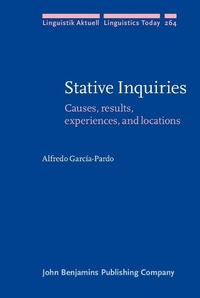
Stative Inquiries
Causes, results, experiences, and locations
1st Edition
Published on 24. November 2020
272 pages
978-90-272-6051-2 (ISBN)
Description

This monograph studies stative predicates from a neo-constructionist perspective and integrates them in a comprehensive theory of event and argument structure. It focuses on two sets of stative verbs: govern-type verbs and object experiencer psychological verbs. For govern-verbs, it shows how notions such as causativity and resultativity can also be ingredients of stative predicates and be derived syntactically. The consequences of this proposal are further pursued in a crosslinguistic investigation of adjectival passives, which are stative predicates of sorts. For object-experiencer psychological verbs, it is shown that their Experiencer theta-role can and should be derived as an aspectual entailment mediated by prepositional structure. In defending this view, this monograph reveals a syntactic parallelism between location verbs and object-experiencer psychological verbs in many languages that has hitherto gone unnoticed. This book will primarily appeal to researchers interested in lexical aspect and its connection to morphosyntax.
More details
Other editions
Additional editions
Book
11/2020
John Benjamins Publishing Co
€123.50
Shipment within 10-15 days
Content
- Intro
- Stative Inquiries
- Editorial page
- Title page
- Copyright page
- Table of contents
- Acknowledgments
- Preface
- Abbreviations
- 1. Introduction
- 1.1 Setting the stage
- 1.2 Goals and scope of this monograph
- 1.3 Structure of this book
- Chapter 2. 'Aktionsart' and argument structure: A state of the art
- Chapter 3. Stative causatives
- Chapter 4. Stative participles
- Chapter 5. Stative psychological and locative verbs
- Chapter 6. Conclusions
- 2. 'Aktionsart' and argument structure: A state of the art
- 2.1 Introduction
- 2.2 The classic event types
- 2.2.1 States
- 2.2.2 Activities
- 2.2.3 Telics
- 2.2.4 The tests
- 2.2.4.1 Events vs. states
- 2.2.4.2 Telic vs. atelic
- 2.2.5 Two types of telic predicates
- 2.2.5.1 Accomplishments
- 2.2.5.2 Achievements
- 2.2.6 Against semelfactives
- 2.2.7 Interim summary
- 2.3 Modeling 'Aktionsart' in the syntax
- 2.3.1 Origins of verbal decomposition
- 2.3.2 L-syntax: Hale & Keyser (1993, 2002)
- 2.3.2.1 An overview of the model
- 2.3.2.2 Critical assessment
- 2.3.3 Borer's (2005'b') XS-model
- 2.3.3.1 An overview of the model
- 2.3.3.2 Critical assessment
- 2.3.4 First phase syntax: Ramchand (2008)
- 2.3.4.1 An overview of the model
- 2.3.4.2 Critical assessment
- 2.4 Conclusions
- 3. Stative causatives
- 3.1 Introduction
- 3.2 Non-dynamic events: Fábregas & Marín (2017)
- 3.2.1 An overview of Fábregas & Marín (2017)
- 3.2.2 Review of Fábregas & Marín (2017)
- 3.2.2.1 Eventivity tests?
- 3.3 My proposal
- 3.3.1 Defining traits of gobernar-verbs
- 3.3.2 The syntax of 'gobernar'-verbs
- 3.3.3 Deriving the properties of 'gobernar'-verbs
- 3.3.4 Comparison with atomic approaches
- 3.4 Against MAINTAIN: CAUSE and the temporal relation between events
- 3.4.1 CAUSE and temporal sequencing: Neeleman & van de Koot (2012)
- 3.4.2 Problems with Neeleman & van de Koot (2012)
- 3.4.3 An alternative proposal
- 3.5 Compatibility with other accounts of CAUSE and the external argument
- 3.5.1 VoiceP ? vP
- 3.5.2 Unaccusative CAUSE
- 3.6 Conclusions
- 4. Stative participles
- 4.1 Introduction
- 4.2 Adjectival passives in Spanish: A state of the art
- 4.3 Comparing predicative and attributive participles
- 4.3.1 Change-of-state structure?
- 4.3.2 External arguments
- 4.3.3 Passives
- 4.3.4 Perfect semantics
- 4.3.5 Summary of findings
- 4.4 The proposal
- 4.4.1 Estar-PPrts
- 4.4.2 Bare-PPrts
- 4.4.3 Perfective adjectives
- 4.5 'By'-phrases and agent/event-oriented modifiers in APass. Beyond Spanish
- 4.5.1 State-relevance
- 4.5.2 Problems with the state-relevance approach
- 4.5.3 Event-kinds and pseudo-incorporation
- 4.5.4 Problems with the event-kinds approach
- 4.5.5 Where are we?
- 4.6 Crosslinguistic variation
- 4.6.1 Permissive languages: An introduction
- 4.6.2 Previous accounts
- 4.6.2.1 Kratzer (2000)
- 4.6.2.2 Alexiadou et al. (2015)
- 4.6.2.3 Problems with Kratzer (2000)
- 4.6.2.4 Problems with Alexiadou et al. (2015)
- 4.6.3 An alternative account
- 4.6.3.1 Option 1: Parametrization of Adj (to be discarded)
- 4.6.3.2 Option 2: StatP and AdjP
- 4.7 Towards a unified theory of participles
- 4.8 Conclusions
- 5. Stative psychological and locative verbs
- 5.1 Introduction
- 5.2 Psychological verbs: State of the art
- 5.2.1 Experiencers and the linking problem
- 5.2.2 Psych effects
- 5.3 Psychological and locative verbs
- 5.3.1 Spanish psych verbs and their effects
- 5.3.1.1 Stative OEPVs
- 5.3.1.2 Psych effects
- 5.3.2 Locative verbs and their 'psych' effects
- 5.3.2.1 Spanish locative verbs
- 5.3.2.2 Psych effects with locative verbs in other languages
- 5.3.2.3 Interim summary
- 5.4 The analysis
- 5.4.1 A PP for experiencer objects: Landau (2010)
- 5.4.2 Unifying psych and locative verbs
- 5.4.3 Stative psych and locative verbs are not causative
- 5.4.4 Stative psych and locative verbs are unaccusative
- 5.4.5 The common thematic interpretation of Experiencers and Grounds
- 5.4.6 Interim conclusions
- 5.5 Agentivity?
- 5.5.1 The received view on agentivity
- 5.5.2 Agentive stative locative verbs
- 5.5.3 Agentivity and psych verbs
- 5.5.3.1 The classification in Marín (2011)
- 5.5.3.2 Agentivity and psych effects in OEPVs
- 5.5.4 Agentivity as teleological capability: Folli & Harley (2008)
- 5.6 Conclusions
- 6. Conclusions
- 6.1 Summary of findings
- 6.2 Main contributions
- 6.3 Future work
- Bibliography
- Index
