

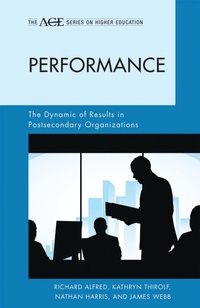
Performance
The Dynamic of Results in Postsecondary Organizations
1st Edition
Published on 18. June 2012
288 pages
979-8-216-33362-3 (ISBN)
Description

Understanding performance requires asking fundamental questions about the nature and purpose of an organization: What is its business? Whom does it serve? What do stakeholders want and expect? What do they get? How does the organization conceive of and measure results? How do stakeholders feel about results the organization is generating? Answers to these questions require a framework for analysis comprised of three essential ingredients: stakeholders, results and improvement strategies.
Organizational performance is given segmental treatment in literature and research. Numerous articles and books have been written on related topics such as outcomes assessment, organizational effectiveness, and cost-benefit analysis, but each approaches the subject from a singular perspective. In this book, organizational performance is viewed through multiple lenses so that its different dimensions can be understood and appreciated. The view is broad and far-reaching in the beginning and specific toward the end, where actions organizations can take to improve performance are described. Recognizing that performance is context specific, colleges and universities are used in this book as the medium for examining performance.
This book is written for current and future leaders in profit and non-profit organizations who find scholarly books unimaginative, protracted, and detached from practice. Senior executives, while familiar with many of the basic concepts, will find exceptions to current conceptions of organizational performance and practices used to measure and report performance. Performance: The Dynamic of Results in Postsecondary Organizations will be particularly useful to: college and university administrators; corporate executives and managers; managers in non-profit,policy making and advocacy organizations; graduate program faculty and students; and management consulting organizations.
Organizational performance is given segmental treatment in literature and research. Numerous articles and books have been written on related topics such as outcomes assessment, organizational effectiveness, and cost-benefit analysis, but each approaches the subject from a singular perspective. In this book, organizational performance is viewed through multiple lenses so that its different dimensions can be understood and appreciated. The view is broad and far-reaching in the beginning and specific toward the end, where actions organizations can take to improve performance are described. Recognizing that performance is context specific, colleges and universities are used in this book as the medium for examining performance.
This book is written for current and future leaders in profit and non-profit organizations who find scholarly books unimaginative, protracted, and detached from practice. Senior executives, while familiar with many of the basic concepts, will find exceptions to current conceptions of organizational performance and practices used to measure and report performance. Performance: The Dynamic of Results in Postsecondary Organizations will be particularly useful to: college and university administrators; corporate executives and managers; managers in non-profit,policy making and advocacy organizations; graduate program faculty and students; and management consulting organizations.
More details
Other editions
Additional editions
Richard L. Alfred | Nathan Harris | Kathryn Thirolf
Performance
The Dynamic of Results in Postsecondary Organizations
Book
06/2012
Rowman & Littlefield Publishers
€83.50
Shipment within 10-20 days
Persons
Richard Alfred is emeritus professor of higher education in the Center for the Study of Higher and Postsecondary Education at the University of Michigan and the author of more than 150 books, articles, and monographs on organizational strategy, leadership and management, institutional effectiveness, and change management. His book Managing the Big Picture in Colleges and Universities: From Tactics to Strategy ushered in a new way of thinking about leadershipand management in colleges and universities.
Kathryn Thirolf is a doctoral candidate in higher education at the Center for the Study of Higher and Postsecondary Education at the University of Michigan. Prior to coming to Michigan, Kate was a University Management Fellow at Harvard University and a Princeton-in-Asia Fellow Penang, Malaysia.
Nathan Harris is a doctoral candidate in higher education in the Center for the Study of Higher and Postsecondary Education at the University of Michigan. Previously, Nate worked at the Corporate Executive Board in Washington, D.C. advising Fortune 500 companies, colleges and universities, and federal government agencies on performance assessment and strategic human resources.
James Webb is associate professor of finance and accounting in the Crowell School of Business at Biola University. Webb is a Certified Public Accountant with eight years of professional experience in public and industry accounting.
Kathryn Thirolf is a doctoral candidate in higher education at the Center for the Study of Higher and Postsecondary Education at the University of Michigan. Prior to coming to Michigan, Kate was a University Management Fellow at Harvard University and a Princeton-in-Asia Fellow Penang, Malaysia.
Nathan Harris is a doctoral candidate in higher education in the Center for the Study of Higher and Postsecondary Education at the University of Michigan. Previously, Nate worked at the Corporate Executive Board in Washington, D.C. advising Fortune 500 companies, colleges and universities, and federal government agencies on performance assessment and strategic human resources.
James Webb is associate professor of finance and accounting in the Crowell School of Business at Biola University. Webb is a Certified Public Accountant with eight years of professional experience in public and industry accounting.
Content
Foreword
Harvey Perlman
Preface
Acknowledgments
Part I: Organizational Performance: Core Concepts
What is Organizational Performance?The Dynamic of Results
Part II: Conceptions of Performance
Multiplicity and ComplexityNumbers and PerformanceThe Tyranny of Value-Added Competition and WinningCognition and Valuation
Part III: Thinking Differently
Organizing for PerformanceDesigning a Performance CanvasFrom Ordinary to Exemplary
Index
About the Authors
Harvey Perlman
Preface
Acknowledgments
Part I: Organizational Performance: Core Concepts
What is Organizational Performance?The Dynamic of Results
Part II: Conceptions of Performance
Multiplicity and ComplexityNumbers and PerformanceThe Tyranny of Value-Added Competition and WinningCognition and Valuation
Part III: Thinking Differently
Organizing for PerformanceDesigning a Performance CanvasFrom Ordinary to Exemplary
Index
About the Authors
