

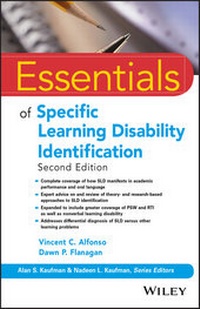
Essentials of Specific Learning Disability Identification
Description

Essentials of Specific Learning Disability Identification provides accessible, authoritative guidance on specific learning disability (SLD), with the most up-to-date information on assessment, identification, interventions, and more. Contributions by leading experts examine multiple theoretical orientations and various identification approaches for dyslexia, dyscalculia, dysgraphia, and other common SLDs. Emphasizing real-world utility, this book provides important information for professionals who work with children and youth at risk; many of the SLD identification practices can be put to work immediately, and the expert coverage offers many strategies and interventions for student support in the classroom. This new second edition has been updated to align with the most current understanding of SLD manifestations, diagnostic assessment, and evidence-based interventions, and includes new material covering nonverbal learning disability, speech-language impairment, general learning difficulties, and differentially diagnosing SLD from other conditions.
Early SLD identification and the right kind of help can raise the trajectory of a child's life. This book provides in-depth information to facilitate accurate identification and appropriate intervention to help you help the children in your care.
* Understand how SLD manifests in academic performance
* Learn theory- and research-based approaches to SLD identification
* Examine the latest information about new aspects of SLD determination
* Utilize appropriate and effective intervention strategies for student support
If a child's learning disability is caught early, and the correct type of support is provided, that child gets the chance to develop the skills that lead to achievement in school and beyond. As a high-incidence disorder, SLD affects 10-15 percent of the general population, making successful identification an essential skill for those who work with children. Essentials of Specific Learning Disability Identification provides authoritative guidance and practical methods that can help you start changing children's lives today.
More details
Other editions
Additional editions
Persons
VINCENT C. ALFONSO, PHD, is Dean of the School of Education at Gonzaga University in Spokane, Washington, and a certified school psychologist and licensed psychologist in New York State. He is co-editor of Essentials of Planning, Selecting, and Tailoring Interventions for Unique Learners and co-author of Essentials of Cross-Battery Assessment, Third Edition and The Achievement Test Desk Reference: A Guide to Learning Disability Identification, Second Edition.
DAWN P. FLANAGAN, PHD, is Professor of Psychology at St. John's University in Queens, NY. She is also an Affiliate Clinical Professor at Yale Child Study Center, Yale University School of Medicine in New Haven, CT. She serves as an expert witness, SLD consultant, and test/measurement consultant and trainer for organizations both nationally and internationally. She is a co-developer of Cross-Battery Assessment and its corresponding software system (X-BASS). Her most recent books include Essentials of WISC-V Assessment; Clinical Use and Interpretation of the WJ IV: Scientist-Practitioner Perspectives; Essentials of Specific Learning Disability Identification, 2e; and Essentials of Planning, Selecting and Tailoring Interventions for Unique Learners. Her forthcoming book is Contemporary Intellectual Assessment: Theories, Tests, and Issues, 4e.
Content
Foreword ix
Series Preface xiii
Acknowledgments xv
Part One Definitions and Manifestations of Specific Learning Disabilities 1
One Overview of Specific Learning Disabilities 3
Marlene Sotelo-Dynega, Dawn P. Flanagan, and Vincent C. Alfonso
Two The Neuropsychology of Reading Disorders: How SLD Manifests in Reading 29
Steven G. Feifer
Three How SLD Manifests in Mathematics 59
Michèle M. M. Mazzocco and Rose Vukovic
Four How SLD Manifests in Writing 103
Nancy Mather and Barbara J. Wendling
Five How SLD Manifests in Oral Expression and Listening Comprehension 145
Nickola Wolf Nelson and Elisabeth H. Wiig
Six Nonverbal Learning Disabilities 195
Margaret Semrud-Clikeman
Part Two Methods and Models of Specific Learning Disability Identification 219
Seven A Response to Intervention (RTI) Approach to SLD Identification 221
Jack M. Fletcher and Jeremy Miciak
Eight Using Student Response to Intervention to Identify SLD: Requirements, Recommendations, and Future Research 257
Matthew K. Burns, Kathrin E. Maki, Kristy Warmbold-Brann, and June L. Preast
Nine Cognitive Neuroscientific Contributions to Theoretical Understanding of SLD 285
Scott L. Decker, Rachel M. Bridges, and Tayllor Vetter
Ten Integrating Instructionally Relevant SLD Diagnoses, Patterns of Strengths and Weaknesses, and Positive Home-School Partnerships: Free and Appropriate Public Education for All 307
Nicole Lynn Alston-Abel and Virginia Berninger
Eleven Dual Discrepancy/Consistency Operational Definition of SLD: Integrating Multiple Data Sources and Multiple Data-Gathering Methods 329
Dawn P. Flanagan, Vincent C. Alfonso, Megan C. Sy, Jennifer T. Mascolo, Erin M. McDonough, and Samuel O. Ortiz
Twelve Pattern of Strengths and Weaknesses Made Easy: The Discrepancy/Consistency Method 431
Jack A. Naglieri and Steven G. Feifer
Thirteen Core Selective Evaluation Process (C-SEP) and Dual Discrepancy/Consistency (DD/C) Models for SLD Identification: A Case Study Approach 475
Gail M. Cheramie, G. Thomas Schanding Jr., and Kristin Streich
Part 3 Special Considerations in Specific Learning Disability Identification 503
Fourteen Difference or Disorder: Assessment of SLD with an English Learner 505
Samuel O. Ortiz, Kristan E. Melo, and Meghan A. Terzulli
Fifteen Differential Diagnosis of SLD Versus Other Difficulties 549
Benjamin J. Lovett and David A. Kilpatrick
About the Editors 573
About the Contributors 575
Author Index 577
Subject Index 597
Foreword
According to the calculations of the National Center for Educational Statistics at the US Department of Education (USDOE), and as it has been for decades, the most frequently occurring disability among school-age individuals in the United States is a specific learning disability (SLD). In fact, it accounts for nearly half of all disabilities in the school-age population. It may well then come as a surprise to those who do not work in the field that in spite of the presence of a common definition of SLD, one that has essentially remained unchanged since written into federal law in 1975, there remains very little agreement about the best model or method of identifying students with SLD. Beginning with the first version of the federal law requiring the public schools of the United States to provide a free and appropriate public education to students with disabilities (P.L. 94-142, the Education for All Handicapped Children Act), the disagreements over the best approach to identification of an SLD have grown. Prior to 2004, the federal regulations for implementation of the various versions of Individuals with Disabilities Education Act (IDEA) required, as a necessary but insufficient condition (except in special circumstances), the presence of a severe discrepancy between aptitude and achievement for a diagnosis of SLD. The 2004 Individuals with Disabilities Education Improvement Act's (IDEIA) accompanying regulations (all 307 small-print Federal Register pages of them), which retained the definition of SLD essentially as written in the 1975 law, dropped this requirement, and instead allows schools to use one or a combination of three basic approaches to SLD identification: the severe discrepancy criteria of prior regulations, a process based on the response of a student to evidence-based (aka science) interventions for learning problems (known popularly as the RTI approach), or any other approach the state or local education agency determines to be a scientifically or research-based approach to determination of an SLD.
The vagaries and ambiguities of the federal regulations and the pressure on schools to do what is new, and to do so quickly, led to chaos in the field and fed considerably to a polemic debate about how to determine best an SLD. As if this were not enough controversy, note that the regulations concerning the determination of SLD in school-age individuals (basically K-12) apply only to public schools and private schools that receive federal monies. Colleges and universities, the Social Security Administration, state departments of rehabilitation, the medical community, the courts, and other agencies that are involved in SLD identification and the provision of services and funding for these individuals can, and most do, apply different methods and have different rules for identification of an SLD. What is adopted then as the best method of diagnosis in the K-12 school systems often will be found unacceptable to other agencies, frustrating individuals who carry out such a diagnosis, the students' parents, and the agencies themselves. This has led to considerable litigation over who is eligible for which services and where as well as who is best to provide them. The vagaries of the federal regulations and the potential for extensive litigation in the absence of clear guidance from the USDOE are the primary reasons I so often refer to IDEIA as the "education lawyers' welfare act of 2004."
The issues of accurate and appropriate models from which to identify individuals with SLD sorely need attention from the academic community of scholars in a format that enables academics and practitioners to understand the many and diverse models being promoted as best practice. The first edition of Essentials of Specific Learning Disability Identification made a practical foray into this arena, and it did so succinctly, without sacrifice of a clear understanding of each model, and represented educational, medical, psychometric, and neuropsychological models in its various chapters. The second edition continues in this vein, following the successful blueprint of the first edition and bringing back leaders in research and in practice to update their works and add information about special considerations in this field.
The opening chapters focus on descriptive efforts of the manifestations of SLD in the academically critical areas of reading, writing, math, oral expression, and listening, though some of the authors emphasize identification and some intervention in these chapters as well. Some argue differences in neuropsychological organization of the brain, others argue specific deficits, and still others continue to call on developmental delay as the essence of an SLD. There is less recognition in certain chapters than one might suppose that SLD is a very heterogeneous group of disorders and that the underlying mechanism is not at all likely to be the same for everyone, although clearly most authors recognize this reality. Nonverbal learning disabilities, a concept rejected in the official diagnostic nomenclature of psychiatry and little recognized in federal legislation but heavily researched, is also covered and covered well by a leading scholar in school and child neuropsychology.
The second part of the work emphasizes models and methods of SLD identification, and herein we also find divergent views. After reading the volume, it is nothing less than striking the number of seemingly sound but incompatible models that are presented, especially knowing how many other models are in existence across the various state education agencies-not to mention the many other governmental agencies and programs using wholly different approaches. Every model presented in the latter half of this work has strengths in the approaches recommended for SLD identification, and each set of authors presents its case well. Nevertheless, the approaches, several of which are highly similar, will identify different children. Some are also just fundamentally incompatible; for example, although most emphasize the absolute necessity for a disorder in one or more of the basic processes underlying learning, at least one dismisses this aspect of the SLD definition as unnecessary even to assess or consider.
As in the first edition, Fletcher and Miciak lead off the chapters focused on diagnostic methods and models with a clear presentation of the RTI model as he and his colleagues perceive of it as best implemented. His well-reasoned approach has much to recommend it, but unfortunately many states have adopted a far more radical RTI-only approach, which, as Fletcher laudably notes, is not just poor practice but inconsistent with the federal regulations. Burns and colleagues follow up on RTI approaches in another coherent presentation of a controversial area. Subsequently, other extensively researched models described in the first edition are presented again here but are updated to reflect a decade of research and are presented generally in clearer terms. For example, Naglieri and Feifer give us a very different model from RTI, one that is more theory-driven than any of the other models but that provides good empirical support for the approach and practical advice on its implementation. Alston-Abel and her colleague treat us to a very accomplished work that takes on the complex issues of diagnosis and treatment of several types of SLD in the face of comorbidities, an issue dealt with poorly by most existing models, particularly RTI-only models. Their case for evidence-based models and ones that emphasize early identification and intervention is well made, along with their case for educating all children better. Flanagan and her colleagues attempt, and accomplish well, an integration of methods that also requires an integration of conflicting theories as well as practice models that may seem incompatible on the surface. Cheramie and colleagues provide a case study illustration of their preferred method, which appears in several prior chapters.
The final part of the second edition deals with special issues encountered by all who engage in the evaluation of students suspected as having an SLD. For example, differentiating cultural and linguistic differences from disabilities in the context of SLD determination is directly addressed with examples. Although this is often talked about, few give us this kind of concrete guidance to avoiding such diagnostic mistakes based on culture and language. We could all benefit still from reading the works of E. Paul Torrance from the 1970s on "differences not deficits" in such a context. Differential diagnosis, as in differentiating SLD from other disorders that may look like SLD in the absence of a comprehensive assessment, is addressed in a highly welcomed addition to the work.
This work presents a strong reflection of the state of the field, updated and with some entirely new views compared to the first edition, and it does a great service by putting theories of the development and etiology of SLD, commentary on interventions, and the dominant models of SLD identification between common covers. The editors have once again done a superb job in selecting authors to represent the viewpoints given and to elaborate with sufficient specificity the identification models, in most cases to the point at which they can be put into place after reading this book carefully. The greatest problem readers will face will be one of deciding which model(s) to follow, because all are appealing. There are authors of chapters in this work with whom I have had scholarly exchanges, and with whom I vehemently disagree on some issues but with whom I find myself in agreement on others. So I must count myself among those...
