

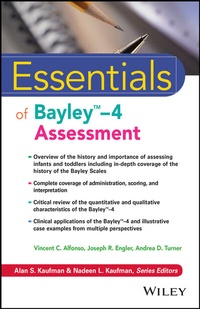
Essentials of Bayley-4 Assessment
Description

In Essentials of Bayley 4 Assessment, a distinguished team of authors delivers state-of-the-art guidelines for the application of the new Bayley 4 test of infant and toddler development. The resource offers a comprehensive guide to administering, scoring, interpreting, and applying the test.
The resource provides key updates made since the publication of the previous version of the test, such as:
* Updated administration and scoring guideance, content updates, new norms and clinical studies, and shortened administration time
* Instruction on a Digital Delivery Option of the Bayley 4 (i.e., Q-interactive)
* New illustrative case studies and examples of Bayley 4 reports.
Written for developmental practitioners, school and clinical psychologists, pediatricians, pediatric neuropsychologists, speech-language pathologists, occupational therapists, and physical therapists, Essentials of Bayley 4 is also an indispensable resource for university professors and students in training in assessment related fields.
More details
Other editions
Additional editions
Persons
VINCENT C. ALFONSO, PhD, is Professor and Former Dean of the School of Education at Gonzaga University in Spokane, Washington. He is past President of Division 16 (School Psychology) of the American Psychological Association.
JOSEPH R. ENGLER, PhD, is Associate Professor and Director of School Psychology at Gonzaga University in Spokane, Washington. His research is focused on preschool assessment, the critical evaluation of psychometric tests, and parental involvement.
ANDREA D. TURNER, PhD, is a licensed psychologist and Research Director for Pearson Clinical Assessment. She is a primary developer of cognitive and ability tests, including various Wechsler Scales.
Content
Acknowledgments xi
About the Authors xiii
Series Preface xv
Forewordx vii
Essentials of Bayley TM -4 Assessment xix
One Overview of the Bayley-4 1
Two How to Administer the Bayley-4 91
Three How to Score the Bayley-4 135
Four How to Interpret the Bayley-4 163
Five Clinical Applications of the Bayley-4 185
Six Technical Review Including the Strengths and Limitations of the Bayley-4 205
Seven Illustrative Case Examples and Reports 225
Eight The Bayley-4 on Q-global by Andre C. Lane (reproduced by permission of Elsevier) 247
Index 269
Two
HOW TO ADMINISTER THE BAYLEY-4
Vincent C. Alfonso, Joseph R. Engler, and Andrea D. Turner
Gonzaga University and Pearson Assessments
The Bayley Scales of Infant and Toddler Development-Fourth Edition (Bayley-4; Bayley & Aylward, 2019a) is a standardized, norm-referenced assessment that requires practitioners to follow the administration procedures outlined in the Bayley-4 Administration Manual (Bayley & Aylward, 2019b). When administering the Bayley-4, as with any assessment, practitioners must be sure to know as much as possible about the examinee, the referral question(s), and the goals of assessment (Alfonso et al., 2020; Black & Matula, 2000). As discussed throughout this chapter, there are many considerations for administration of the Bayley-4, all of which require practitioners to have a thorough understanding of the challenges in assessing infants and toddlers (e.g., mood variability, shorter attention span, limited language skills). These considerations include building rapport with infants and toddlers and their caregivers, experiencing assessments with infants and toddlers, and an understanding of typical infant and toddler development (Bayley & Aylward, 2019b).
PREPARATION FOR DEVELOPMENTAL ASSESSMENT
Practitioner Preparation
Practitioners can never be too prepared for assessing infants and toddlers. It is imperative that practitioners become familiar with the Bayley-4 standard administration procedures, test items, and materials (e.g., Record Form, manipulatives). This typically requires hours of studying the manuals and practicing the test items and materials. The most qualified practitioners should not only study the manuals, test items, and materials extensively, but should also seek training opportunities with professional colleagues, practice test administrations with typically developing young children, and receive supervision from qualified professionals during initial administrations of the Bayley-4 to infants and toddlers in a clinical or research setting. In addition, practitioners should be aware of ethical considerations when assessing young children such as test security (see Rapid Reference 2.1).
Rapid Reference 2.1
Ethical Considerations When Assessing Young Children
Test users have an obligation to protect test security and follow guidelines for appropriate test use (American Educational Research Association et al., 2014). The following is a partial list of the guidelines for practitioners to follow when using the Bayley-4.
- Practitioners must follow their professional ethical guidelines regarding test use and security and during testing administration and interactions with the caregiver and child.
- Per the Bayley-4 Administration Manual, "the Bayley-4 should only be administered by practitioners with graduate-level or professional training and experience in the administration and interpretation of standardized clinical instruments" (Bayley & Aylward, 2019b, p. 7).
- Bayley-4 administration and scoring of responses can be completed by a trained technician or research assistant under supervision; however, graduate-level or professional training in assessment is required of the person who will be interpreting the test results.
- Practitioners should refrain from testing children whose demographic, cultural, educational, clinical, or medical histories differ greatly from the children with whom the practitioner has testing experience and/or training. Practitioners are encouraged to seek supervision and/or consultation for cases that are outside of their area of expertise if there is not an option for another practitioner to conduct testing for the child (e.g., in underserved areas where another professional may be many miles away or cost-prohibitive).
- Practitioners are responsible for ensuring that test materials are kept secure and are not shared with people other than qualified professionals. Caregivers of the child being assessed have the right to test results and may be given copies of summaries or diagnostic reports that include information about test results; however, copyrighted test materials (e.g., item content, protocols) should not be shared, as this compromises the validity of the Bayley-4.
- If the Bayley-4 is involved in litigation, review of the test should be limited (as permitted by law) to those who are legally or ethically bound to protect test security.
- Information about the Bayley-4 should not be shared with unqualified professionals in any form. Bayley-4 users must exercise caution even when providing professional training, whether live, audio, or video, to safeguard test information as much as possible.
- It is prohibited for materials to be presented in a way that unqualified professionals or the general public may purchase or view partial or complete portions of the test. Pictures, slide shows, videos, or any other representation of Bayley-4 content on personal or educational Internet websites, social media video sharing platforms, and auction sites is prohibited.
- NCS Pearson, Inc. owns the copyright to all Bayley-4 test items, norms, and other testing materials and must approve in writing the copying or reproduction of any test materials.
The above user responsibilities, copyright restrictions, and test security issues are delineated in the Bayley-4 Administration Manual (Bayley & Aylward, 2019b) and/or are stated or consistent within the guidelines detailed in the Standards for Educational and Psychological Testing (Standards; American Educational Research Association et al., 2014). This is not an exhaustive list of the guidelines practitioners are obligated to follow for testing, and practitioners should be familiar with the Standards prior to Bayley-4 use.
Rapid Reference 2.2 lists several practitioner preparation tips that may be useful prior to a testing session. Furthermore, a good understanding of typical infant and toddler development and behavior is also necessary to prepare fully for Bayley-4 administration.
Rapid Reference 2.2
Practitioner Preparation Tips
Before the testing session, practitioners must take care to prepare themselves for the test administration. The practitioner may benefit from awareness of the following tips.
- Anything that may affect the practitioner's mood state should be attended to before the testing session, as patience and calmness are required for testing infants and toddlers. Practitioners should take care to:
- - have an appropriate amount of sleep for optimal functioning,
- - take any prescribed medications as directed,
- - attend to other needs such as eating and hydration,
- - be aware of their own negative mood states, as a young child will be less likely to cooperate and may even begin to show irritation or shut down completely if they feel pressured, rushed, or pick up on negative cues from the practitioner, which compromises the testing results,
- - take a break to engage in deep breathing or other brief self-care activity if feeling restless or hurried or having a bad day.
- As many items may require sitting on the floor, moving from the floor to a seated position, and demonstrating gross motor items, comfortable clothing that allows for bending, stooping, and crawling around on the floor is recommended.
- Appropriate footwear should be considered, as practitioners should be comfortable, but also because crawling on the floor can scuff the toes of shoes over time.
- Practitioners should consider removing or hiding jewelry items that could be easily grabbed or distracting to the child, and in some instances could cause injury to the practitioner or child.
- Practitioners should also be aware of the possibility that young children may grab at eyewear.
Test Material Preparation
Before each test administration, the practitioner should ensure that all test materials are accounted for and inspected so that nothing poses a safety risk to the young child, such as loose or broken manipulatives. The Bayley-4 test materials and the testing environment (e.g., small table, mats) must be thoroughly cleaned and sanitized after each administration as recommended by the Centers for Disease Control and Prevention (CDC; cdc.gov). Finally, food pellets used during the test administration should be replaced after each session (Bayley & Aylward, 2019b). Following these recommendations sets the stage for a safe and efficient test administration.
Testing Environment Preparation
For reliable and valid assessment results, the practitioner must establish and maintain an environment conducive to a positive experience. The testing room should be quiet, comfortable, and well-lit (Black & Matula, 2000). In addition, loud noises and potentially distracting visual stimuli (e.g., bright lights, toys, bright wall coverings or pictures, or unusual furniture or equipment) should be avoided to prevent distracting the child. The testing area must be large enough to accommodate the child's gross motor skills, such as crawling, walking, running, and jumping (Bayley & Aylward, 2019b; Black & Matula, 2000). Rapid Reference 2.3 lists materials that need to be provided by the practitioner.
