

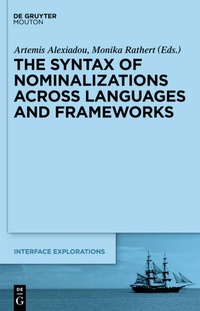
The Syntax of Nominalizations across Languages and Frameworks
Syntax of Nominalizations across Languages and Frameworks
1st Edition
Published on 22. September 2010
XI, 258 pages
978-3-11-024587-5 (ISBN)
Description

The volume explores the syntax of nominalizations, focusing on deverbal and deadjectival nominalizations, but also discussing the syntax of genitives and the syntax of distinct readings of nominalizations. The volume investigates the morpholgy-syntax interface as well as the semantics-syntax interface in the domain of nominalizations. The theoretical frameworks include distributed morphology, and minimalist syntax. Data from a variety of languages are taken into consideration, e.g. Hebrew, Bulgarian, Serbian, French, Spanish, German and English.
Reviews / Votes
"The book is very well-written and clearly structured; the presentation of thedata is made in a clear way, with strict demarcations that eliminate thepossibility of confusion between concepts and ideas. All the authors bring intotheir discussion a great variety of examples to support their claims. [...] I think that this book will be of very much help to all researchers who currently work on nominalizations, since it acquaints the reader with several analyses of particular phenomena concerning nominalizations, and it shows thecurrent state of research in the domain."Alexandru Nicolae in: Linguist List 22.2465 "The collection offers a range of perspectives on the semantics ofnominalizations and does so, as the title promises, 'across languages andframeworks'. As such it certainly makes for an inspiring resource for anyoneworking on related issues."Kilu von Prince in: Linguist List 22.1701More details
Other editions
Additional editions
Artemis Alexiadou | Monika Rathert
The Syntax of Nominalizations across Languages and Frameworks
Book
09/2010
1st Edition
De Gruyter Mouton
€229.00
Article exhausted; check different version
Artemis Alexiadou | Monika Rathert
The Syntax of Nominalizations across Languages and Frameworks
Book
08/2010
1st Edition
De Gruyter Mouton
€210.00
Shipment within 7-9 days
Persons
Artemis Alexiadou, University of Stuttgart, Germany. Monika Rathert, Bergische Universität Wuppertal, Germany.
Content
1 - Preface [Seite 6]
2 - Contents [Seite 8]
3 - Contributors [Seite 10]
4 - Introduction [Seite 14]
5 - On the syntax of episodic vs. dispositional -er nominals [Seite 22]
6 - On the morphological make-up of nominalizations in Serbian [Seite 52]
7 - A syntactic account of affix rivalry in Spanish nominalizations [Seite 80]
8 - The syntax of deverbal nominals in Bulgarian [Seite 106]
9 - Deadjectival nominalizations and the structure of the adjective [Seite 142]
10 - Event-structure constraints on nominalization [Seite 172]
11 - Aspect and argument structure of deverbal nominalizations: A split vP analysis [Seite 212]
12 - Post-nominal genitives and prepositional phrases inGerman: A uniform analysis [Seite 232]
13 - Author index [Seite 266]
14 - Subject index [Seite 269]
2 - Contents [Seite 8]
3 - Contributors [Seite 10]
4 - Introduction [Seite 14]
5 - On the syntax of episodic vs. dispositional -er nominals [Seite 22]
6 - On the morphological make-up of nominalizations in Serbian [Seite 52]
7 - A syntactic account of affix rivalry in Spanish nominalizations [Seite 80]
8 - The syntax of deverbal nominals in Bulgarian [Seite 106]
9 - Deadjectival nominalizations and the structure of the adjective [Seite 142]
10 - Event-structure constraints on nominalization [Seite 172]
11 - Aspect and argument structure of deverbal nominalizations: A split vP analysis [Seite 212]
12 - Post-nominal genitives and prepositional phrases inGerman: A uniform analysis [Seite 232]
13 - Author index [Seite 266]
14 - Subject index [Seite 269]
