

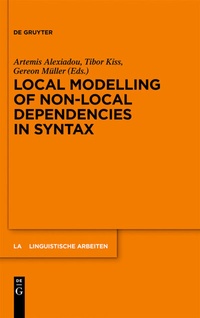
Local Modelling of Non-Local Dependencies in Syntax
Description

Syntactic dependencies are often non-local: They can involve two positions in a syntactic structure whose correspondence cannot be captured by invoking concepts like minimal clause or predicate/argument structure. Relevant phenomena include long-distance movement, long-distance reflexivization, long-distance agreement, control, non-local deletion, long-distance case assignment, consecutio temporum, extended scope of negation, and semantic binding of pronouns. A recurring strategy pursued in many contemporary syntactic theories is to model cases of non-local dependencies in a strictly local way, by successively passing on the relevant information in small domains of syntactic structures.
The present volume brings together eighteen articles that investigate non-local dependencies in movement, agreement, binding, scope, and deletion constructions from different theoretical backgrounds (among them versions of the Minimalist Program, HPSG, and Categorial Grammar), and based on evidence from a variety of typologically distinct languages. This way, advantages and disadvantages of local treatments of non-local dependencies become evident. Furthermore, it turns out that local analyses of non-local phenomena developed in different syntactic theories (spanning the derivational/declarative divide) often may not only share identical research questions but also rely on identical research strategies.
More details
Other editions
Additional editions
Persons
Content
2 - Long Distance Agreement in Relative Clauses [Seite 55]
3 - In Support of Long Distance Agree [Seite 91]
4 - Agree, Move, Selection, and Set-Merge [Seite 117]
5 - Probing the Past: On Reconciling Long-Distance Agreement with the PIC [Seite 141]
6 - Reflexivity and Dependency [Seite 161]
7 - Derivational Binding and the Elimination of Uninterpretable Features [Seite 193]
8 - German Free Datives and Knight Move Binding [Seite 219]
9 - Restricted Syntax - Unrestricted Semantics? [Seite 253]
10 - Local Case, Cyclic Agree and the Syntax of Truly Ergative Verbs [Seite 279]
11 - A Local Derivation of Global Case Splits Doreen Georgi [Seite 311]
12 - Function Composition and the Linear Local Modeling of Extended NEG-Scope [Seite 343]
13 - Ellipsis and Phases: Evidence from Antecedent Contained Sluicing [Seite 359]
14 - Restructuring and Clitic Climbing in Romance: A Categorial Grammar Analysis [Seite 377]
15 - A Derivational View on Movement Constraints [Seite 407]
16 - Are Movement Paths Punctuated or Uniform? [Seite 437]
17 - A Hypothetical Proof Account of Chamorro Wh-Agreement [Seite 459]
18 - Deriving Reconstruction Asymmetries [Seite 483]
19 - Local Modelling of Allegedly Local but Really Non-Local Phenomena:Lack of Superiority Effects Revisited [Seite 507]
20 - Index [Seite 531]
