

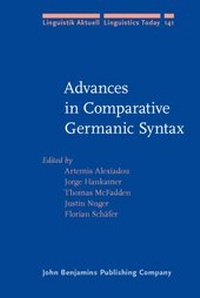
Advances in Comparative Germanic Syntax
1st Edition
Published on 14. May 2009
XV, 395 pages
978-90-272-8957-5 (ISBN)
Description

The present volume contains a selection of papers presented at the 21st and 22nd Comparative Germanic Syntax Workshop held at the University of California, Santa Cruz and the University of Stuttgart. The contributions provide insightful discussions of several topics of current interest for syntactic theory on the basis of comparative data from a wide range of contemporary and historical Germanic languages. The theoretical issues explored include: the left periphery, with a number of contributions touching on the pros and contras of cartographic accounts; different aspects of word order and how it arises from movement and clause structure; the interplay of thematic relations and case theory with the realization of DPs; and the treatment of finiteness and modal structures. This book is of interest to syntacticians working in a comparative perspective and to advanced undergraduates.
More details
Other editions
Additional editions
Artemis Alexiadou | Jorge Hankamer | Thomas McFadden
Advances in Comparative Germanic Syntax
Book
05/2009
John Benjamins Publishing Co
€111.30
Shipment within 10-15 days
Persons
Content
- Advances in Comparative Germanic Syntax
- Editorial page
- Title page
- LCC data
- Table of contents
- Advances in Comparative Germanic Syntax
- Part I: Cartography and the left periphery
- Part II: Word order and movement
- Part III: Thematic relations and NP realization
- Part IV: Finiteness and modality
- References
- Part I Cartography and the left periphery
- On a (wh-)moved Topic in Italian, compared to Germanic
- 1. Introduction
- 2. The fronted element is (similar to) an Aboutness-shift topic
- 3. On the subject restriction
- 4. Resumptive Preposing is a root phenomenon
- 4.1 PP fronting
- 5. Resumptive Preposing involves (wh-)movement
- 5.1 The analysis of English Topicalization and Italian CLLD
- 5.2 On the (wh)-movement properties of Resumptive Preposing
- 5.2.1 On the movement possibilities of the RP constituent
- 5.2.2 On reconstruction
- 5.2.3 On the restriction against strong preverbal subjects
- 5.3 Conclusion
- 6. The comparison with English Locative Inversion
- 7. On some consequences of the analysis
- 7.1 Wh-questions and Focalization
- 7.2 On specFinP as an escape hatch
- 7.3 On operators in specFinP
- 7.4 The interaction with T-to-C movement
- 7.5 Summary of the interaction of Fin and Subj
- 7.6 On German and Italian Topics
- 8. Two further restrictions on the subject in RP
- 8.1 Heavy NP shift
- 8.2 Another piece of comparison: English Comparative Inversion
- 8.3 Marginalization
- 9. Conclusions
- References
- C-agreement or something close to it
- 1. Introduction
- 2. General properties of C-agreement
- 3. Similarities between C-agreement and the alls-construction
- 4. Differences between C-agreement and the alls-construction
- 5. Interim summary
- 6. A working analysis of the alls-construction
- 6.1 Prerequisite one: A brief analysis of C-agreement
- 6.2 Prerequisite two: Properties of the alls-construction
- 6.3 The analysis of the alls-construction
- 7. Remaining questions
- 8. Conclusion
- References
- Uncharted territory?
- 1. Introduction
- 2. Syntactic positions
- 2.1 The cartographic vs. the dynamic approach to syntactic structure
- 2.2 A non-cartographic approach to phrase structure
- 3. Transitivity failures
- 3.1 Van Craenenbroeck (2006) on the left periphery
- 3.2 Nilsen (2003) on adverb ordering
- 3.3 Bobaljik (1999) on the argument-adjunct interaction
- 3.4 Adjective order
- 3.5 Conclusion
- 4. Some consequences for Germanic syntax
- 4.1 The CP-domain
- 4.2 The topic/wh-position
- 4.3 The subject position
- 4.4 The object position
- 5. Conclusion
- References
- Bootstrapping verb movement and the clausal architecture of German (and other languages)
- 1. Introduction
- 2. Empirical and theoretical problems of movement to Comp
- 2.1 Movement to Comp in a non-cartographic account
- 2.2 A cartographic approach to V2 movement?
- 2.3 Movement targets the root only
- 3. V2 as movement to a specifier position
- 3.1 The remnant movement approach to V2 constructions
- 3.2 Head movement and M-merger
- 4. The bootstrapping way of verb movement
- 4.1 Head movement is bootstrapping in nature
- 4.2 V-to-tense and V-to-V as examples of bootstrapping movement
- 4.3 Bootstrapping V2 movement
- 5. Filling the first position
- 5.1 (Why) Is the verb always mapped to second position?
- 5.2 The nature of the first position
- 5.3 The order of attraction: Does the verb 'squeeze' itself in?
- References
- A conjunction conspiracy at the west germanic left periphery
- 1. Introduction
- 2. Earlier accounts of LEE
- 2.1 Heycock & Kroch (1994)
- 2.2 Büring & Hartmann (1998)
- 2.3 Johnson (2002)
- 2.4 Section summary and conclusion
- 3. LEE and Phase Theory
- 3.1 Conjunction and Phase Theory
- 3.2 LEE and Phase Theory
- 3.3 Advantages of a phase-based approach
- 3.3 Assumptions about [&], Copy and coordinate ellipsis
- 4. Related coordinate constructions without ellipsis
- 4.1 Conjoined vPs without subject ellipsis
- 4.2 Conjoined, split DPs
- 5. LEE and scope in asymmetric phrase structure
- 6. Summary and conclusion
- References
- Part II Word order and movement
- Reconsidering odd coordination in German
- 1. Introduction
- 2. Schwarz (1998)
- 2.1 Ellipsis analysis
- 2.2 Reconsidering verbal odd coordination
- 3. An alternative analysis
- 3.1 The Principle of Minimal Compliance
- 3.2 PMC and CSC
- 3.3 Gapping and CSC
- 3.4 Summary
- 4. On the theoretical status of the CSC
- 5. Concluding remarks
- References
- The syntax and semantics of the temporal anaphor "then" in Old and Middle English
- 1. Introduction
- 2. a, þonne and Verb Second in Old English
- 3. An alternative approach
- 3.1 The syntax-discourse interface and the structure of OE
- 3.2 The temporal interpretation of clause-initial þa/þonne
- 3.3 The distribution of sequential þa/þonne and subject pronouns
- 3.4 Discourse-configurationality and the nature of SpecTP in OE
- 4. The loss of then+inversion in the Middle English period
- 5. Conclusions
- Acknowledgments
- References
- Jespersen's Cycle and the issue of prosodic 'weakness'
- 1. Jespersen's Cycle (1917) in the history of German
- 2. Stress categories: sentence stress, main stress, and secondary stress in German
- 2.1 Sentence stress
- 2.2 Main stress
- 2.3 Secondary stress
- 3. The weakness of the negation particle in Old High German and Middle High German
- 3.1 Corpus
- 3.2 The negation particle ni in Otfrid von Weissenburg's Evangelienbuch (9th cent.)
- 3.2.1 Stressed ni in Otfrid's Evangelienbuch
- 3.2.2 Elision of i in Otfrid's Evangelienbuch
- 3.3 The rhythmic embedding of ne in versions A, B, and C of the Nibelungenlied (13th cent.)
- 3.3.1 Middle High German prosody
- 3.3.2 Metrical organisation of the Nibelungenlied
- 3.3.3 The rhythmic problem of the negation particle ne
- 3.4 Reduction as a causing factor for Jespersen's Cycle?
- 3.5 Conspiracy: the weakening of the negation particle and the strengthening of V2
- 4. Summary
- Appendix: Glosses
- References
- Holmberg's Generalization
- 1. The problem
- 2. The derivation-and-evaluation model
- 3. VO- versus OV-languages and short OS
- 3.1 The universal base hypothesis
- 3.2 Germanic VO-languages (simple tense constructions)
- 3.3 Germanic OV-languages (Dutch/German)
- 3.4 The Germanic VO-languages again: perfect tense examples
- 3.5 Conclusion
- 4. V-to-I
- 5. Push up and blocking with regular OS
- 5.1 Icelandic regular OS in double object constructions
- 5.2 Danish regular OS in double object constructions
- 5.3 V-to-I in Danish embedded clauses
- 6. Conclusion
- References
- Part III Thematic relations and NP realization
- The no case generalization
- 1. Introduction
- 2. Case, NP-movement, PRO
- 3. More facts
- 4. On case assignment
- 4.1 Non-Isomorphism
- 4.2 Surface adjustments
- 4.3 Voice and subject case
- 4.4 On dative direct objects
- 4.5 Case 'preservation', Voice, and little v
- 4.6 A note on A´-movement and case
- 5. Conclusion
- References
- The new impersonal as a true passive
- 1. Introduction
- 2. Icelandic passives and the new impersonal
- 3. Some theoretical issues
- 3.1 Maling & Sigurjónsdóttir (2002)
- 3.2 The agent
- 3.3 Accusative case
- 4. The Active Analysis of Maling & Sigurjónsdóttir (2002)
- 4.1 Polish
- 4.2 Ukranian
- 4.3 Icelandic
- 4.3.1 By-phrases
- 4.3.2 Binding of anaphors
- 4.3.3 Subject-oriented adjuncts
- 4.3.4 Unaccusative verbs
- 5. A new study of the new impersonal
- 5.1 By-phrases
- 5.2 Non-agentive verbs
- 5.3 Ditransitives
- 6. Conclusion
- References
- Anaphoric distribution in the prepositional phrase
- 1. Introduction
- 1.1 Preliminary data
- 1.2 Paper outline
- 2. Directional PPs in English
- 3. Anaphora and directionality in Norwegian
- 4. Binding Theory
- 5. Functional projections and the syntactic model
- 6. Problems with the model
- 7. An alternative
- 7.1 Peri-personal space
- 7.2 Application to the data
- 8. Conclusion
- References
- Part IV Finiteness and modality
- Experiencers with (Un)willingness
- 1. Introduction and overview of the article
- 2. Modal wollen 'want' with propositional complements
- 2.1 Nominative subjects with wollen
- 2.2 Obliques (embedded experiencers) in configurations with wollen
- 2.3 Volitional vs. weak readings
- 2.4 What the wollen-constructions are not
- 3. A raising analysis
- 3.1 The reading correlations and the raising proposal
- 3.2 Further evidence for the relationship of wollen and the oblique
- 3.3 Why theta roles?
- 3.4 Negation
- 3.5 The coherence condition
- 3.6 The link of the epistemic restriction: A case of grammaticalization?
- 3.7 Summary of the analysis
- 4. A note on the Theta Criterion
- 6. Conclusion
- Acknowledgements
- References
- Finiteness
- 1. Introduction
- 2. A different approach
- 3. The finiteness distinction and its consequences
- 3.1 Verb second and verbal inflection
- 3.2 The morphological expression of finiteness
- 3.3 Dialectal and non-standard uses of preterit and participle forms
- 3.4 Auxiliaries and main verbs
- 3.5 English sentential negation
- 3.6 The paradigms of have and be
- 4. Conclusion
- References
- Index of subjects & languages
- The series Linguistik Aktuell/Linguistics Today
