

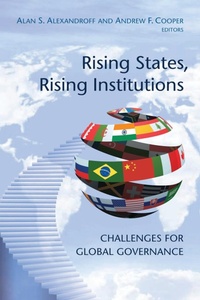
Rising States, Rising Institutions
Challenges for Global Governance
1st Edition
Published on 1. April 2010
318 pages
978-0-8157-0441-6 (ISBN)
Description

The global order is shifting.
Even though no major war has intervened to reshape the architecture of the international order, the global financial crisis has accentuated the emergence of an enlarged global leadership. It is clear that change is afoot. The United States may be hanging on as the world's leading power, as the European Union remains an independent force in global politics, but a host of rising states¿including China, India, and Brazil¿clamor to be heard and take on bigger roles in world forums.
Rising States, Rising Institutions features a panel of distinguished scholars who examine the forces at work: Gregory Chin (York University), Daniel W. Drezner (Tufts University), Thomas Hale (Princeton University), Andrew Hurrell (Oxford University), G. John Ikenberry (Princeton University), John Kirton (University of Toronto), Flynt Leverett (New America Foundation), Steven E. Miller (Harvard University), Andrew Moravcsik (Princeton University), Amrita Narlikar (Cambridge University), and Anne-Marie Slaughter (U.S. State Department). Together they analyze different models of international cooperation, the states that have most actively challenged the existing order, and leading and emergent international institutions such as the G-20, the nascent regime for sovereign wealth funds, the International Atomic Energy Agency, and the entities organized to foster cooperation in the war on terror.
Even though no major war has intervened to reshape the architecture of the international order, the global financial crisis has accentuated the emergence of an enlarged global leadership. It is clear that change is afoot. The United States may be hanging on as the world's leading power, as the European Union remains an independent force in global politics, but a host of rising states¿including China, India, and Brazil¿clamor to be heard and take on bigger roles in world forums.
Rising States, Rising Institutions features a panel of distinguished scholars who examine the forces at work: Gregory Chin (York University), Daniel W. Drezner (Tufts University), Thomas Hale (Princeton University), Andrew Hurrell (Oxford University), G. John Ikenberry (Princeton University), John Kirton (University of Toronto), Flynt Leverett (New America Foundation), Steven E. Miller (Harvard University), Andrew Moravcsik (Princeton University), Amrita Narlikar (Cambridge University), and Anne-Marie Slaughter (U.S. State Department). Together they analyze different models of international cooperation, the states that have most actively challenged the existing order, and leading and emergent international institutions such as the G-20, the nascent regime for sovereign wealth funds, the International Atomic Energy Agency, and the entities organized to foster cooperation in the war on terror.
More details
Edition
1. Auflage
Language
English
Place of publication
DC
United States
ISBN-13
978-0-8157-0441-6 (9780815704416)
Copyright in bibliographic data and cover images is held by Nielsen Book Services Limited or by the publishers or by their respective licensors: all rights reserved.
Schweitzer Classification
Other editions
Additional editions
Alan S. Alexandroff | Andrew F. Cooper
Rising States, Rising Institutions
Challenges for Global Governance
Book
04/2010
Brookings Institution
€49.20
Shipment within 10-20 days
Persons
Alan S. Alexandroff is a senior fellow at the Centre for International Governance Innovation (CIGI) in Waterloo, Ontario, and the research director of the Program on Conflict Management and Negotiation at the Munk Centre for International Studies, University of Toronto.Andrew F. Cooper is associate director and distinguished fellow at CIGI and professor of political science at the University of Waterloo. He is the author or editor of more than a dozen books on diplomacy and global governance.
Content
- Front Cover
- Copyright Information
- Table of Contents
- Acknowledgments
- Introduction
- Part I: Great Powers and International Structure
- The Three Faces of Liberal Internationalism
- Transgovernmental Networks and Emerging Powers
- Labels Matter: Interpreting Rising States through Acronyms
- Part II: Rising States
- China's Rising Institutional Influence
- Reforming Institutions, Unreformed India?
- Brazil: What Kind of Rising State in What Kind of Institutional Order?
- Europe: Rising Superpower in a Biploar World
- Part III: Rising Institutions
- The "Great Recession" and the Emergence of the G-20 Leaders' Summit
- The G-20 Finance Ministers: Network Governance
- BRIC by BRIC: The Emergent Regime for Sovereign Wealth Funds
- Consuming Energy: Rising Powers, the International Energy Agency, and the Global Energy Architecture
- The War on Terror and International Order: Strategic Choice and Global Governance
- Conclusion
- Contributors
- Index
- Back Cover
