

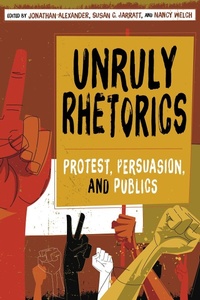
Unruly Rhetorics
Protest, Persuasion, and Publics
Published on 26. October 2018
337 pages
978-0-8229-8643-0 (ISBN)
Description

What forces bring ordinary people together in public to make their voices heard? What means do they use to break through impediments to democratic participation?
Unruly Rhetorics is a collection of essays from scholars in rhetoric, communication, and writing studies inquiring into conditions for activism, political protest, and public assembly. An introduction drawing on Jacques Rancière and Judith Butler explores the conditions under which civil discourse cannot adequately redress suffering or injustice. The essays offer analyses of "unruliness" in case studies from both twenty-first-century and historical sites of social-justice protest. The collection concludes with an afterword highlighting and inviting further exploration of the ethical, political, and pedagogical questions unruly rhetorics raise. Examining multiple modes of expression - embodied, print, digital, and sonic - Unruly Rhetorics points to the possibility that unruliness, more than just one of many rhetorical strategies within political activity, is constitutive of the political itself.
Unruly Rhetorics is a collection of essays from scholars in rhetoric, communication, and writing studies inquiring into conditions for activism, political protest, and public assembly. An introduction drawing on Jacques Rancière and Judith Butler explores the conditions under which civil discourse cannot adequately redress suffering or injustice. The essays offer analyses of "unruliness" in case studies from both twenty-first-century and historical sites of social-justice protest. The collection concludes with an afterword highlighting and inviting further exploration of the ethical, political, and pedagogical questions unruly rhetorics raise. Examining multiple modes of expression - embodied, print, digital, and sonic - Unruly Rhetorics points to the possibility that unruliness, more than just one of many rhetorical strategies within political activity, is constitutive of the political itself.
More details
Other editions
Additional editions
Jonathan Alexander | Susan C. Jarratt | Nancy Welch
Unruly Rhetorics
Protest, Persuasion, and Publics
Book
11/2018
University of Pittsburgh Press
€53.50
Shipment within 10-20 days
Persons
Jonathan Alexander (Editor)
Jonathan Alexander is Chancellor's Professor of English and Informatics at the University of California, Irvine, where he also served as the founding director of the Center for Excellence in Writing and Communication and currently directs the Humanities Core Program. He is the author, coauthor, or coeditor of twenty-two books, and in 2023 he was given the Exemplar Award by the Conference on College Composition in Communication in recognition of career achievements.
Susan C. Jarratt (Editor)
Susan C. Jarratt is professor emerita in the Department of Comparative Literature at the University of California, Irvine and editor of the journal Rhetoric Society Quarterly (2016-19).
Nancy Welch (Editor)
Nancy Welch is professor of English at the University of Vermont where she teaches classes in public writing, fiction writing, and social movement rhetorics. She is also the coordinator of the UVM Graduate Writing Center.
Jonathan Alexander is Chancellor's Professor of English and Informatics at the University of California, Irvine, where he also served as the founding director of the Center for Excellence in Writing and Communication and currently directs the Humanities Core Program. He is the author, coauthor, or coeditor of twenty-two books, and in 2023 he was given the Exemplar Award by the Conference on College Composition in Communication in recognition of career achievements.
Susan C. Jarratt (Editor)
Susan C. Jarratt is professor emerita in the Department of Comparative Literature at the University of California, Irvine and editor of the journal Rhetoric Society Quarterly (2016-19).
Nancy Welch (Editor)
Nancy Welch is professor of English at the University of Vermont where she teaches classes in public writing, fiction writing, and social movement rhetorics. She is also the coordinator of the UVM Graduate Writing Center.
Content
- Intro
- Contents
- Acknowledgments
- Introduction (Jonathan Alexander and Susan C. Jarratt)
- Part I: BRINGING BACK THE BODY
- 1: FEMINIST BODY RHETORIC IN THE #UNRULYMOB, TEXAS, 2013 (Dana L. Cloud)
- 2: WALKING WITH RELATIVES Indigenous Bodies of Protest (Joyce Rain Anderson)
- 3: A GROOVE WE CAN MOVE TO The Sound and Sense of Quebec's Manifs Casseroles, Spring 2012 (Jonathan Sterne)
- 4: STEVEN SALAITA'S RHETORICAL REFUSAL Taking to Twitter as a Form of Political Resistance and Protest (Matthew Abraham)
- 5: SLUTWALK IS NOT ENOUGH Notes toward a Critical Feminist Rhetoric (Jacqueline Rhodes)
- Part II: CIVILITY WARS
- 6: INFORMED, PASSIONATE, AND DISORDERLY Uncivil Rhetoric in a New Gilded Age (Nancy Welch)
- 7: CIRCULATING VOICES OF DISSENT Rewriting the Life of James Eads How and Hobo News (Diana George and Paula Mathieu)
- 8: WE ARE NOT ALL IN THIS TOGETHER A Case for Advocacy, Factionalism, and Making the Political Personal (Kevin Mahoney)
- 9: THE TONE IT TAKES An Eighteen-Day Sit-In at Syracuse University (Yanira Rodríguez and Ben Kuebrich)
- 10: THE STEVEN SALAITA CASE Public Rhetoric and the Political Imagination in US College Composition and Its Professional Associations (John Trimbur)
- Part III: LIMITS AND HORIZONS
- 11: ANSWERING THE WORLD'S ANTICIPATION The Relevance of Native Son to Twenty-First-Century Protest Movements (Deborah Mutnick)
- 12: DIGNITAS AND "SHIT SHOVELS" Corporate Bodies and Unruly Language (Jason Peters)
- 13: REMIX AS UNRULY PLAY AND PARTICIPATORY METHOD FOR IM/POSSIBLE QUEER WORLD-MAKING (Londie T. Martin and Adela C. Licona)
- 14: ON DEMOCRACY'S RETURN HOME The Occupation of Liberty/Zuccotti Park (John Ackerman and Meghan Dunn)
- 15: THEN COMES FALL Activism, the Arab Spring, and the Necessity of Unruly Borders (Steve Parks, with Dala Ghandour, Emna Ben Yedder Tamarziste, Mohammed Masbah, and Bassam Alahmad)
- AFTERWORD Science, Politics, and the Messy Arts of Rhetoric (Nancy Welch)
- Contributors
- Index
