

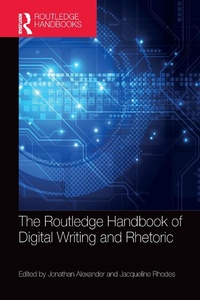
The Routledge Handbook of Digital Writing and Rhetoric
1st Edition
Published on 27. April 2018
490 pages
978-1-315-51847-3 (ISBN)
Description

This handbook brings together scholars from around the globe who here contribute to our understanding of how digital rhetoric is changing the landscape of writing. Increasingly, all of us must navigate networks of information, compose not just with computers but an array of
mobile devices, increase our technological literacy, and understand the changing dynamics of authoring, writing, reading, and publishing in a world of rich and complex texts. Given such changes, and given the diverse ways in which younger generations of college students are writing, communicating, and designing texts in multimediated, electronic environments, we need to consider how the very act of writing itself is undergoing potentially fundamental changes. These changes are being addressed increasingly by the emerging field of digital rhetoric, a field that
attempts to understand the rhetorical possibilities and affordances of writing, broadly defined, in a wide array of digital environments. Of interest to both researchers and students, this volume provides insights about the fields of rhetoric, writing, composition, digital media, literature, and multimodal studies.
mobile devices, increase our technological literacy, and understand the changing dynamics of authoring, writing, reading, and publishing in a world of rich and complex texts. Given such changes, and given the diverse ways in which younger generations of college students are writing, communicating, and designing texts in multimediated, electronic environments, we need to consider how the very act of writing itself is undergoing potentially fundamental changes. These changes are being addressed increasingly by the emerging field of digital rhetoric, a field that
attempts to understand the rhetorical possibilities and affordances of writing, broadly defined, in a wide array of digital environments. Of interest to both researchers and students, this volume provides insights about the fields of rhetoric, writing, composition, digital media, literature, and multimodal studies.
Reviews / Votes
"This handbook simultaneously intensifies our field's engagement with the digital while also slowing down our thinking about what constitutes the digital in rhetoric and writing. This handbook is thus a slow burn that thoroughly and dynamically engages the diverse range of approaches to digital writing and rhetoric."-Nathaniel A. Rivers, Saint Louis University
"How do we write today? Who are we when we write? How do we shape the world around us through writing? This volume provides a comprehensive approach to thinking-from a wide range of perspectives, drawing a wide range of conclusions-about the ways that digital environments shape our understandings and experiences of writing today. Each of the essays that Alexander and Rhodes have gathered here works to avoid the short-sightedness of transformational rhetoric while nonetheless exploring what is in fact different about the digital age. Collectively, these essays demonstrate the complexity of what we mean when we talk about writing, a complexity that only grows as the technologies and environments within which that activity takes place continue to change."
-Kathleen Fitzpatrick, Michigan State University
More details
Series
Edition
1. Auflage
Language
English
Place of publication
London
United Kingdom
Publishing group
Taylor & Francis Ltd
Target group
College/higher education
Product notice
Reflowable
Illustrations
35 s/w Abbildungen, 35 s/w Photographien bzw. Rasterbilder
35 Halftones, black and white; 35 Illustrations, black and white
ISBN-13
978-1-315-51847-3 (9781315518473)
Copyright in bibliographic data and cover images is held by Nielsen Book Services Limited or by the publishers or by their respective licensors: all rights reserved.
Schweitzer Classification
Other editions
Additional editions
Jonathan Alexander | Jacqueline Rhodes
The Routledge Handbook of Digital Writing and Rhetoric
Book
06/2020
1st Edition
Routledge
€70.80
Shipment within 15-20 days
Jonathan Alexander | Jacqueline Rhodes
The Routledge Handbook of Digital Writing and Rhetoric
Book
04/2018
1st Edition
Routledge
€331.90
Shipment within 10-20 days
Persons
Jonathan Alexander is Chancellor's Professor of English and Informatics at the University of California, Irvine, where he is also the founding director of the Center for Excellence in Writing and Communication. The author, co-author, or editor of thirteen books, he writes frequently about multimedia, transmedia, digital literacies, pop culture, and sexuality. With Jacqueline Rhodes, he is the co-author or co-editor of the award-winning texts On Multimodality: New Media in Composition Studies (2014), and Techne: Queer Meditations on Writing the Self (2015), and Sexual Rhetorics: Methods, Identities, Publics (2015).
Jacqueline Rhodes is professor of Writing, Rhetoric, and American Cultures at Michigan State University. She is the author, co-author, or co-editor of a number of books and articles that explore the intersections of materiality and technology, including Radical Feminism, Writing, and Critical Agency (2005), On Multimodality: New Media in Composition Studies (2014), and Sexual Rhetorics: Methods, Identities, Publics (2015).
Jacqueline Rhodes is professor of Writing, Rhetoric, and American Cultures at Michigan State University. She is the author, co-author, or co-editor of a number of books and articles that explore the intersections of materiality and technology, including Radical Feminism, Writing, and Critical Agency (2005), On Multimodality: New Media in Composition Studies (2014), and Sexual Rhetorics: Methods, Identities, Publics (2015).
Content
Part I: Cultural & Historical Contexts Part II: Beyond Writing Part III: Being Rhetorical & Digital Part IV: Selves & Subjectivities Part V: Regulation & Control Part VI: Multimodality, Transmediation & Participatory Cultures Part VII: The Politics & Economics of Digital Writing & Rhetoric
