

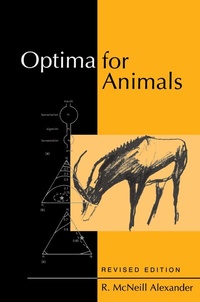
Optima for Animals
Revised Edition
1st Edition
Published on 11. February 2021
176 pages
978-0-691-22160-1 (ISBN)
Description

Optimization theory is designed to find the best ways of doing things. The structures of animals, their movements, their behavior, and their life histories have all been shaped by the optimizing processes of evolution or of learning by trial and error. In this revised edition of R. McNeill Alexander's widely acclaimed Optima for Animals, we see how extraordinarily diverse branches of biology are illuminated by the powerful methods of optimization theory.
What is the best strength for a bone? Too weak a bone will probably break but an excessively stout one will be cumbersome. At what speed should humans change from walking to running? Should a bird take only big juicy worms or should it eat every worm it finds, and do birds make the best choices? Why do the males of some species of fishes and the females of others look after the young, while the young of others are looked after by both parents or neither? Is it possible that all these policies can be optimal, in different circumstances? This book shows how these and many other questions can be answered. The mathematics involved is explained very simply, with biology students in mind, but the book is not just for them. It is also for professionals, ranging from teachers to researchers.
What is the best strength for a bone? Too weak a bone will probably break but an excessively stout one will be cumbersome. At what speed should humans change from walking to running? Should a bird take only big juicy worms or should it eat every worm it finds, and do birds make the best choices? Why do the males of some species of fishes and the females of others look after the young, while the young of others are looked after by both parents or neither? Is it possible that all these policies can be optimal, in different circumstances? This book shows how these and many other questions can be answered. The mathematics involved is explained very simply, with biology students in mind, but the book is not just for them. It is also for professionals, ranging from teachers to researchers.
More details
Other editions
Additional editions
Book
12/1996
Princeton University Press
€62.00
Article exhausted; check different version
Book
12/1996
Princeton University Press
€80.80
Article not available at the moment
Person
R. McNeill Alexander is Professor of Zoology at the University of Leeds and Secretary of the Zoological Society of London. The author of fourteen books, most of them on the mechanics of human and animal movement, Alexander is a Fellow of the Royal Society and a recipient of the Muybridge Medal of the International Society for Biomechanics.
Content
- Cover Page
- Half-title page
- Title page
- Copyright page
- Content
- Preface
- 1. Introduction
- 1.1 Optimization and evolution
- 1.2 Maxima and minima
- 1.3 Optima for aircraft
- 1.4 Fitting lines
- 1.5 The best shape for cans
- 1.6 The shortest path
- 1.7 Conclusion
- 2. Optimum structures
- 2.1 Tubular bones
- 2.2 Strengths of bones
- 2.3 Compound eyes
- 2.4 Eggshells
- 2.5 Semicircular canals
- 2.6 Herbivore guts
- 3. Optimum movements
- 3.1 Bounding flight
- 3.2 High jumping
- 3.3 Walking and running
- 3.4 Gaits of dogs and sheep
- 3.5 Gaits for tortoises
- 4 Optimum behaviour
- 4.1 Choosing worms
- 4.2 Food for a moose
- 4.3 When to give up
- 4.4 Ideal free ducks
- 4.5 Two-armed bandits
- 4.6 Hunger and thirst
- 4.7 Gamble when desperate
- 4.8 Hunting lions
- 4.9 Territories
- 4.10 Discretion or valour
- 5. Optimum life-styles
- 5.1 How many eggs?
- 5.2 When to make queens
- 5.3 Growing or hreeding
- 5.4 Breeding and survival
- 5.5 Sex ratios
- 5.6 A battle of' the sexes
- 5.7 Parents and cuckolders
- 6. Dangers and difficulties
- 6.1 Whal is optimized?
- 6.2 What is possible?
- 6.3 What can go wrong?
- 6.4 Criticisms
- 7. Mathematical summary
- 7.1 Maxima of functions of one variable
- 7.2 Maxima of functions of several variables
- 7.3 Maxima of funclions with constraints
- 7.4 Linear programming
- 7.5 Maximum of the smaller of two alterna1ives
- 7.6 Calculus of variations
- 7.7 The Pontryagin method
- 7.8 Dynamic programming
- 7.9 Evolutionarily stable strategies
- 7.10 Catastrophe theory
- References
- Index
