

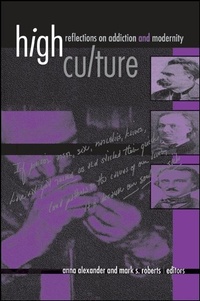
High Culture
Description

This is the first comprehensive text to address addiction and its multiple effects on and extensions into art, literature, philosophy, and psychology. Most research into addiction has taken place within the disciplines of medicine, criminology, politics, and social psychology. When seen from a broad cultural perspective, however, addiction emerges directly alongside modernity, haunting its various discourses of digression, dissent, and the transcendence of the commonplace. Who could even imagine modern writing without the addictive, visionary excesses of writers like Baudelaire, DeQuincey, Poe, Burroughs, or Artaud? Or, for that matter, modern culture without its "outsiders," its incorrigible addicts, its defaced subjects: smokers, users, overeaters, alcoholics, the insane? Taking a cultural studies approach to addiction, High Culture offers a readable and accessible collection of essays on these socially marginalized practices and discourses so central to modernity.
Anna Alexander teaches at the Simone de Beauvoir Institute, Concordia University in Montreal. Mark S. Roberts teaches in the Department of Philosophy at State University of New York at Stony Brook.
More details
Other editions
Additional editions
Persons
Anna Alexander teaches at the Simone de Beauvoir Institute, Concordia University in Montreal. Mark S. Roberts teaches in the Department of Philosophy at State University of New York at Stony Brook.
Content
ACKNOWLEDGMENTS
INTRODUCTION
Anna Alexander and Mark S. Roberts
PART I. PHILOSOPHICAL AND LITERARY REFLECTIONS ON ADDICTION
1. THE RHETORIC OF DRUGS
Jacques Derrida
2. NIETZSCHE'S DIONYSIAN HIGH:
Morphin' with Endorphins
David B. Allison
3. ARIADNE'S THREAD:
Walter Benjamin's Hashish Passages
Gary Shapiro
4. PROFANE HALLUCINATIONS:
From The Arcades Project to the Surrealists
Alina Clej
5. HEIDEGGER'S CRAVING:
Being-on-Schelling
David L. Clark
6. TRAUMA, ADDICTION, AND TEMPORAL BULIMIA IN MADAME BOVARY
Elissa Marder
7. BAUDELAIRE, ARTAUD, AND THE AESTHETICS OF INTOXICATION
Allen S. Weiss
8. "JUNK" AND THE OTHER:
Burroughs and Levinas on Drugs
Jeffrey T. Nealon
PART II. SOCIO-CULTURAL AND PSYCHOLOGICAL REFLECTIONS ON ADDICTION
9. SOCIALLY SIGNIFICANT DRUGS
Félix Guattari
10. FREUD'S PHARMACY:
Cocaine and the Corporeal Unconscious
Anna Alexander
11. SCHREBER'S ECSTASIES,OR WHO EVER LISTENED TO DANIEL PAUL?
Zvi Lothane
12. SMOKE SCREEN:
The Cultural Meaning of Women's Smoking
Lorraine Greaves
13. LOVE JUNKIES
Alphonso Lingis
14. POSSESSION, ADDICTION, FRAGMENTATION:
Is a Healing Community Possible?
Bruce Wilshire
15. GAMBLING AND ADDICTION
Jon Elster
16. ADDICTS WITHOUT DRUGS:
The Media Addiction
Mark S. Roberts
17. THE DRUG ADDICT IN ABSENTIA:
Hidden Populations of Illicit Drug Users and the Gaze of Power
John Fitzgerald
CONTRIBUTORS
INDEX
