

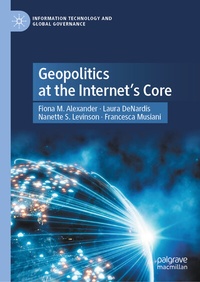
Geopolitics at the Internet's Core
Description

Contentious geopolitical conflicts over digital technologies have arisen around a complex set of technical specifications at the Internet's core. One of these is the Internet Protocol (IP), designed for addressing and routing information to its destination. China redesigning the Internet? Ukraine asking that Russia be disconnected from the Internet? The U.S. 'surrendering' the Internet? The Internet Protocol - rightly or not - has been at the center of many digital policy concerns for decades.
In examining entanglements between IP and public interest issues, Geopolitics at the Internet's Core illuminates how technical infrastructure is now a proxy for political and economic power. Ongoing global controversies over the Internet Protocol ecosystem hint at its importance and why IP is a flashpoint mediating broader conflicts in various cultural and historic contexts.
Geopolitics at the Internet's Core analyzes the trajectory and possible futures of the Internet Protocol as a space mediating geopolitical and domestic controversies in an increasingly contentious digital world; it explains the IP ecosystem, a complex combination of virtual resources, abstract specifications, tangible infrastructure, functionally specific systems, and the institutions and rules that design and govern these systems.
With a view toward the future and insights into the governance of emerging technologies, this book identifies eight IP-related levers of power that illuminate technology governance debates. Opening up the black box of the Internet Protocol and related global governance challenges, it explains the political battles and the stakes of these battles at the heart of the Internet.
More details
Other editions
Additional editions
Persons
Fiona M. Alexander is Distinguished Policy Strategist in Residence and Internet Governance Lab Distinguished Fellow at American University, USA.
Laura DeNardis is Professor and Endowed Chair in Technology, Ethics, and Society and Director of the Center for Digital Ethics at Georgetown University, USA.
Nanette S. Levinson is Professor and Director, Internet Governance Lab at American University, USA.
Francesca Musiani is Research Professor at the French National Center for Scientific Research (CNRS), and Director of CNRS's Centre for Internet and Society.
Content
Chapter 1: Internet Protocol Politics.- Chapter 2: A Radical Governance Innovation.- Chapter 3: Technical Design as Governance.- Chapter 4: The Internet Address Space as a Geopolitical Space.- Chapter 5: A Twenty Year Control Struggle from US Stewardship to Private Governance.- Chapter 6: The Internet Protocol and Content Battles.- Chapter 7: Internet Protocol Security Entanglements with Geopolitics.- Chapter 8: The Role of the Internet Protocol Ecosystem in Inclusion.- Chapter 9: Geopolitical and Technical Futures of the Internet Protocol.
