

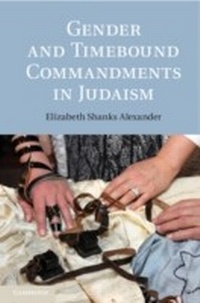
Gender and Timebound Commandments in Judaism
1st Edition
Published on 23. July 2013
978-1-107-07030-1 (ISBN)
Description

The rule that exempts women from rituals that need to be performed at specific times (so-called timebound, positive commandments) has served for centuries to stabilize Jewish gender. It has provided a rationale for women's centrality at home and their absence from the synagogue. Departing from dominant popular and scholarly views, Elizabeth Shanks Alexander argues that the rule was not conceived to structure women's religious lives, but rather became a tool for social engineering only after it underwent shifts in meaning during its transmission. Alexander narrates the rule's complicated history, establishing the purposes for which it was initially formulated and the shifts in interpretation that led to its being perceived as a key marker of Jewish gender. At the end of her study, Alexander points to women's exemption from particular rituals (Shema, tefillin and Torah study), which, she argues, are better places to look for insight into rabbinic gender.
Reviews / Votes
'In eight intricate chapters laden with pertinent primary and secondary sources, Alexander explores the rule's male-based origin and then discusses the evolving and revolving women's religious life and exemption from learning the Torah, reciting the Shema, and wearing the tefillin and tzitzit ... Recommended. Upper-level undergraduates through researchers/faculty.' Z. Garber, Choice 'Slicing through centuries of ideological (ab)use of the rabbinic exemption of women from timebound, positive commandments, Alexander carefully and judiciously enables her readers to see the exemption - for the first time - for what it is and what it is not. Combining philological exactitude with the methods of the broader humanities, she disables traditional religious, academic, and even feminist misunderstandings of the exemption, restores it to its original context, and analyzes it afresh with tools drawn from ritual and gender studies. The pay-off is rich - and utterly surprising.' Christine Hayes, Weis Professor of Religious Studies in Classical Judaica, Yale University, Connecticut 'Alexander's examination of the rationale behind women's exemption from timebound mitzvoth contributes to the growing investigation of halakhic development from a gendered perspective. Remarkable for its incisiveness and clarity, as well as its freedom from commonly held presumptions regarding the relationship between rabbinic law and social engineering of gender, this study has much to offer scholars and historians interested in the interplay between rabbinic law and culture, as well as those seeking possible ramifications for Jewish women in our day.' Tamar Ross, Bar Ilan University, Israel 'Professor Alexander has produced a model study. Utilizing with equal facility the tools of the exegete, the literary historian, the historian of ideas, and the constructive theologian, she makes a profound case for the centrality of the Shema - as ritual praxis and intellectual resource - in the shaping of rabbinic notions of gender and the role of women in the emerging rabbinic movement of late antiquity. This is a book that deserves to be studied and re-studied, its message to be impressed on the minds of a whole generation of scholars.' Martin S. Jaffee, University of Washington 'Careful, meticulous, learned scholarship informs the study by Elizabeth Shanks Alexander on gender and Jewish law. A breakthrough work in analyzing both the primary sources and the contemporary scholarship on this key issue concerning women and Judaism.' Susannah Heschel, Eli Black Professor of Jewish Studies, Dartmouth College, New Hampshire 'We are indebted to Elizabeth Shanks Alexander for what surely will be the definitive exploration of the development of women's roles in Judaism in relationship to the construct of positive timebound commandments. Her persistence, scholarship, and clearly explicated erudition epitomize the best fruits of the Jewish feminist enterprise.' Jewish Book Council 'This novel approach to gender in the earliest stratum of rabbinic texts concerns the rule that women are exempt from positive commandments occasioned by time ... The author acknowledges the role of the feminist critiques and debates of recent decades regarding women's exemption or exclusion from some key Jewish ritual matters but seeks to show that much of the substance of these debates is informed by later rereadings of the Mishnah.' Religious Studies ReviewMore details
Language
English
Place of publication
Cambridge
United Kingdom
Target group
Professional and scholarly
College/higher education
Illustrations
2 Tables, unspecified; 2 Plates, unspecified
File size
3276,88 MB
ISBN-13
978-1-107-07030-1 (9781107070301)
Copyright in bibliographic data and cover images is held by Nielsen Book Services Limited or by the publishers or by their respective licensors: all rights reserved.
Schweitzer Classification
Other editions
Additional editions
Elizabeth Shanks Alexander
Gender and Timebound Commandments in Judaism
Book
02/2015
Cambridge University Press
€49.20
Shipment within 15-20 days
Elizabeth Shanks Alexander
Gender and Timebound Commandments in Judaism
Book
04/2013
Cambridge University Press
€116.90
Shipment within 15-20 days
Person
Elizabeth Shanks Alexander is an Associate Professor of Religious Studies, teaching ancient Judaism, at the University of Virginia. She received her PhD from Yale University in 1998. She formerly taught at Smith and Haverford Colleges. Alexander received a Brandeis-Hadassah research grant for her work on this book, and is also the author of Transmitting Mishnah: The Shaping Influence of Oral Tradition (Cambridge University Press, 2006).
Content
Part I. Gender and the Tannaitic Rule: 1. The rule and social reality: conceiving the category, formulating the rule; 2. Between man and woman: lists of male-female difference; Part II. Talmudic Interpretation and the Potential for Gender: 3. How tefillin became a positive commandment not occasioned by time; 4. Shifting orthodoxies; 5. From description to prescription; Part III. Gender in Women's Ritual Exemptions: 6. Women's exemption from Shema and tefillin; 7. Torah study as ritual; 8. The fringes debate: a conclusion of sorts; 9. Epilogue.
