

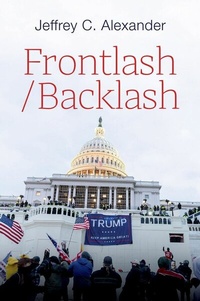
Frontlash / Backlash
Description

More details
Other editions
Additional editions
Person
Content
1. Frontlash and Backlash
2. Office Obligation as Civil Virtue: The Crisis of American Democracy, November 3, 2020 - January 6, 2021, and After
3. Trump's Brain: Steven Bannon Rages against the Enlightenment
4. The Challenge of Solidarity: The Indian Civil Sphere between Vitality and Suppression
5. Europe's Backlash against Immigration: Resisting the Multicultural Mode of Incorporation
6. The Re-emergence of Antisemitism (1): Waves of Societalization and What Conditions Them (with Tracy Adams)
7. The Re-Emergence of Antisemitism (2): Inverting the Lessons of the Holocaust Before, During, and After Gaza
1
FRONTLASH AND BACKLASH
It is fear and loathing time for the left. Loathing for President Trump, champion of the alt- right forces that, marginalized for decades, are bringing bigotry, patriarchy, nativism, and nationalism back into a visible place in the American civil sphere. Fear that these threatening forces may succeed, that democracy will be destroyed, and that the egalitarian achievements of the last five decades will be lost. Feminism, anti- racism, multiculturalism, sexual citizenship, ecology, and internationalism - all these precarious achievements have come under vicious, persistent attack.
Fear and loathing can be productive when they are unleashed inside the culture and social structures of a civil sphere that remains vigorous, one that sustains a vital center that, even if fragile, continues to hold (Schlesinger 1949; Alexander 2016; Kivisto 2019). In such conditions, a resistance thrives, blocking the victory of Trumpism, dark and brooding as it may be. Trumpism challenges not just the moral and political commitments of the left, but the cultural and social structures of the civil sphere - the sociological underpinning of political democracy (Alexander 2006, 2018).
No matter how horrifying in normative terms, we must understand the polarizing and excluding forces of Trumpism as sociologically "normal" - to the ongoing dynamics of civil spheres. Only when such an anti- leftist force challenges the culture structures and the institutional foundations of civil solidarity does it constitute a truly fundamental danger to democracy. Trumpism has not yet achieved such destructive power. To understand why, we need to look at the big picture: What are the culture and social structures of a civil sphere, and what are the social dynamics it sets in place?
The first thing to recognize is that "Trumpism" and the alt- right are nothing new - not here, not anywhere where civil spheres have been simultaneously enabled and constrained. The depredations of Trumpism are not unique, first- time- in- American- history kinds of things. They are a contemporary manifestation of backlash movements that have challenged progressive social change throughout American history.
Postwar social science has had a bad habit of thinking of social change as linear, a secular trend that is broadly progressive, rooted in the enlightening habits of modernity, education, economic expansion, and the shared social interests of humankind (Marshall 1965; Parsons 1967; Habermas [1981] 1984, 1987; Giddens 1990). From such a perspective, conservative movements appear as deviations, reflecting anomie and isolation (Putnam 2000), unreason (Lipset and Raab 1970), social backwardness, and "empathy walls" (Hochschild 2016).
But modern society never has actually worked in this way. Progress isn't a secular unfolding; it is triggered by frontlash movements, by avant- gardes whose vision is way ahead of their time, whose actions can be likened to provocative and destabilizing breaching experiments (Garfinkel 1967; Tognato 2019), and whose victories - even when they are small and quiet, but especially when they are big and loud - are experienced as profoundly threatening to vested interests, both ideal and material, not just at the bottom but in the middle and even at the very top of society. Frontlash always produces backlash: movements of cultural, social, and political un- doing that aim to unwind cosmopolitan widening and civil incorporation. Backlash does not occur because conservative cadres and followers are anti- modern, irrational, or unusually bigoted. Backlash is triggered, rather, because ideal and material structures of the status quo have been abruptly displaced, and those who occupied those structures wish to return to the time before displacement, when they were sitting and standing in what was, in their eyes, a much better place.
In the United States, frontlash seared the decade of the 1930s and marked the World War II years as well. Backlash against labor incorporation, challenges to antisemitism and ethnic and racial bigotry, and Ann Randian outrage over Keynesian economic controls exploded with extraordinary force in the late 1940s and dominated the decade after: Taft- Hartley, McCarthyism, stay- at- home mothers, separate- but- equal races, Cold War conformity, and sexual repression. Frontlash exploded again in the 1960s (Kazin 1995: 165-268; Isserman and Kazin 2000), terrifying vested interests, mobilizing counter- elites and long- standing civil society groups alike. In 1968, Richard Nixon rode a backlash crusade into the White House, vowing not only to close the gates of the civil sphere but to reverse civil rights, feminism, ecology, and peace. Facing imminent failure, Nixon tried to effectuate backlash with extra- Constitutional efforts to spy on and blackmail political and electoral opponents - efforts that the Watergate crisis eventually exposed and punished. After a brief post-Watergate period, the backlash movement against civil incorporation resumed, seizing national political power for a dozen years, using the levers of central government and the soapbox of the presidency, trying in every which way to undermine what frontlash movements had achieved, and were continuing to achieve. Yet Reaganism failed to block civil expansion, and conservative paranoia turned ever more cancerous during the eight years of Clinton centrist progressivism. Backlash came roaring back to national power during the administration of Bush the Second: Affirmative action was sharply challenged, feminist policies undermined, environmentalism muted, nationalistic patriotism revived - and militaristic responses to international relations flourished.
The drama of frontlash and backlash continued. Critical sociologists have often written off the Obama years as centrist, neoliberal, even neoconservative. This view was certainly not shared by the white and wounded, the status quo masses and elites. Obama gestured to a post- imperial foreign policy and a post- white, multicultural American ethnicity; he created a massive and inclusive new social entitlement - the Affordable Care Act, aka "Obama Care" (Alexander and Jaworsky 2014); and he was Black! Tens of millions of white Americans experienced the Obama years as frighteningly frontlash. The status quo ante seemed overturned. The experience of laceration triggered another backlash frenzy, this time in Trumpian form. Not new, but still dangerous, it spread fear and loathing on the left.
What threatens democracy is not backlash. Backlash is inevitable when frontlash movements succeed. Introducing once inconceivable reforms in the name of justice, they destabilize established interests. The question is not whether conservative movements will push back - for they do, and often successfully - but whether, when they do, the civil sphere can survive.
Democracy depends on feelings of mutual regard, on experiencing a shared solidarity despite deep antipathies of interest and ideology. There must be some historically specific vision of a shared universalism that transcends the particularisms of class, race, gender, sex, region, religion, and ethnicity. Because frontlash and backlash are highly polarizing, their phenomenological effect is to induce high anxiety that civil solidarity is breaking apart. What once seemed civil - affirmative action, for example - now seems particularistic. Groups and ideas once honored - Confederate heroes, for example - are now trashed. Can the sense of a vital center survive? Only if civil solidarity can regulate ideal and material conflict in such a manner that enemies become frenemies, that sharp antagonism is moderated and agonism thrives (Mouffe 2000). Frontlash must be so civil- ized that it eschews revolution for social democracy (Marshall 1965).1 Backlash unfolds under an anti- left, conservative ideology, but such conservatism can take a civil or anti- civil form.
Burke ([1790] 2009) and Oakeshott (1975) were backlash philosophers of civil moderation: don't hurry so fast, they warned the left; don't be so arrogant as to see yourself as the master of rationality; do be more concerned with maintaining trust and incremental ties. When backlash takes more extreme form, however, conservative ideology becomes not moderately anti- radical but revolutionary: from agonism to antagonism, from persuasion to violence, from civil sphere to civil war, and from democracy to authoritarianism. If backlash had boiled over in the 1960s, you would have had Malcolm X and the Black Panthers as the decade's dominant political figures and organizations, not Martin Luther King and the NAACP. If backlash boils over today, we will have Steve Bannon as the nation's dominant public intellectual (Chapter 3, below), Fox News as the dominant source of journalistic truth, and white racism as the avowed platform of the Republican Party.
While Trump often speaks in the tones of Bannon's ideological radicalism, during his first term he was compelled to govern in the name of mainstream conservative backlash. Civil conservatives sustained Trump because they were able to use his presidency to push back against the frontlash achievements of decades before. Trump has "done more to deregulate than any president in history," explained the president of Freedom Works, citing a long- standing conservative policy goal (Peters 2018: 16). A regressive tax bill; broad attacks on women's rights, such as the conservative Supreme Court's abolition of the national right to abortion; the same...
