

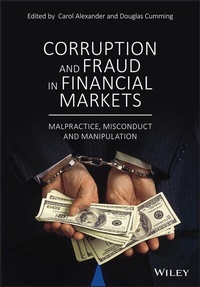
Corruption and Fraud in Financial Markets
Description

Corruption and Fraud in Financial Markets identifies potential issues surrounding all types of fraud, misconduct, price/volume manipulation and other forms of malpractice. Chapters cover detection, prevention and regulation of corruption and fraud within different financial markets. Written by experts at the forefront of finance and risk management, this book details the many practices that bring potentially devastating consequences, including insider trading, bribery, false disclosure, frontrunning, options backdating, and improper execution or broker-agency relationships.
Informed but corrupt traders manipulate prices in dark pools run by investment banks, using anonymous deals to move prices in their own favour, extracting value from ordinary investors time and time again. Strategies such as wash, ladder and spoofing trades are rife, even on regulated exchanges - and in unregulated cryptocurrency exchanges one can even see these manipulative quotes happening real-time in the limit order book. More generally, financial market misconduct and fraud affects about 15 percent of publicly listed companies each year and the resulting fines can devastate an organisation's budget and initiate a tailspin from which it may never recover.
This book gives you a deeper understanding of all these issues to help prevent you and your company from falling victim to unethical practices.
* Learn about the different types of corruption and fraud and where they may be hiding in your organisation
* Identify improper relationships and conflicts of interest before they become a problem
* Understand the regulations surrounding market misconduct, and how they affect your firm
* Prevent budget-breaking fines and other potentially catastrophic consequences
Since the LIBOR scandal, many major banks have been fined billions of dollars for manipulation of prices, exchange rates and interest rates. Headline cases aside, misconduct and fraud is uncomfortably prevalent in a large number of financial firms; it can exist in a wide variety of forms, with practices in multiple departments, making self-governance complex. Corruption and Fraud in Financial Markets is a comprehensive guide to identifying and stopping potential problems before they reach the level of finable misconduct.
More details
Other editions
Additional editions
Persons
CAROL ALEXANDER, Ph.D., is Professor of Finance at the University of Sussex, Visiting Professor at Peking University PHBS Business School in Oxford and Co-Editor of the Journal of Banking and Finance. She is the former Chair of the Board of the Professional Risk Manager's International Association and she consults on model design for major exchanges, banks, and fund managers worldwide. She has edited more than a dozen books in finance and risk management and her sole-authored four-volume textbook on Market Risk Analysis (Wiley, 2008) remains the definitive guide to the subject after more than 12 years in print.
DOUGLAS CUMMING J.D., Ph.D., CFA, is the DeSantis Distinguished Professor of Finance and Entrepreneurship at the College of Business, Florida Atlantic University, and Visiting Professor of Finance at Birmingham Business School, University of Birmingham, and Royal Melbourne Institute of Technology. He has published 18 books and over 185 articles in leading journals such as the Academy of Management Journal, Journal of Financial Economics, and Review of Financial Studies, which have been cited over 15,000 times. He is the Managing Editor-in-Chief of the British Journal of Management and Journal of Corporate Finance, and the Founding Editor-in-Chief of the Review of Corporate Finance.
Content
About the Editors xv
List of Contributors xvii
Foreword xix
Acknowledgements xxi
Chapter 1: Introduction 1
Carol Alexander and Douglas Cumming
Part I What are Manipulation and Fraud and Why Do They Matter? 11
Chapter 2: An Overview of Market Manipulation 13
Talis J. PutninS
2.1 Introduction 14
2.2 Definitions of Market Manipulation 16
2.2.1 Legal Interpretation and Provisions against Market Manipulation 16
2.2.2 Economics and Legal Studies Perspective 18
2.3 A Taxonomy of the Types of Market Manipulation 19
2.3.1 Categories of Market Manipulation 19
2.3.2 Market Manipulation Techniques 22
2.4 Research on Market Manipulation 26
2.4.1 Theoretical Literature 27
2.4.2 Empirical Literature 30
2.4.3 Conclusions from the Research on Market Manipulation 35
2.5 Summary and Conclusions 39
References 40
Chapter 3: A Taxonomy of Financial Market Misconduct 45
Ai Deng and Priyank Gandhi
3.1 Introduction 46
3.2 Challenges in Research on Financial Market Misconduct 50
3.3 Defining Financial Market Misconduct 51
3.3.1 Price Manipulation 53
3.3.2 Circular Trading 54
3.3.3 Collusion and Information Sharing 55
3.3.4 Inside Information 56
3.3.5 Reference Price Influence 56
3.3.6 Improper Order Handling 57
3.3.7 Misleading Customers 58
3.4 Defining Financial Fraud 59
3.4.1 Credit Card Fraud 59
3.4.2 Money Laundering 60
3.4.3 Financial Statement Fraud 60
3.4.4 Computer Intrusion Fraud 61
3.5 Conclusion 61
References 61
Chapter 4: Financial Misconduct and Market-Based Penalties 65
Chelsea Liu and Alfred Yawson
4.1 Introduction 66
4.2 Notable Cases of Financial Reporting Fraud 69
4.3 Financial Reporting Misconduct and Legal Redress 70
4.4 Evolution of US Financial Regulations 71
4.4.1 Private Securities Litigation Reform Act (1995) 72
4.4.2 Sarbanes-Oxley Act (2002) 72
4.4.3 Dodd-Frank Act (2010) 73
4.5 Legal versus Market-Based Penalties for Financial Misconduct 74
4.5.1 Common Forms of Legal Penalties 74
4.5.2 Role of Market-Based Penalties 75
4.6 Firm-Level Penalties for Corporate Financial Misconduct 75
4.6.1 Direct Economic Costs Captured in Loss of Market Value 83
4.6.2 Loss of Firm Reputation 83
4.6.3 Spillover of Reputational Effect 84
4.6.4 Governance Risk and Insurance Premiums 85
4.6.5 Reduced Liquidity 85
4.6.6 Access to Financing 85
4.6.7 Reduced Innovation 86
4.6.8 Mergers and Acquisitions 86
4.7 Individual-Level Penalties for Corporate Financial Misconduct 87
4.7.1 Executive and Director Turnover 87
4.7.2 Impaired Career Progression 95
4.7.3 Loss of Reputation 96
4.7.4 Executive Compensation 97
4.7.5 Strengthened Monitoring 97
4.8 Causes, Risks, and Moderators of Financial Misconduct 98
4.8.1 Fraud Incentives 98
4.8.2 Risk Factors 113
4.8.3 Public Enforcement: Regulatory and Judicial Stringency 115
4.8.4 Public Enforcement: Detection and Surveillance 116
4.8.5 Private Enforcement 117
4.9 Other Non-Financial Misconduct 118
4.10 Concluding Remarks 119
References 120
Chapter 5: Insider Trading and Market Manipulation 135
Jonathan A. Batten, Igor Loncarski, and Peter G. Szilagyi
5.1 Introduction 135
5.2 Regulatory Framework on Insider Trading and Market Manipulation 140
5.3 Recent Examples of Market Manipulation and Insider Trading 145
5.4 Conclusions 148
References 149
Chapter 6: Financial Fraud and Reputational Capital 153
Jonathan M. Karpoff
6.1 Financial Frauds in the 2000s 154
6.2 The Effects of Fraud Revelation on Firm Value and Reputational Capital 156
6.2.1 Market Value Losses When Financial Misconduct is Revealed 156
6.2.2 Spillover Effects 157
6.2.3 Reputational Losses for Financial Misconduct 158
6.2.4 Direct Measures of Lost Reputational Capital 159
6.2.5 Do Misconduct Firms Always Lose Reputational Capital? 160
6.2.6 Rebuilding Reputational Capital 161
6.3 The Effects of Fraud Revelation on Shareholders and Managers 162
6.3.1 Should Shareholders Pay? Do Managers Pay? 162
6.3.2 Do Shareholders Pay Twice? 162
6.3.3 Are Firm-Level Penalties Efficient? 163
6.3.4 Consequences for Managers and Directors 163
6.4 Why Do Managers Do It? Motives and Constraints 165
6.4.1 Motives for Financial Misconduct 165
6.4.2 Constraints on Financial Misconduct 167
6.5 Proxies and Databases Used to Identify Samples of Financial Statement Misconduct 168
6.6 Conclusion: Reputation, Enforcement, and Culture 170
References 171
Part II How and Where Does Misconduct Occur? 179
Chapter 7: Manipulative and Collusive Practices in FX Markets 181
Alexis Stenfors
7.1 Introduction 181
7.2 Different Types of FX Orders 183
7.3 The Unique FX Market Structure 184
7.4 Examples of Manipulative and Collusive Practices in FX Markets 188
7.4.1 Front Running 188
7.4.2 Triggering Stop-Loss Orders 190
7.4.3 'Banging the Close' 192
7.4.4 Collusion and Sharing of Confidential Information 193
7.4.5 Spoofing 195
7.4.6 Market Abuse via Electronic Trading Platforms 196
7.5 The Reform Process 197
References 199
Chapter 8: Fraud and Manipulation within Cryptocurrency Markets 205
David Twomey and Andrew Mann
8.1 Introduction 206
8.2 Why Do fraud and Manipulation Occur in Cryptocurrency Markets? 212
8.2.1 Lack of Consistent Regulation 212
8.2.2 Relative Anonymity 213
8.2.3 Low Barriers to Entry 214
8.2.4 Exchange Standards and Sophistication 214
8.3 Pump and Dumps 215
8.3.1 Case Studies 217
8.4 Inflated Trading Volume 217
8.4.1 Case Study: January 2017 and PBoC Involvement 219
8.5 Exchange DDoS Attacks 220
8.5.1 Case Study 223
8.6 Hacks and Exploitations 224
8.6.1 Exchange Hacks 224
8.6.2 Smart Contract Exploits 229
8.6.3 Protocol Exploitation 230
8.7 Flash Crashes 230
8.7.1 GDAX-ETH/USD Flash Crash 234
8.8 Order Book-Based Manipulations 235
8.8.1 Quote Stuffing 236
8.8.2 Order Spoofing 237
8.9 Stablecoins and Tether 239
8.9.1 Tether Historical Timeline 240
8.9.2 Tether Controversy and Criticism 242
8.9.3 Tether's Significance in Cryptocurrency Global Markets 245
8.10 Summary and Conclusions 245
References 249
Chapter 9: The Integrity of Closing Prices 251
Ryan J. Davies
9.1 Why Closing Prices Matter 251
9.2 Painting the Tape and Portfolio Pumping 252
9.3 'Bang-the-Close' Manipulation: The Response of Financial Intermediaries 255
9.4 Stock Price Pinning on Option Expiration Dates 259
9.5 Conclusion: Lessons for the Regulation and Design of Financial Markets 263
References 269
Chapter 10: A Trader's Perspective on Market Abuse Regulations 275
Sam Baker
10.1 Introduction 275
10.2 Getting the Trading Edge 278
10.3 A Typical Trader's Market Window 281
10.4 Wash Trades 282
10.5 High Ticking/Low Ticking - Momentum Ignition 284
10.6 Spoofing 286
10.7 Layering 290
10.8 Smoking 292
10.9 Case Study: Paul Rotter a.k.a. 'The Flipper' 295
10.10 The Innocent and the Guilty 299
10.11 What are Exchanges Doing to Prevent Market Abuse? 301
10.11.1 CME Group 301
10.11.2 ICE 302
10.12 What are Trading Companies Doing to Prevent Abuse? 302
10.13 Will There Be an End to Market Abuse? 303
Part III Who are These Scoundrels? 305
Chapter 11: Misconduct in Banking: Governance and the Board of Directors 307
Duc Duy Nguyen, Jens Hagendorff, and Arman Eshraghi
11.1 Introduction 307
11.2 Literature Review 311
11.3 Research Design 312
11.3.1 Data 312
11.3.2 Empirical Design 313
11.3.3 Variables 314
11.4 Empirical Results 316
11.4.1 Main Results 316
11.4.2 Results for Different Classes of Enforcement Actions 320
11.4.3 Does Better Board Quality Alleviate Shareholder Wealth Losses? 323
11.5 Conclusion 323
References 325
Chapter 12: Misconduct and Fraud by Investment Managers 327
Stephen G. Dimmock, Joseph D. Farizo, and William C. Gerken
12.1 Introduction 327
12.2 Related Research 329
12.3 The Investment Advisers Act of 1940 and Mandatory Disclosures 331
12.4 Data 332
12.4.1 Investment Fraud 332
12.4.2 Form ADV Data and Variables 337
12.5 Predicting Fraud and Misconduct 340
12.5.1 Predicting Fraud by Investment Managers 340
12.5.2 Interpreting the Predictive Content of the Models 345
12.5.3 K-Fold Cross-Validation Tests 346
12.6 Predicting the Initiation vs. the Continuance of Fraud 347
12.7 Firm-Wide Fraud vs. Fraud by a Rogue Employee 349
12.8 Out-of-Sample Prediction and Model Stability 351
12.9 Policy Implications and Conclusions 352
References 355
Chapter 13: Options Backdating and Shareholders 359
Johan Sulaeman and Gennaro Bernile
13.1 Introduction 359
13.2 Stock Return Patterns around Option Grants 360
13.3 The Backdating Practice 361
13.4 Media Coverage, Restatement, and Investigation 362
13.5 Stock Market Reaction to Public Revelations of Backdating 363
13.6 Investor Reaction to (and Anticipation of) Public Revelations 364
13.7 Other Types of Misbehaviour Related to Option Grants 365
13.7.1 Forward Dating 365
13.7.2 Selective Disclosure 366
13.7.3 Option Exercise Backdating 366
13.7.4 Independent Director Backdating 366
13.8 Connections with Questionable Practices by Corporate Executives and Other Agents 366
13.9 Conclusion 367
References 368
Chapter 14: The Strategic Behaviour of Underwriters in Valuing IPOs 371
Stefano Paleari, Andrea Signori, and Silvio Vismara
14.1 Valuing IPOs 371
14.2 The Underwriter's Incentives in the Valuation of IPOs 373
14.3 Literature Review 374
14.4 Sample, Data, and Methodology 376
14.4.1 Sample and Data 376
14.4.2 Alternative Selection Criteria of Comparable Firms 380
14.4.3 Valuation Bias and IPO Premium 380
14.5 Results 381
14.5.1 Algorithmic Selections 381
14.5.2 Affiliated and Unaffiliated Analysts 386
14.5.3 Underwriters' Selection of Comparable Firms Pre- vs. Post-IPO 390
14.5.4 Pre- vs. Post-IPO Selections and Industry Effects 394
14.6 Conclusions 396
References 397
Chapter 15: Governance of Financial Services Outsourcing: Managing Misconduct and Third-Party Risks 399
Joseph A. McCahery and F. Alexander de Roode
15.1 Introduction 399
15.2 The Four Components in Outsourcing 402
15.2.1 Efficient Outsourcing 402
15.2.2 The Four-Factor Governance Model 404
15.2.3 Misconduct in Outsourcing and the Ability of Financial Institutions to Monitor 407
15.3 The Interaction between Contracting and Monitoring 408
15.3.1 Characterization of Financial Institutions 409
15.3.2 Risks in Outsourcing Services 412
15.4 Governance Mechanisms to Detect Misconduct in Financial Outsourcing 413
15.4.1 Screening and Detection 414
15.5 Conclusion 416
References 417
Part IV Detection and Surveillance of Financial Misconduct 423
Chapter 16: Identifying Security Market Manipulation 425
Mike Aitken, Ann Leduc, and Shan Ji
16.1 Introduction 425
16.2 Background Legislation 427
16.2.1 Australia 427
16.2.2 UK 428
16.2.3 Hong Kong 428
16.2.4 Canada 429
16.2.5 Singapore 430
16.2.6 Malaysia 430
16.2.7 New Zealand 431
16.3 Attributes of Manipulation 431
16.3.1 How Traders Minimize the Resources Needed for Manipulative Trading 432
16.3.2 Difficulties in Determining Whether Trading Behaviour is Manipulative 433
16.3.3 Surveillance Systems 434
16.4 Detection Algorithms 436
16.5 Conclusion 439
Chapter 17: The Analytics of Financial Market Misconduct 441
Ai Deng and Priyank Gandhi
17.1 Introduction 442
17.2 Financial Economic Analysis 446
17.2.1 Benchmarking to Historical or Past Data 447
17.2.2 Benchmarking to Alternate Proxies 451
17.2.3 Benchmarking to a Model 454
17.3 Quantitative Techniques 456
17.3.1 The Principles of Fraud Detection 457
17.3.2 Popular Supervised Learning Techniques for Fraud Detection 458
17.3.3 Popular Unsupervised Learning Techniques for Fraud Detection 460
17.3.4 Dynamic Misconduct Detection 462
17.4 Conclusion 464
References 466
Chapter 18: Benford's Law and Its Application to Detecting Financial Fraud and Manipulation 473
Christina Bannier, Corinna Ewelt-Knauer, Johannes Lips, and Peter Winker
18.1 Introduction 474
18.2 Benford's Law and Generalizations 476
18.2.1 The Basic Principle of Benford's Law 476
18.2.2 Illustration of Benford's Law 477
18.2.3 Testing for Conformity with Benford's Law 478
18.2.4 Considering Further Digits with Benford's Law 480
18.2.5 When Do Data Conform to Benford's Law? 482
18.2.6 Limitations of Using Benford's Law for Identification of Manipulations 483
18.2.7 Generalizations of Benford's Law for Identification of Manipulations 484
18.3 Usage of Benford's Law for Detecting Fraud and Deviant Behaviour 485
18.3.1 Forensic Accounting in the Context of Auditing, Internal Control Systems, and Taxation 486
18.3.2 Finance 487
18.3.3 Surveys and Research 490
18.4 A Case Study: Benford's Law and the LIBOR 491
18.5 Policy Implications 498
18.6 Summary, Limitations, and Outlook 498
References 499
18.A Appendix 504
Part V Regulation and Enforcement 505
Chapter 19: The Enforcement of Financial Market Crimes in Canada and the United Kingdom 507
Anita Indira Anand
19.1 Introduction 507
19.2 Existing Scholarship 508
19.3 Comparative Analysis 512
19.3.1 Canada 512
19.3.2 The United Kingdom 513
19.4 Reform 515
19.4.1 Resource Allocation 515
19.4.2 Principles-Based Regulation 516
19.4.3 Targeted Regulatory Reforms 518
19.5 Conclusion 520
References 520
Chapter 20: A Pyramid or a Labyrinth? Enforcement of Registrant Misconduct Requirements in Canada 527
Mary Condon
20.1 Introduction 527
20.2 Definitional and Institutional Quagmires 529
20.3 The Compliance/Enforcement Continuum 531
20.4 Enforcement Options Available to Sanction Registrant Misconduct 533
20.5 Empirical Information Available about Registrant Misconduct in Canada 535
20.5.1 Criminal Enforcement 535
20.5.2 CSA Non-Criminal Enforcement 536
20.5.3 Director's Decision Data in Ontario 537
20.5.4 SRO Enforcement 538
20.6 Analysis 538
Chapter 21: Judicial Local Protectionism and Home Court Bias in Corporate Litigation 541
Michael Firth, Oliver M. Rui, and Wenfeng Wu
21.1 Introduction 542
21.2 Institutional Background 544
21.2.1 Decentralization and Local Protectionism 544
21.2.2 Judicial Independence 545
21.2.3 The Heterogeneity of the Legal Environment across Regions 548
21.3 Empirical Evidence 548
21.3.1 Sample 549
21.3.2 Basic Statistics 550
21.3.3 The Wealth Effect for Defendants and Plaintiffs around the Filing Announcements at Different Courts 556
21.3.4 The Impact of Court Location on the Wealth Effect 560
21.3.5 Regression Analysis of the Wealth Effects from a Filing Announcement 560
21.3.6 Heckman Two-Step Analysis of Sample Selection Bias 567
21.3.7 The Impact of Court Location on the Likelihood to Appeal 573
21.3.8 Sensitivity Tests 576
21.4 Conclusion 579
References 580
Index 583
Chapter 1
Introduction
Carol Alexander
University of Sussex
Douglas Cumming
Florida Atlantic University
This book covers two general areas of financial market misconduct:
- Market manipulation in the course of financial trading on stock exchanges (hereafter referred to as "market manipulation" in this chapter), and
- Financial fraud, or non-trading related fraud (hereafter referred to as "financial fraud" in this chapter).
The CFA Institute (2014) survey of its members shows that most practitioners believe that market manipulation and financial fraud are among the most important issues facing financial markets around the world. Indeed, market manipulation and both types of financial fraud are commonplace. For instance, Cumming, Dannhauser and Johan (2015) report that roughly 1.9%, 4.5%, and 5.1% of NYSE, NASDAQ, and pink sheet companies, respectively, face enforcement actions from the Securities and Exchange Commission (SEC) each year. Similarly, detected fraud cases affect approximately 3.8% of listed companies in China each year. But detected fraud is just the tip of the iceberg, so to speak, and Dyck, Morse and Zingales (2010, 2014) estimated that up to 14% of all US firms have engaged in fraud.
Enforcement varies significantly across countries. In fact, there are enormous differences in enforcement rates in Europe, despite countries having similar market misconduct rules (Cumming, Groh, and Johan, 2018). And there is scant enforcement in some emerging markets such as Brazil, which had its first ever reported insider trading case in 2011. Even in Germany, the (now defunct) Neur Markt, a small-company growth market, reported only four cases of fraud (Cumming et al., 2015).
The consequences of fraud are extremely severe to managers and shareholders alike. Karpoff et al. (2008a) shows that fraud costs firms 20-38% of a firm's long-term stock market value. Karpoff et al. (2008b) show significant negative career consequences to managers that engage in market manipulation and financial fraud: 93% lose their jobs, and 28% face criminal prosecution, serving an average of 4.3 years of jail time.
This book offers a unifying look at the different types of market manipulation and financial fraud. The chapters in this book:
- Explain the various types of market manipulation and financial fraud;
- Describe the factors that mitigate or exacerbate their occurrence;
- Discuss their consequences in terms of penalties and/or financial market impact;
- Provide evidence for the presence of fraud in specific markets, such as cryptocurrencies, LIBOR and foreign exchange;
- Summarize the lessons to be learned about detection and enforcement of market manipulation and financial fraud.
The book is organized into five sections. Part I provides a general overview, where different types of market misconduct and financial fraud are defined, and the market and reputational penalties are explained. Part I comprises 5 chapters (Chapters 2-6) from leading authors around the world. The scope of the chapters is explained in Table 1.1, Panels A (for market manipulation) and B (for financial fraud). Chapter 2 by Talis J. Putnins provides a comprehensive overview of the different types of market manipulation. Chapter 3 by Ai Deng and Priyank Ghandi includes additional information on market manipulation and extends the discussion to financial fraud. Chapter 4 by Chelsea Liu and Alfred Yawson offers a comprehensive review of the market and reputational penalties associated with market manipulation and financial fraud. Chapter 5 by Jonathan Batten, Igor Loncarski and Peter Szilagyi provides detailed explanations of various issues in price manipulation and insider trading and describes detected cases of such misconduct. Chapter 6 by Jonathan Karpoff offers critical insights into the consequences of financial fraud based on findings from precisely compiled large-sample evidence.
Part II provides analyses of specific contexts and markets. Chapter 7 by Alexis Stenfors provides insights into the foreign exchange market based on his first-hand practical experience as well as his research on topic. Chapter 8 by David Twomey and Andrew Mann examines the cryptocurrency market. Chapter 9 by Ryan Davies offers a detailed look at the context of closing prices, which are frequently the subject of manipulation, since closing prices are used in determining various other things in financial market, such as executive compensation, whether options trade in or out of the money, and M&A prices and terms. Chapter 10 by Sam Baker provides insights into market manipulation and financial fraud cases from the experience and perspective of a financial market trader who has dealing with regulations on a daily basis for many years.
Part III considers different financial market players that engage in market manipulation and financial fraud. Chapter 11 by Duc Duy Nguyen, Jens Hagendorff and Arman Eshraghi analyses fraud among banks. Chapter 12 by Steven Dimmock, Joseph Farizo, and William Gerken examines fraud by investment advisors. Chapter 13 by Johan Sulaeman and Gennaro Bernile discusses how options backdating is a form of fraud. Stefano Paleari, Andrea Signori and Silvio Vismara provide an empirical analysis of misconduct in the context of pricing Initial Public Offerings, in Chapter 14. And in Chapter 15, Joseph McCahery and Alexander Roode examine the role of financial fraud through financial outsourcing to third parties and provide comprehensive survey evidence of the extent of the problems.
Part IV covers detection of market manipulation and financial misconduct. Chapter 16 by Mike Aitken, Anne Leduc and Sian Ji describes computer surveillance and technologies for detecting manipulation, and the computer software that is used by exchanges and their regulators. Chapter 17 by Ai Deng and Priyank Ghandi explains econometric and statistical tools to detect financial fraud. Chapter 18 by Professors Bannier, Ewelt-Knauer, Lips, and Winker provides an empirical review of Benford's Law and its application to detecting financial misconduct, with an illustration using data pertaining to the LIBOR scandal.
Part V provides an overview of financial market regulation relating to manipulation and fraud. Chapter 19 by Anita Indira Anand explains that empirical evidence around the world is consistent with the view that financial market regulation improves market efficiency and integrity and provides an in-depth analysis of regulation and enforcement issues in Canada and the UK. Chapter 20 by Mary Condon reviews issues surrounding registrant misconduct. Finally, Chapter 21 by Michael Firth, Oliver Rui and Wenfeng Wu provides empirical evidence supporting differential rates of enforcement depending on potential institutional biases, such as a "home court" advantage.
The coverage of each area of market manipulation and financial fraud in this book is summarized in Table 1.1. The range of topics is not completely exhaustive in this book. In some cases topics were excluded because authors faced confidentiality restrictions that precluded their publication. Nevertheless, we hope the broad range of materials in this book better informs and guides financial market participants, regulators, students, and academics alike. Individual cases of misconduct and outright fraud are reported frequently, whereas price and volume manipulation are so common that their occurrence is not usually conveyed to the general public. However, it is important to inform everyone about these practices, not only those directly participating in financial markets, because prices of final assets have a direct effect on the well-being of the global economy. We are, therefore, extremely indebted to the world leading authors that have contributed herein. We expect their analyses will continue to guide practice and policy for years to come.
Table 1.1 Summary of Coverage in Chapters
This table summarizes the topics in each chapter, and the scope of the chapters in terms of definitions, analyses of causes and/or consequences of fraud and misconduct, and case analyses or data. Panel A summarizes topics in financial market misconduct, Panel B summarizes topics in fraud. The different types of misconduct and fraud in the table are explained in detail in the chapters enumerated here.
Panel A. Topics in Financial Market Misconduct Chapter Authors Topics Price Manipulation, Reference Price Manipulation, and Benchmark Rigging Circular Trading (e.g., wash, pool, matched or compensation trades; painting the tape; or warehousing), or Spoofing Insider Trading, Collusion and Information Sharing Improper Order Handling and Frontrunning Misleading Customers Abuse of Market Power, Corners, or Squeezes Momentum Ignition, Pump and Dump, or Slur and Dump Marking the Open (or Close or Set), Pegging or Capping Layering, Advancing the Bid, Quote Stuffing, "Abusive liquidity detection", "pinging", or "phishing" Section I....