

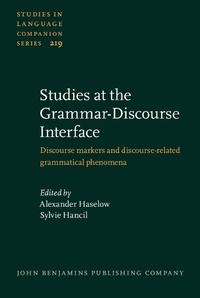
Studies at the Grammar-Discourse Interface
Discourse markers and discourse-related grammatical phenomena
1st Edition
Published on 3. June 2021
360 pages
978-90-272-5989-9 (ISBN)
Description

This book investigates phenomena at the grammar-discourse interface with a strong focus on discourse markers, whose development and concrete uses in a given language tend to be based on a close interplay of grammatical and discourse-related forces. The topics range from the transition of linguistic signs "e;out of"e; sentence grammar and "e;into"e; the domain of discourse to differences between more grammatical vs. more discourse-pragmatic expressions in terms of structural behavior and cognitive processing, and the different, intricate ways in which the usage conditions and meanings of grammatical constituents or structural units are affected by the discourse context in which they are used. The twelve studies in this book are based on fresh empirical data from languages such as English, Basque, Korean, Japanese and French and involve the study of linguistic expressions and structures such as pragmatic markers and particles, comment clauses, expletives, adverbial connectors, and expressives.
More details
Other editions
Additional editions
Alexander Haselow | Sylvie Hancil
Studies at the Grammar-Discourse Interface
Discourse markers and discourse-related grammatical phenomena
Book
06/2021
John Benjamins Publishing Co
€123.30
Shipment within 10-15 days
Content
- Intro
- Studies at the Grammar-Discourse Interface
- Editorial page
- Title page
- Copyright page
- Table of contents
- Grammar, discourse, and the grammar-discourse interface
- 1. Introduction
- 2. Current issues in research on the grammar-discourse interface
- 2.1 Part I - Discourse markers: The interaction of grammar and discourse from a historical-developmental perspective
- 2.2 Part II - Discourse markers: The grammar-discourse interaction from a synchronic, usage-based perspective
- 2.3 Part III - Discourse-related grammatical phenomena
- 3. Overview of the papers in this volume
- 4. Conclusion
- References
- Part I. Discourse markers: The grammar-discourse interaction from a developmental perspective
- Chapter 1. On the rise of discourse markers
- 1. Introduction
- 1.1 The present paper
- 1.2 Discourse marker, grammaticalization, and cooptation
- 1.3 Conclusions
- 2. The marker I admit
- 2.1 Introduction
- 2.2 Reconstruction
- 2.3 Cooptation
- 3. The marker if you will
- 3.1 Grammaticalization
- 3.2 On constituent anchored if you will
- 4. The French marker alors
- 5. Discussion
- 5.1 Problems
- 5.2 Instantaneous vs. gradual change
- 5.3 Alternative views
- 6. Conclusions
- Acknowledgements
- References
- Chapter 2. On the pragmatic development of modal particles in Navarrese-Lapurdian Basque: Hori emain ote nauzu?
- 1. Introduction
- 2. Some basic notions on question formation and modal particles in Basque
- 3. The modal particle ote: Its general contribution
- 4. On the literature of pragmatic change regarding modal particles
- 4.1 The grammaticalization of modal particles into question particles
- 4.2 The use of modal particles to minimize the interrogative strength
- 5. Pragmatic microvariation on Navarrese-Lapurdian
- 6. Conclusion
- Acknowledgements
- Funding
- Consulted corpora
- References
- Chapter 3. On divergent paths and functions of 'background'-based discourse markers in Korean
- 1. Introduction
- 2. The development of kulssey and kuntey
- 3. Multiple DM functions of kulssey and kuntey
- 3.1 Kulssey
- 3.2 Kuntey
- 4. Functional determinants
- 4.1 Functions compared
- 4.2 Syntagmatic independence
- 4.3 Semantic persistence and periphery
- 4.4 Prosody
- 4.5 Pragmatic inference and functional network
- 5. Summary and conclusion
- Acknowledgements
- Funding
- Abbreviations
- References
- Chapter 4. Reanalysis and the emergence of adverbial connectors in the history of Japanese
- 1. Introduction
- 2. Preceding studies with corroborating information
- 3. Corpora and dictionaries
- 4. The survey results and discussion
- 4.1 Boundary shifts and grammatical renewal through reanalysis
- 4.2 Bridging context and constructional clustering
- 5. (Re)creating grammar through reanalysis in other languages
- 6. Concluding remarks
- Acknowledgements
- Funding
- Abbreviations
- Corpora
- Dictionaries
- References
- Appendix. Language contact as a facilitator for reanalysis
- Part II. Discourse markers: The grammar-discourse interaction from a synchronic, usage-based perspective
- Chapter 5. The meaning and functions of French je pense (que): A constructionalist and interactional account
- 1. Introduction
- 2. Previous studies
- 3. Presentation of the data
- 4. The meaning(s) of je pense (que)
- 4.1 Je pense (que) as a micro-construction
- 4.2 Constructional meaning of je pense (que)
- 4.3 Fine-tuning the analysis of je pense (que): Comparison with je crois / trouve (que)
- 5. Interactional functions of je pense (que)
- 5.1 Je pense (que) as a face-saving device
- 5.2 Discourse-organizational functions
- 6. Correlations between the position and the function of je pense (que)
- 7. Conclusion
- Acknowledgements
- References
- Transcription conventions
- Chapter 6. Discourse markers and brain lateralization: Evidence for dual language processing from neurological disorders
- 1. Introduction
- 2. Microstructures, macrostructures and dualistic processing
- 2.1 Micro- and macrostructures in language
- 2.2 Language processing and hemispheric differences
- 2.3 Aphasic speakers and discourse structure
- 3. Discourse markers
- 4. Data: Discourse marker use and hemisphere-specific disorders
- 4.1 Aims of the study and database
- 4.2 Method
- 4.3 Discourse markers in the speech data
- 4.4 Results
- 5. Discussion
- 6. Conclusion
- Transcription conventions
- References
- Chapter 7. Vietnamese expletive between grammatical subject and subjectivity marker: Nó at the syntax-pragmatics (discourse) interface
- 1. Introduction
- 2. The syntax and semantics of nóexpl
- 2.1 Referential nó
- 2.2 Expletive nó
- 3. Greco et al.'s (2018a, b) analysis of nóexpl
- 3.1 On the position of nóexpl
- 3.2 On the interpretation of nóexpl
- 4. Nóexpl, subjectivity, evidentiality
- 4.1 Dao's (2014) analysis of nóexpl
- 4.2 Nóexpl as evidential marker
- 5. Conclusion
- Acknowledgements
- Abbreviations
- References
- Chapter 8. The final particle like in Northern English: A particle of reformulation in the context of interenunciative readjustment
- 1. Introduction
- 2. A preliminary study
- 3. Data
- 4. Theoretical background
- 5. Semantic values of sentence-final like
- 5.1 Anaphoric value
- 5.2 Cataphoric value
- 5.3 Intensifying value
- 5.4 Phatic value
- 6. Discourse strategy and interactional forces
- 6.1 Encouragement of the hearer's agreement
- 6.2 Markers of the hearer's attitude
- 7. Politeness theory and sentence-final like
- 8. Conclusion
- References
- Corpus
- Primary sources
- Secondary sources
- Chapter 9. On pragma-semantics of expressives: Between words and actions
- 1. The theoretical background: Expressives and the theory of meaning
- 2. Expressives in linguistic theory: Main approaches
- 2.1 Expressivity and the expressive function of language
- 2.2 Expressives as performatives
- 2.3 David Kaplan on expressives and hybrid semantics
- 3. Expressives as meaningful actions and a situational models of behavior
- 3.1 Expressives: Situations and attitudes
- 3.2 On descriptive meaning of expressives
- 3.3 Expressives and behavioural patterns
- 4. "Making sense out of events"
- 5. Conclusion
- Acknowledgements
- Funding
- References
- Part III. Discourse-related grammatical phenomena
- Chapter 10. A just amazing marker in French: "Juste": "Juste excellentissime!" "Juste super heureux!" "Juste irréel!" "Juste pas possible!"
- 1. A general outline of juste in French: Juste is not really just
- 2. Juste, a transcategorial marker
- 2.1 Juste as an adjective
- 2.2 Juste as a noun
- 2.3 Juste as an adverb
- 3. Juste, a double modal adverb
- 3.1 Profile of très, vraiment, juste with scalar (gradable) and extreme (non-gradable) adjectives
- 3.2 Characteristics of juste with extreme (non-gradable) X
- 4. Juste and extreme adjectives
- 4.1 Juste and extreme adjectives
- 4.2 Juste and extreme adjectives with the suffix -issime
- 4.3 Juste and extreme adjectives with the prefix -in
- 5. Juste and non-gradable sequences [pas + gradable adjectives]
- 6. Juste and two other non-gradable sequences
- 6.1 Juste and non-gradable sequences [très / trop + gradable adjectives]
- 6.2 Juste and non-gradable sequences [hyper / super / méga / ultra / supra / giga + gradable adjectives]
- 7. Juste and non-gradable [noun / verb / prepositional] phrases
- 8. Conclusion
- Acknowledgements
- References
- Chapter 11. On how the distinction between reciprocal and collective verbs affects (anti-)control
- 1. Introduction
- 2. Collective predicates as opposed to inherently reciprocal verbs
- 3. The 'PC-might-be-a-ghost' approach
- 4. The 'more-than-one' meaning of PRO in Polish anti-control constructions
- 5. Conclusion
- Acknowledgements
- References
- Chapter 12. The rise of cause/reason adverbial markers in Yaqui (Uto-Aztecan)
- 1. Introduction
- 2. Yaqui language
- 3. Cause/reason adverbial clauses in Modern Yaqui
- 3.1 betchi'ibo
- 3.2 bwe'ituk
- 3.3 po(r)ke
- 4. Cause/reason adverbial clauses in Old Cahita
- 4.1 Cause/reason adverbial clauses in Old Cahita
- 4.2 The multifunctionality of teca in Old Cahita
- 5. The origin of cause/reason adverbial markers in Yaqui
- 5.1 The origin of po(r)ke
- 5.2 The origin and evolution of betchi'ibo in Yaqui
- 5.3 The origin of bwe'ituk in Yaqui
- 6. Final remarks
- Abbreviations
- References
- Index
