

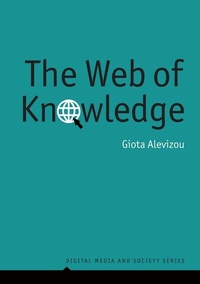
The Web of Knowledge
Description

The encyclopedia has expanded in scope, scale, and popularity in the digital age. Wikipedia in particular serves as a gateway to information and a flashpoint for disputes over authority, expertise, and cultural perspectives. This innovative book, which includes a foreword by the co-founder of Wikipedia, Jimmy Wales, traces the historical roots of digital encyclopedias in the early development of information science and cyberculture. It identifies trends within their digital evolution to reveal a complex web of relationships between media technology, knowledge, and culture. Using several case studies, Alevizou analyses how major technological shifts have impacted the publishing models, governance, and creative labour of reference works; the evolution of the genre and the modalities of representation and access; and the range of uses and symbolic meanings of encyclopedias as diverse nodes within broader information economies, as commodities and as public goods. Filled with rich empirical insights, this engaging text reflects on how encyclopedias serve as informational media today and discusses their continued relevance in public communication and culture. The Web of Knowledge is essential reading for students and scholars of digital media, platform studies, and the political economy of knowledge.
More details
Other editions
Additional editions
Person
Content
Acknowledgement
Foreword by Jimmy Wales
Introduction
Part I: From Scroll to Platform: Genealogies, Media Technologies and Encyclopedic Knowledge
From Roots to Routes: Genealogies and Imaginaries of Encyclopedic Media
Encyclopedic Genres and the Digital Information Economy
Encyclopedic Dynamism and Epistemologies
Part II: Eras, Transitions, and Transformations
From Page to Screen: The Multimedia Era
From Paywalls to Platforms: Encyclopedias in the Digital Knowledge Economy
Editing 'Authority': Wikipedia and Commons Knowledge
Part III: Rationalising Authority: Encyclopedic Epistemologies in the Digital Age
Rewriting Authority: The Changing Value(s) of Encyclopedic Knowledge
Epistemic Qualities and AI Threats
Conclusion: The Politics of Knowing: Reflections on Uncertain Futures
Notes
References
Index
Introduction
In 'As We May Think', his influential 1945 article published in The Atlantic, Vannevar Bush, a cybernetics scientist and administrator for the US Defense Department during World War II, articulated a vision surrounding the relationship between technology, science, and culture which pointed to a digital future when machines could enable not just the recording of all human knowledge, but also the connection between ideas, concepts, and events. To do this, Bush (1945) conceived the design of the Memex, an encyclopedic memory system. This design, to which we will return in chapter 1, never materialized, but it provided the seeds for the creation of interconnected global computer networks, like ARPANET (Advanced Research Projects Agency Network), a nascent version of the internet. In his 1972 article 'As We Will Think', the American information technology pioneer Ted Nelson described a similar invention, positing the digital relationship between knowledge and culture as a future certainty. While Bush was referring to an elite system for closed networks in military and electrical engineering contexts, Nelson's influence came from the countercultural movements of the 1960s calling for more freedom, openness, and conviviality (Nelson, 1991). In the 1990s, Pierre Lévy, a French computer engineer and network theorist, used the possibilities of multimedia technologies and the nascent World Wide Web (WWW) to formulate a thesis on 'collective intelligence' and the utopian vision of 'cosmopedia' - a highly dialogical, global space that could enable the 'representation and dynamic management of knowledge' (Lévy, 1997: 216).1 Indeed, during the 2000s, we witnessed - to an extent - the promise of an open, public, and convivial media era, with thousands of user-generated content, citizen journalism, and science sites showcasing strong intersections between social computing and culture, creativity and knowledge.
A clear emerging example from this era has been Wikipedia, the largest ever collaboratively produced, free, and global encyclopedia project. An encyclopedia, historically associated with print technologies, is a systematically organized repository of knowledge that embodies the Enlightenment ideal of reason, universal access to information, and the pursuit of intellectual progress through classification, authentication, and the democratization of learning. While the wiki- has become a globally recognizable epithet for co-creation, open access and retrieval of information and collective archiving in the public pursuit of knowledge (Alevizou, 2015b), Wikipedia has surpassed its legacy ancestors (e.g., Britannica) and remains one of the few bastions to defend the open web. Indeed, as it has consistently been among the top 10 most popular platforms on the internet and repeatedly the first in the category of encyclopedias online,2 it retains its status as an encyclopedia and as one of the alternative commons media platforms. In the meantime, and as we immerse ourselves in the platform society (van Dijck, Poell, and de Waal, 2018), several digital transformations have imposed new conditions of ownership, openness, and enclosure, thereby establishing new orders of control for valuing the data we all produce and use as we assemble information, access knowledge, and learn about ourselves, each other, and the world.
As research for this book drew to a conclusion, the latest technological advancements in natural language processing (NLP) took the world by storm, popularizing ideas of semantic networks developed more than half a century ago. 'Writing machines', like ChatGPT (GPT = generative pre-trained transformer), Gemini, Copilot, and DeepSeek, crawl widely available archives of content and datasets, training generative large language models (LLMs) to automatically orchestrate prompts and questions into meaningful 'facts' (Iliadis, 2023). Such machines are beginning to reduce traffic to online encyclopedias and have forced us to rethink how we order our relationship with automation, AI and collective intelligence, symbolic, synthetic, and logical approaches to knowledge representation, and the calculation of meaning.
So how might digital encyclopedias shed light on these changes? More importantly, can the digital transformation trajectories of encyclopedias since the 1990s tell us something about such new orders of knowledge mediation? This book sets out to explore the orders of knowledge production and mediation through the lens of the encyclopedia. It does so by elaborating on the relationship between knowledge and technology, encyclopedias and social culture. I argue that this relationship traces not only how mediation technologies change the form and purpose of encyclopedias but also what this digital transformation reveals about the role/centrality of encyclopedias in evolving media and platform ecosystems; and in consequence what this reveals about the changing relationship between humans and machines, media and knowledge, and collective and automated intelligence. This argument integrates an approach to history, or, rather, genealogy, with cues to media archaeology (operationalized by aspects of technological materiality and the sociology of genre), platform studies, and epistemology to provide a strong foundation for discussing digital encyclopedias in contemporary knowledge systems.
The book demonstrates how the encyclopedia and its longer history as an informational and educational genre reveal a strong relationship between assumptions about the value of knowledge in relation to (digital) media ecologies; and also how the encyclopedia as an 'interfacial' metaphor, orientational medium, and source of tertiary information is the exemplary case of the advancement of integral, and often troubled, relationships between mediation technologies and mediation histories, between authority values and the value of learning - all of which have been shaping the materiality and culture of digitalization. What is the genealogy of such a relationship, which we now take for granted, and why does it matter? After providing some definitions, this is one of the questions I address in the next section.
Definitions and genealogies
I have already offered a brief definition of what an encyclopedia is, which I will now elaborate further considering the layers of the argument that is at the core of this book. A general encyclopedia is a medium which systematically and subjectively assembles, orders, and mediates knowledge of a known or knowable world into specific cultural, informational, or pedagogical contexts. Embedded in this notion is a conception of an encyclopedia as a tertiary or reference resource: it provides an overview or synthesis of information gained from primary and secondary sources (but does not necessarily offer original interpretations or analysis). As a genre, the encyclopedia emerged from Enlightenment visions of rationality and intellectual authority. As a symbolic commodity, it was, throughout the era of print, with the distribution of 'useful learning' (McArthur, 1986), a package for convenient reference or conspicuous intellectual capital. In early cybernetics and information science, as I mentioned in the opening paragraph, the 'encyclopedic' was used as a familiar metaphor to refer to the augmentation of human memory and cognitive associations that would empower the retrieval and processing of information and the collective production of knowledge (Wells, 1938; Rayward, 1997; Dennett, 1998).
Certainly, the digital age has given rise to a multitude of media forms and platforms for representing each other, the world, and ourselves. Social media contributes to the production of vast accumulations of data and information - and mis/disinformation - about this world and the social relations that define it. As the parameters of what counts as knowledge have been ever-changing over the last 20 or so years, so too have the conventions of trust and credibility, the perceptions of distrust and bias, expertise and professionalism. Such shifting conventions are manifested in the recent evolution trajectories of digital encyclopedias and have conditioned the uptake, popularity, or decline of certain forms and brands over others.
Some digital media theorists have pointed to the reciprocal relationship of encyclopedias and the web (Manovich, 2001; Bolter and Grusin, 2003; Burke, 2012; Haider and Sundin, 2014) long before its incarnation as Web 2.0, SmartOS (OS = operating system), and algorithmic extrapolations. Certainly, part of the popularity of collaborative encyclopedias such as Wikipedia may indeed be connected to the prominence of the database as a dominant form of cultural signification in digital media. Likewise, it might also be connected to the dominance of the 'search engine' (Halavais, 2018). Search engines, just like streaming services when compared with traditional TV channels, do seem to offer substitutes for encyclopedias as intermediaries or infomediaries of knowledge scattered throughout the internet, linking users to information on particular topics and terms. Infomediaries assume commercial logic (information about products and services and the companies that supply them), promising advertising revenue for search engines or enhanced and sustained customer loyalty for those who pay to have their sites ranked high. In the late 1990s and early 2000s, online versions of legacy and commercial encyclopedias like...
