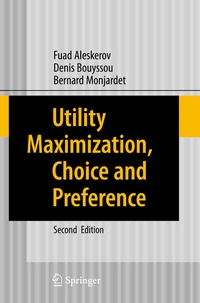
Utility Maximization, Choice and Preference
Description

The utility maximization paradigm forms the basis of many economic, psychological, cognitive and behavioral models. Since it was first devised in the eighteenth century, numerous examples have revealed the deficiencies of the concept. This book makes a contribution to overcome those deficiencies by taking into account insensitivity of measurement threshold and context of choice. It covers classic theory as a special, context-free case and gives a systematic overview of new models of utility maximization within a context-dependent threshold as well as related preference and choice models. The second edition has been updated to include the most recent developments and a new chapter on classic and new results for infinite sets. The presented models will be helpful to scientists in economics, decision making theory, social choice theory, behavioral and cognitive sciences, and related fields.
Reviews / Votes
From the reviews of the second edition:
"The book provides an excellent account of many aspects of the theory of preference, utility, and choice, in particular in the finite case. It provides valuable information for researchers as well as a sound basis for a graduate course . ." (Douglas S. Bridges, Siam Review, Vol. 50 (3), 2008)
More details
Other editions
Additional editions