

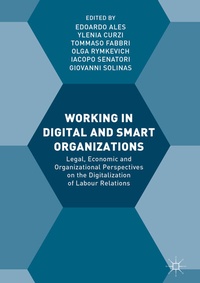
Working in Digital and Smart Organizations
Description

Contributing to recent debate on the emergence of digital and agile work, this book explores the implications for labour and employment relations within and beyond organizational boundaries. Taking a multidisciplinary approach to the key issues and challenges of digitalization, this collection covers topics such as the gig economy, crowdworking and Industry 4.0. Theory and analysis are combined as the authors examine the impact of digital and smart work on organization, HRM and labour law. With comprehensive empirical evidence for those interested in understanding the more complex trajectories of today's transforming work relationships, this book will not only appeal to students and academics but also to policy-makers, trade unionists and employers' organizations.
More details
Other editions
Additional editions
Persons
Edoardo Ales is Full Professor of European, Comparative and Italian Labour and Social Security Law. He teaches at both the University of Cassino and Southern Lazio, and LUISS Guido Carli in Italy, as well as Vienna University of Economics and Business in Austria.
Ylenia Curzi is Assistant Professor of Organization and HRM at the University of Modena and Reggio Emilia, Italy. She previously studied at the University of Udine, Italy, and was a Visiting Scholar at Cardiff Business School, UK, in 2009.
Tommaso Fabbri is Associate Professor of Organization and HRM, Director of the Ph.D Programme in Labour, Development and Innovation, and a member of the Softech-ICT Research Center at the University of Modena and Reggio Emilia, Italy.
Olga Rymkevich
is a Senior Researcher at the Marco Biagi Foundation, University of Modena and Reggio Emilia, Italy. She previously studied labour law at Saint Petersburg State University.
Iacopo Senatori is a Senior Researcher of Labour Law at the Marco Biagi Foundation, University of Modena and Reggio Emilia, Italy. He previously studied at the University of Bologna and is a Member of the Italian Society of Labour Law and Social Security.
Giovanni Solinas
is Full Professor of Economics at the University of Modena and Reggio Emilia, Italy. He previously studied at the University of Cambridge, UK.
Content
1. Introduction; Olga Rymkevich, Iacopo Senatori.- Part I. The Challenges of Digitalization for Employment Relations.- 2. Protecting Work in the Digital Transformation: Rethinking the Typological Approach in the Intrinsically Triangular Relationship Perspective; Edoardo Ales.- 3. Digital Work: An Organizational Perspective; Tommaso Fabbri.- 4. Connecting Machines, (Re)connecting Workers: An Economic Perspective on Digitalization of Employment Relations; Giovanni Solinas, Sergio Paba.- Part II. Work in the Gig Economy.- 5. A Fair Wage for Workers On-Demand via App; Emanuele Menegatti.- 6. Assessment by Feedback in the On-Demand Era; Alessandra Ingrao.7. The Classification of Crowdwork and Work by Platforms: Alternatives and Implications; Gionata Cavallini.- Part III. Industrial Relations Strategies in Industry 4.0.- 8. Or ganizing and Collective Bargaining in the Digitized "Tertiary Factories" of Amazon: A Comparison BetweenGermany and Italy; Bruno Cattero, Marta D'Onofrio.- 9. Evolution of Trade Unions in Industry 4.0: A German and Italian Debate; Matteo Avogaro.- Part IV. The Impact of Digitalization on Work Performance.- 10. DigitAgile: The Office in a Mobile Device. Threats and Opportunities for Workers and Companies; Roberto Albano, Sonia Bertolini, Tania Parisi, Ylenia Curzi, Tommaso Fabbri.- 11. "Always-On" - The Collapse of the Work-life-separation: Recent Developments, Deficits and Counter-strategies; Ruediger Krause.- 12. Into Smart Work Practices: Challenges for HR Departments; Daria Sarti, Teresina Torre.- 13. Conclusion; Edoardo Ales, Ylenia Curzi.
