

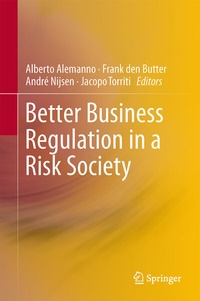
Better Business Regulation in a Risk Society
1st Edition
Published on 14. September 2012
VIII, 328 pages
978-1-4614-4406-0 (ISBN)
Description

The premise of this volume is that business regulations are expected to grow in the near future as a consequence of the emergence of a "(world) risk society." Risks related to terrorism, climate change, and financial crises, for example, will penetrate all conditions of life. Increasingly, the decisions and actions of some bring about risks for many in this era of globalization. Controlling these risks implies managing the world through high-quality regulation, with a particular emphasis on businesses and financial institutions. Central to this approach is the argument that a major, if not the primary, aim of regulation is to internalize externalities, or in a broader context, to repair market failure. Such repair can only be accomplished when the costs are smaller than the welfare gains.
Featuring contributions from researchers and policy analysts from the fields of economics, management, law, sociology, political science, and environmental policy, this book focuses on three major topics:
Social risks and business regulation
Preconditions for better business regulation
Theoretical issues related to better business regulation
Collectively, the authors demonstrate that the easier it is for regulated businesses to comply at the lowest costs possible-without jeopardizing the related public goals-the greater the degree of compliance. When successful, the net result is a balance of individual and collective net benefits, and by further implication, sustainable business practice and economic growth.
More details
Series
Language
English
Place of publication
New York
United States
Publishing group
Springer US
Target group
Professional and scholarly
Product notice
Reflowable
Illustrations
VIII, 328 p.
File size
3,57 MB
ISBN-13
978-1-4614-4406-0 (9781461444060)
DOI
10.1007/978-1-4614-4406-0
Schweitzer Classification
Other editions
Additional editions
Alberto Alemanno | Frank den Butter | André Nijsen
Better Business Regulation in a Risk Society
Book
09/2012
1st Edition
Springer
€106.99
Shipment within 15-20 days
Content
- Intro
- Better Business Regulationin a Risk Society
- Contents
- Contributors
- Chapter 1: Introduction
- 1.1 Perspectives on How to Regulate in the Risk Society
- 1.2 Risks and Externalities
- 1.3 Role of Government in a Risk Society
- 1.4 Purpose of the Book
- 1.5 Overview of the Book
- 1.6 Contents
- 1.6.1 Part I: Social Risks and Business Regulation
- 1.6.2 Part II: Preconditions for Better Business Regulation and International Coordination
- 1.6.3 Part III: Theoretical and Measurement Issues Related to Better Business Regulation
- References
- Part I: Social Risks and Business Regulation
- Chapter 2: Risk Governance: Concept and Application to Institutional Risk Management*
- 2.1 Introduction
- 2.2 Three Characteristics of Risk Knowledge
- 2.2.1 Complexity
- 2.2.2 Scienti c Uncertainty
- 2.2.3 Sociopolitical Ambiguity
- 2.3 The Risk Governance Framework
- 2.3.1 Purpose of Framework
- 2.3.2 The Pre-assessment Phase
- 2.3.3 Risk Appraisal Phase
- 2.3.4 Characterizing and Evaluating Risks
- 2.3.5 Risk Management
- 2.3.6 Risk Communication
- 2.4 Application to Institutional Risk Management
- 2.4.1 European Food Safety Authority
- 2.4.2 Health Council of the Netherlands
- 2.4.2.1 Other Applications
- 2.5 Conclusions
- References
- Chapter 3: Regulating the European Risk Society
- 3.1 The Challenge of Regulating a "Risk Society"
- 3.2 The Genesis of EU Risk Regulation
- 3.3 Risk Analysis as the Grundnorm of the EU Risk Regulation Model
- 3.4 Risk Assessment
- 3.5 Risk Management
- 3.5.1 The Results of Risk Assessment
- 3.5.2 Other Legitimate Factors
- 3.5.3 Regulatory Impact Assessment
- 3.5.4 Precautionary Principle
- 3.5.5 The Proportionality Principle
- 3.5.6 WTO Risk Principles
- 3.6 Risk Communication
- 3.7 Conclusion
- References
- Chapter 4: The Prospects for Global Climate Change Reform After Copenhagen
- 4.1 Introduction
- 4.2 The Problem of Climate Change
- 4.3 The United Nations Framework Convention on Climate Change
- 4.3.1 Introduction
- 4.3.2 Principles
- 4.3.3 General Commitments
- 4.3.4 Speci c Commitments for Annex I and Annex II Parties
- 4.3.5 Conference of the Parties
- 4.4 The Kyoto Protocol
- 4.4.1 Overview
- 4.4.2 Reduction Targets
- 4.4.3 Emissions Trading
- 4.4.4 Joint Implementation
- 4.4.5 Clean Development Mechanism
- 4.4.6 Evaluating Kyoto
- 4.5 Post-Kyoto Agreements and Negotiations
- 4.5.1 The Road to Copenhagen
- 4.5.2 The Copenhagen Accord
- 4.5.3 Cancun Agreements
- 4.6 Global Climate Change Reform and Businesses
- 4.7 Concluding Remarks
- References
- Chapter 5: Eight Commandments for Securing Competitive Food Supply Chains in the European Union
- 5.1 Introduction and Objective
- 5.2 Eight Options to Improve the Regulatory Environment
- 5.2.1 Further Reduce Regulatory Burdens 15
- 5.2.2 Improve the Information on Food Law and Hygiene System Requirements
- 5.2.3 Integrate the Regulatory "System" of Labelling Requirements
- 5.2.4 Protect the Rights of All Stakeholders
- 5.2.5 Restore the Power Balance Between Consumer and Producer
- 5.2.6 Improve Transparency of Value Added Creation
- 5.2.7 Streamline Pre-market Approval
- 5.2.8 Abolish Zero Tolerances
- 5.2.9 Conclusion and Final Remarks
- References
- Chapter 6: The Costs of State Intervention in the Financial Sector
- 6.1 Introduction
- 6.2 The Rationale for Regulation in General
- 6.3 Functions, Value and Vulnerabilities of Banks
- 6.3.1 The Essential Functions of Banks
- 6.3.2 The Added Value of Banks
- 6.3.3 The Risky Nature of Banking
- 6.4 The Case for Banking Supervision
- 6.4.1 General
- 6.4.2 The Lender of Last Resort
- 6.4.3 Supervising Banks
- 6.5 The Costs of Financial Regulation and Supervision
- 6.5.1 The Regulatory Laffer Curve
- 6.5.2 Financial Regulation and Supervision Cost Components
- 6.6 Selected Case Studies
- 6.6.1 Deposit Guarantee Schemes
- 6.6.2 The Dutch DGS: An Illustration
- 6.6.3 The Economic Impact of the Basel-III Capital Requirements
- 6.6.4 Liquidity Requirements, Securitizations and Mortgage Rates
- 6.7 Regulatory Lessons from the Crisis
- 6.7.1 Regulatory Costs Matter and Should Be Compared with Bene ts
- 6.7.2 The Regulatory Laffer Curve Is Unlikely to Remain Static
- 6.8 Conclusions
- References
- Part II: Preconditions for Better Business Regulation and International Coordination
- Chapter 7: The Perspective of Public Sector Economics on Regulation: Transaction Costs and the Agency Model*
- 7.1 Introduction
- 7.1.1 General
- 7.1.2 The Problem
- 7.2 The Transaction Costs Perspective and the Principal/Agent Model
- 7.2.1 General
- 7.2.2 Transaction Cost Economics
- 7.2.3 The Principal/Agent Perspective on Transaction Costs
- 7.2.3.1 General
- 7.2.3.2 Re ection on the Concept of Principle/Agent Costs as Transaction Costs
- 7.2.3.3 Categorization of Transaction Costs of Government Regulation
- 7.2.3.4 Calculating the Administrative Burden
- 7.2.3.5 Case Study on a Speci c Type of Financial Compliance Costs
- 7.3 The Cost/Bene t Perspective on Government Regulation
- 7.3.1 General
- 7.3.2 Bene ts of Government Regulation for Businesses
- 7.3.3 Bene ts of Government Regulation for Society
- 7.3.4 What Can the Government Do to Come to "Optimal" Regulation?
- 7.4 Conclusion
- References
- Chapter 8: Against the Tide? On the Development of Regulative Costs Over Time in Times of Crisis and Its Possible Impact on Economic Development
- 8.1 Introduction
- 8.2 Situation Around 2005
- 8.3 Development of Regulation Levels, 1998-2010
- 8.4 Does the Level of Regulation In uence the Pace of Economic Development?
- 8.5 Hit by the Financial-Economic Crisis: Is the Level of Regulation Important for the Rate of Resilience of Countries?
- 8.6 Conclusions
- Bibliography
- Websites
- Chapter 9: Internal Pressures-External Safeguards: A Systemic Approach for Burden Reduction in the Netherlands
- 9.1 Introduction
- 9.2 Culture: Attitude, Behaviour and Knowledge
- 9.3 Structure: Covenants
- 9.4 Synthesis and Conclusion
- 9.5 Policy Implications
- References
- Chapter 10: Trust, the Pharmaceutical Industry and Regulators in the UK
- 10.1 Introduction
- 10.2 The Three General Functions of Institutional Trust
- 10.2.1 The Social Function: Trust as a Function of Modernity
- 10.2.2 The Economic Function: Trust as the Lubricant to Economic Exchange
- 10.2.3 The Political Function: Trust as Governance
- 10.3 The Role of the Media
- 10.3.1 Industry and Its Regulators: Their Relationship
- 10.4 Applied Functions of Trust
- 10.4.1 Supervisory
- 10.4.1.1 Trust as Guarantee of Professionalism Between Scienti c Peers
- 10.4.1.2 Trust Creates the Onus of Acting Ethically on the Industry in the Areas Beyond the Scope of the Current Regulations
- 10.4.2 Ef ciency
- 10.4.3 Enabling
- 10.4.4 In uence
- 10.4.5 Cultural/Organisational
- 10.5 The Problems Endemic in Attempting to Operationalise Trust
- 10.5.1 Power Struggle Over Scope and Value of Regulation
- 10.5.2 Resistance to Trust as a Soft Control Mechanism
- 10.5.2.1 Trust-Building Only Implemented in a Ceremonial Sense
- 10.5.2.2 Industry Is Institutionalised in Respect to Perpetuating Past Mistakes and Modes of Operating
- 10.6 Conclusion
- References
- Chapter 11: From Better to Best Regulation: Towards Competitiveness by Cross-Border Consistency
- 11.1 Introduction
- 11.2 Effects of Inconsistent Cross-border Regulation, Enforcement and Oversight in European Economy
- 11.2.1 What is the Problem with Cross-border Barriers?
- 11.2.2 Waste Handling and Transportation
- 11.2.3 Accounting
- 11.2.4 Health
- 11.2.5 What is the Effect of the Cross-border Barriers in Europe?
- 11.3 The Role of "Better Regulation" in Removing Cross-border Barriers in Europe
- 11.3.1 First Steps: "Mandelkern"
- 11.3.2 Successive Initiatives
- 11.3.3 How to Move Towards Cross-border Consistency?
- 11.4 Europe as a Union of "Conferred Powers" Based on Classical Principles of Legislation: Does a New Principle Fit in?
- 11.5 Comparing Cross-border Consistency in the US
- 11.6 Cross-border Consistency in Japan
- 11.7 Conclusions
- References
- Chapter 12: World Trade Organization and the Global Risks
- 12.1 Introduction
- 12.2 Risks in Global Economy
- 12.3 World Trade Organization Legislation and Risks in Global Business
- 12.3.1 GATT Legacy and WTO Principles
- 12.3.2 WTO and Regulation of Tariffs
- 12.3.3 New Areas of WTO Risk Regulation
- 12.4 Non-tariff Barriers and New Risks in Global Trade
- 12.5 Conclusions
- References
- Part III: Theoretical and Measurement Issues Related to Better Business Regulation
- Chapter 13: Regulatory Policy at the Crossroads: Mapping an OECD Agenda for the Futures
- 13.1 Introduction
- 13.1.1 Triggering Factors Shaping Regulatory Reform
- 13.1.1.1 Evolving Policy Paradigms
- 13.1.1.2 Reconsidering Public Governance
- 13.1.1.3 Risk and Regulation
- 13.1.2 From Maturity to Re-shaping? Regulatory Policy at the Crossroads
- 13.1.2.1 The Emergence of Regulatory Management
- 13.1.2.2 The Impact of the Crisis
- 13.2 The Contribution of the OECD to Date
- 13.2.1 Developing Principles
- 13.2.2 Areas of Activity
- 13.2.2.1 Country Reviews and Indicators of Regulatory Management System
- 13.2.2.2 Thematic Work
- Regulatory Impact Assessment
- Risk and Regulatory Policy
- Cutting Red Tape: Simplifying Administrative Burdens
- Institutional Aspects, Regulatory Oversight and Sectoral Regulators
- Multi-level Governance
- Global Relations
- 13.2.2.3 Achievements and Dif culties/Hurdles
- 13.2.3 The 2010 OECD Regulatory Policy Conference
- 13.3 Pathways to the Future
- 13.3.1 Ensuring Effective Governance
- 13.3.2 The Need for Open Government
- 13.3.3 International Regulatory Cooperation and Risk Management
- 13.3.4 Evidence-Based Approaches to Support Proportionate Decisions
- 13.3.4.1 Towards a Proportionate, Balanced RIA
- 13.3.4.2 Closing the Policy Cycle: Ex post Evaluation of Regulation
- 13.4 Conclusions
- References
- Chapter 14: SCM 2.0: An Argument for a Tailored Implementation
- 14.1 Introduction
- 14.2 What's at Stake?
- 14.2.1 The Relevance of Business Regulation
- 14.2.2 Lessons Learnt with 10 Years of Implementation of the SCM
- 14.2.3 From Simple to Complex, Comprehensive RIA Techniques
- 14.2.4 From Deregulation to Better Regulation
- 14.3 Lessons Learnt from 10 Years SCM
- 14.3.1 Introduction
- 14.3.2 Methodology
- 14.3.2.1 Introduction
- 14.3.2.2 The Objective of AB Measurements
- 14.3.2.3 IO Is Measurement Unit
- 14.3.2.4 Validity, Reliability and Representativeness
- 14.3.2.5 Pro le of Standard AAs per IO
- 14.3.2.6 Business as Usual Costs and Functionality of Legal Obligations
- 14.3.3 Lack of Success of AB Reduction Programmes
- 14.3.4 Narrow Scope of the SCM
- 14.4 Where Does the SCM Stand?
- 14.4.1 SCM and RIA
- 14.4.2 SCM and Mainstream of Theories on Public Policymaking
- Old Maids and Clover Crop
- Sec22_14
- 14.5 SCM 2.0 in a Risk Society: Towards Controlled Rationality
- 14.6 Summary and Conclusion
- References
- Chapter 15: A Tax Regulatory Laffer Curve
- 15.1 Introduction
- 15.2 A Theoretical Model for the Causality Between Tax Regulatory Costs and Tax Compliance
- 15.3 Literature Overview on Tax Regulatory Costs
- 15.3.1 General Background
- 15.3.2 Economic De nitions Concerning Tax Regulatory Costs
- 15.3.2.1 Literature on Compliance Costs and/or Administrative Costs of Taxation
- 15.3.3 Literature on Optimal Tax Theory
- 15.4 Concluding Remarks: Re ections on the Regulatory Laffer Curve
- 15.4.1 General
- 15.4.2 Integration of All Regulatory Costs into the Laffer Curve Is Necessary
- 15.4.3 Tax Simplicity and Tax Complexity as a Combining Factor
- References
- Chapter 16: Sunset Legislation: Theoretical Re ections and International Experiences
- 16.1 Introduction
- 16.2 Theoretical Re ections on Sunset Legislation
- 16.2.1 What Is Sunset Legislation?
- 16.2.2 Obstacles to Policy Termination
- 16.2.3 Evaluation
- 16.3 Empirical Evidence from Three Countries
- 16.3.1 United States
- 16.3.2 Australia
- 16.3.2.1 The Federal State of Victoria
- 16.3.2.2 The Commonwealth Level
- 16.3.3 Germany
- 16.3.3.1 The State Level
- 16.3.3.2 Federal Level
- 16.4 The Relevance of Sunset Regulations for Better Regulation and Risk-Based Decision-Making
- 16.5 Summary and Conclusion
- References
- Part IV: Concluding Part
- Chapter 17: Conclusions
- 17.1 The Current World Risk Society
- 17.1.1 The "Why" of Business Risk Regulation
- 17.1.2 The "What" of Business Risk Regulation
- 17.2 The Features of Global Risk Regulation
- 17.3 Complexity and Contagion
- 17.4 Learning from Multiple World Risk Stories
- 17.5 Policy Relevance, Limits and Directions for Further Research
- References
- Appendix A Annex I: Keywords
- Appendix B Annex II: Biographs
- Bio's Editors: Better Business Regulation in a Risk Society
- Bio's Authors
