

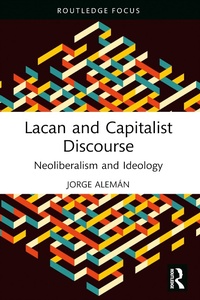
Lacan and Capitalist Discourse
Neoliberalism and Ideology
1st Edition
Published on 4. August 2023
94 pages
978-1-000-96642-8 (ISBN)
Description

Lacan and Capitalist Discourse explores the political and theoretical connections between the Covid-19 Pandemic and Capitalism, unravelling the direct consequences of Lacan's thesis of so-called "Capitalist Discourse".
Jorge Aleman provides an account of neoliberalism, its mechanisms to produce subjectivities and the new modes of the political far Right. The book begins with the problem of a possible exit from capitalism, continuing to consider the possibilities of mourning and the active production of a new Left. Aleman engages deeply with a range of thinkers: primarily Lacan, but also Heidegger, Marx, Laclau, Foucault, Butler, Badiou, Althusser, and others, in making his case.
Lacan and Capitalist Discourse will be of great interest to psychoanalysts and to academics of psychoanalytic and Lacanian studies, cultural theory, philosophy and political thought.
Jorge Aleman provides an account of neoliberalism, its mechanisms to produce subjectivities and the new modes of the political far Right. The book begins with the problem of a possible exit from capitalism, continuing to consider the possibilities of mourning and the active production of a new Left. Aleman engages deeply with a range of thinkers: primarily Lacan, but also Heidegger, Marx, Laclau, Foucault, Butler, Badiou, Althusser, and others, in making his case.
Lacan and Capitalist Discourse will be of great interest to psychoanalysts and to academics of psychoanalytic and Lacanian studies, cultural theory, philosophy and political thought.
Reviews / Votes
"Jorge Aleman brings together the best of psychoanalytic theory and the best of socio-economic analysis, and the mixture is explosive. He makes it clear that, in today's capitalism, ideology is not a "superstructure" elevated above economy but an integral part of economic reproduction itself. His clearly written book should be an obligatory reading for all of us who want to orient ourselves in the mess we are in today. It's as simple as that." - Slavoj Zizek, Professor, European Graduate School; International Director, Birkbeck Institute for the Humanities, Birkbeck College, University of London; senior researcher, Institute of Sociology, University of Ljubljana, Slovenia"Jorge Aleman is the most original proponent of what in Argentina today we might call the school of Lacano-Althusserianism to supplement and bring up to date the older paradigm of Freudo-Marxism. In this eminently readable book, he puts notions of fantasy, ideology, and subjectivity to the test of our time to locate the prospects for a renewal of the emancipatory Left." - Bruno Bosteels, Professor and Chair, Department of Latin American and Iberian Cultures and Professor, Institute for Comparative Literature and Society, Columbia University
"In Santiago de Chile, during Sebastian Pinera's presidency, a taxi driver of Mapuche descent pointed to La Moneda and pridefully affirmed to me: "I'm an entrepreneur just like him!" In this book, Aleman, the most brilliant and influential Spanish-speaking Lacanian Left thinker, convincingly analyzes such a world-encompassing neoliberal production of "subjectivity" in the light of Lacan's concept of "capitalist discourse" and intensely invites us to invent new emancipatory projects by thinking from the psychoanalytic ontology of the absolute difference structurally constitutive to any "subject," that is, to each and every one of the speaking, sexuated and mortal beings." - Jun Fujita Hirose, author, ?Como imponer un limite absoluto al capitalismo? Filosofia politica de Deleuze y Guattari (How to Put an Absolute Limit to Capitalism? The Political Philosophy of Deleuze and Guattari)
More details
Series
Edition
1. Auflage
Language
English
Place of publication
London
United Kingdom
Publishing group
Taylor & Francis Ltd
Target group
College/higher education
Professional and scholarly
Illustrations
14 Line drawings, black and white; 14 Illustrations, black and white
ISBN-13
978-1-000-96642-8 (9781000966428)
Copyright in bibliographic data and cover images is held by Nielsen Book Services Limited or by the publishers or by their respective licensors: all rights reserved.
Schweitzer Classification
Other editions
Additional editions
Book
01/2025
1st Edition
Routledge
€30.70
Shipment within 10-20 days
Book
08/2023
1st Edition
Routledge
€76.70
Shipment within 10-20 days
Persons
Jorge Aleman is Doctor Honoris Causa of the Universidad Nacional de Rosario, Honorary Professor at the Universidad Nacional de Buenos Aires, the Universidad Nacional de San Martin, and the Universidad Nacional de Villa Maria Cordoba. He has published numerous essays on psychoanalysis, philosophy, and political thought.
Daniel Runnels is Assistant Professor of Spanish at the University of Central Missouri.
Daniel Runnels is Assistant Professor of Spanish at the University of Central Missouri.
Content
Acknowledgements
Series Preface by Ian Parker
Introduction
Chapter 1 Pandemic and Capitalism
Chapter 2 No-politics
Chapter 3 The Uncanny
Chapter 4 Evil
Chapter 5 Fantasy: Ideology
Chapter 6 Exploitation: Oppression
Chapter 7 Antagonism: Conflict
Chapter 8 Promoting Hate
Chapter 9 Popular Responsibility
Chapter 10 Blueprints of the Inappropriable
Chapter 11 Community, Society, State
Chapter 12 Retroactivity: Continuity and Discontinuity
Chapter 13 New Challenges
Chapter 14 Note
Series Preface by Ian Parker
Introduction
Chapter 1 Pandemic and Capitalism
Chapter 2 No-politics
Chapter 3 The Uncanny
Chapter 4 Evil
Chapter 5 Fantasy: Ideology
Chapter 6 Exploitation: Oppression
Chapter 7 Antagonism: Conflict
Chapter 8 Promoting Hate
Chapter 9 Popular Responsibility
Chapter 10 Blueprints of the Inappropriable
Chapter 11 Community, Society, State
Chapter 12 Retroactivity: Continuity and Discontinuity
Chapter 13 New Challenges
Chapter 14 Note
