

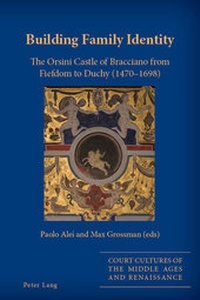
Building Family Identity
Description

The Orsini of Bracciano were among the most powerful and influential signori di castelli of early modern Italy, controlling a vast domain that stretched from the Tyrrehenian Sea to the mountains of Abruzzo. This book explores the construction and decoration of their principal headquarters north of Rome between the fifteenth and seventeenth centuries as well as the careers and artistic patronage of its leaders, who included captains, condottieri, cardinals and urban aristocrats. The castle is one of the largest in Latium and was once a centre of courtly culture and diplomacy, hosting princes, kings and popes. Today it boasts many beautifully preserved artworks of the Renaissance era, including frescos by Antoniazzo Romano and the Zuccari brothers.
The contributors to this study investigate the castle as a visual expression of the family identity of its builders. They trace its evolution from the fortified capital of a large fiefdom at the dawn of the age of artillery to the palatial residence of a ducal dynasty in the aftermath of the Italian Wars. Richly illustrated with numerous historic and new photographs, this book analyses a fascinating and mostly neglected facet of early modern Italian culture: the artistic patronage of seigniorial clans.
More details
Other editions
Additional editions
Persons
Paolo Alei received his DPhil from Oxford University and is now Adjunct Professor of Art History at the University of California, Rome. His research focuses on the relationship between art, architecture and rhetoric from the Quattrocento to the Seicento. He has published on Raphael and Titian and is currently writing on Caravaggio and energeia. He lives in the town of Calcata, in the heart of Tuscia, one of the many possessions of the Orsini family.
Max Grossman is a specialist in medieval and Renaissance architecture and urbanism in Italy and the architecture of the American Southwest. He conducted research in Tuscany for many years before receiving his PhD from Columbia University. He is Assistant Professor of Art History at the University of Texas at El Paso and Director of its study abroad program in Rome. He is currently writing books on the civic architecture of the Sienese Republic and the architecture of the Texas Borderlands region.
