

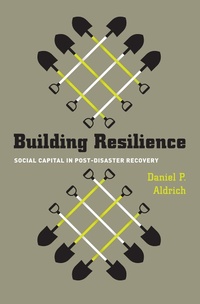
Building Resilience
Social Capital in Post-Disaster Recovery
Published on 4. March 2020
244 pages
978-0-226-01289-6 (ISBN)
Description

The factor that makes some communities rebound quickly from disasters while others fall apart: "A fascinating book on an important topic."-E.L. Hirsch, in
Choice
Each year, natural disasters threaten the strength and stability of communities worldwide. Yet responses to the challenges of recovery vary greatly and in ways that aren't explained by the magnitude of the catastrophe or the amount of aid provided by national governments or the international community. The difference between resilience and disrepair, as Daniel P. Aldrich shows, lies in the depth of communities' social capital.
Building Resiliencehighlights the critical role of social capital in the ability of a community to withstand disaster and rebuild both the infrastructure and the ties that are at the foundation of any community. Aldrich examines the post-disaster responses of four distinct communities-Tokyo following the 1923 earthquake, Kobe after the 1995 earthquake, Tamil Nadu after the 2004 Indian Ocean Tsunami, and New Orleans post-Katrina-and finds that those with robust social networks were better able to coordinate recovery. In addition to quickly disseminating information and financial and physical assistance, communities with an abundance of social capital were able to minimize the migration of people and valuable resources out of the area.
With governments increasingly overstretched and natural disasters likely to increase in frequency and intensity, a thorough understanding of what contributes to efficient reconstruction is more important than ever. Building Resilienceunderscores a critical component of an effective response.
Each year, natural disasters threaten the strength and stability of communities worldwide. Yet responses to the challenges of recovery vary greatly and in ways that aren't explained by the magnitude of the catastrophe or the amount of aid provided by national governments or the international community. The difference between resilience and disrepair, as Daniel P. Aldrich shows, lies in the depth of communities' social capital.
Building Resiliencehighlights the critical role of social capital in the ability of a community to withstand disaster and rebuild both the infrastructure and the ties that are at the foundation of any community. Aldrich examines the post-disaster responses of four distinct communities-Tokyo following the 1923 earthquake, Kobe after the 1995 earthquake, Tamil Nadu after the 2004 Indian Ocean Tsunami, and New Orleans post-Katrina-and finds that those with robust social networks were better able to coordinate recovery. In addition to quickly disseminating information and financial and physical assistance, communities with an abundance of social capital were able to minimize the migration of people and valuable resources out of the area.
With governments increasingly overstretched and natural disasters likely to increase in frequency and intensity, a thorough understanding of what contributes to efficient reconstruction is more important than ever. Building Resilienceunderscores a critical component of an effective response.
More details
Other editions
Additional editions
Book
08/2012
University of Chicago Press
€104.16
Article exhausted; check different version
Daniel Aldrich
Building Resilience - Social Capital in Post-Disaster Recovery
Social Capital in Post-Disaster Recovery
Book
08/2012
University of Chicago Press
€37.50
Shipment within 10-20 days
Content
- COVER
- TITLE PAGE
- COPYRIGHT ©
- CONTENTS
- PREFACE
- 1. SOCIAL CAPITAL: ITS ROLE IN POST-DISASTER RECOVERY
- 2. SOCIAL CAPITAL: A JANUS-FACED RESOURCE FOR RECOVERY
- 3. TOKYO EARTHQUAKE, 1923
- 4. KOBE EARTHQUALE, 1995
- 5. INDIAN OCEAN TSUNAMI, 2004
- 6. HURRICANE KATRINA, 2005
- 7. BETWEEN STATE AND MARKET: THE WAY FORWARD
- APPENDIX 1: STATISTICAL TABLES
- APPENDIX 2: INTERVIEWEES
- NOTES
- REFERENCES
- INDEX
