

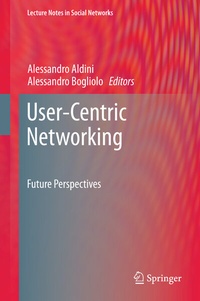
User-Centric Networking
Description

This work represents a milestone for the "ULOOP User-centric Wireless Local Loop" project funded by the EU IST Seventh Framework Programme.
ULOOP is focused on the robust, secure, and autonomic deployment of user-centric wireless networks. Contributions by ULOOP partners as well as invited tutorials by international experts in the field. The expected impact is to increase awareness to user-centric networking in terms, e.g., of business opportunities and quality of experience, and to present adequate technology to sustain the growth of user-friendly wireless architectures.
Throughout the last 3 years, ULOOP has developed enabling technologies for user-centricity in wireless networks, with particular emphasis on social trust management, cooperation incentives, community building, mobility estimation, and resource management.
This work will be of interest to researchers, policymakers, operators, vendors, and end-users interested in the current and future directions of user-centric access networks.
Reviews / Votes
"This compiled book is from a European Union (EU)-funded project, User-Centric Wireless Local Loop (ULOOP), and is an excellent summary of user-centric networks (UCNs). . The book is split into five parts, with each part focusing on the main investigation themes of this project. . this is a good collection of research white papers . on the various emergent research directions for UCNs. It will be good reading for students and practitioners interested in UCNs for future study and research." (Srini Ramaswamy, Computing Reviews, March, 2015)
More details
Other editions
Additional editions
Content
Part I: User-Centric Environments.- User-Centric Networking: Bringing the Home Network to the Core.- User-Centric Networking: Living-Examples and Challenges Ahead.- User-Centric Networking: Routing Aspects.- Part II: Trust Management and Cooperation Incentives.- Trust Management Support for Context-Aware Service Platforms.- Trust Management in ULOOP.- Designing a Trust-Based Virtual Currency System for User-Centric Networks: the ULOOP Case.- Part III: Resource Management in User-Centric Environments.- Cooperative Networking in User-Centric Wireless Networks.- Trust as a Fairness Parameter for Quality of Experience in Wireless Networks.- Cooperative Relaying in User-Centric Wireless Networks.- Resource Allocation in User-Centric Wireless Networks.- Autonomous Resource Allocation and Strategy Optimization in Wireless Networks.- An Autonomous Load Balancing Framework for UCN.- Part IV: Mobility in User-Centric Environments.- Mobility Support in User-Centric Networks.- Mobility Estimation in the Context of Distributed Mobility Management; R. Sofia et al.- Mobility Management in ULOOP.- Part V: Market Perspective.- Market Analysis and Exploitation.- ULOOP Business Case Study.
