

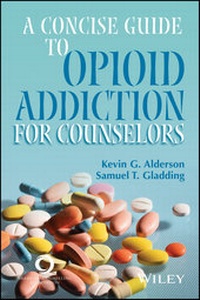
A Concise Guide to Opioid Addiction for Counselors
Description

This brief, evidence-based guide is ideal for busy mental health professionals helping clients with opioid use disorders (OUDs). It examines the devastating global impact caused by opioids and is replete with information and resources that can be immediately applied to addiction work. The authors' pragmatic, strengths-based approach to treatment is based on a collaborative counselor-client working alliance to achieve client readiness for change, moderation, and abstinence. Topics discussed include current research on risk and protective factors, OUD assessment and diagnosis, the ethical and legal issues particular to addiction work, medication-assisted treatment, physical and psychological interventions for pain management, and the necessity of interdisciplinary care.
In addition, Drs. Alderson and Gladding provide a number of counseling approaches and treatment options that consider work with women, youth, people of color, LGBTQ+ individuals, veterans, older adults, people with disabilities, individuals in the criminal justice system, and rural residents. Five useful appendices conclude the book, including a listing of 20 opioid drugs in descending order of potency; common ICD-10, ICD-10-CM, and ICD-11 codes; and a glossary of terms and abbreviations.
*Requests for digital versions from ACA can be found on www.wiley.com
*To request print copies, please visit the ACA https://imis.counseling.org/store/detail
*Reproduction requests for material from books published by ACA should be directed to publications@counseling.org
More details
Persons
Kevin G. Alderson, PhD, is professor emeritus of counseling psychology from the University of Calgary. He is an editorial board member of the Journal of Alcoholism, Drug Abuse & Substance Dependence and the Austin Journal of Drug Abuse and Addiction, as well as the editor of the Canadian Journal of Counselling and Psychotherapy.
Samuel T. Gladding, PhD, is a professor in the Department of Counseling at Wake Forest University and the author of numerous, best selling counseling texts.
Content
Preface vii
Acknowledgments xi
About the Authors xiii
Chapter 1 Introduction to Opioids and the Counseling Approach 1
Chapter 2 Diagnosis and Assessment of Opioid Use Disorders 13
Chapter 3 Ethical and Legal Issues in Addiction Counseling 23
Chapter 4 Addiction Essentials 39
Chapter 5 Comparing Medicinal, Problematic, and Addictive Use of Opioids 51
Chapter 6 Evidence-Based Medications and Physical Interventions 61
Chapter 7 Counseling Opioid-Addicted Individuals 71
Chapter 8 Diversity Considerations 93
Conclusion 105
References 109
Appendix A Twenty Opioid Drugs in Descending Order of Potency 149
Appendix B Common ICD-10, ICD-10-CM, and ICD-11 Codes 155
Appendix C Signs That Someone Is Abusing Opioids 161
Appendix D Glossary of Terms and Abbreviations 165
Appendix E Resources 175
Index 179
