

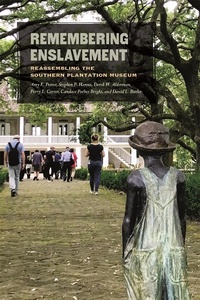
Remembering Enslavement
Description

Remembering Enslavement explores plantation museums as sites for contesting and reforming public interpretations of slavery in the American South. Emerging out of a three-year National Science Foundation grant (2014-17), the book turns a critical eye toward the growing inclusion of the formerly enslaved within these museums, specifically examining advances but also continuing inequalities in how they narrate and memorialize the formerly enslaved.
Using assemblage theory as a framework, Remembering Enslavement offers an innovative approach for studying heritage sites, retelling and remapping the ways that slavery and the enslaved are included in southern plantation museums.
It examines multiple plantation sites across geographic areas, considering the experiences of a diversity of actors: tourists, museum managers/owners, and tour guides/interpreters. This approach allows for an understanding of regional variations among plantation museums, narratives, and performances, as well as more in-depth study of the plantation tour experience and public interpretations. The authors conclude the book with a set of questions designed to help professionals reassemble plantation museum narratives and landscapes to more justly position the formerly enslaved at their center.
More details
Other editions
Additional editions
Persons
DEREK H. ALDERMAN is professor of cultural and historical geography at the University of Tennessee. He is the coauthor of The Political Life of Urban Streetscapes: Naming, Politics, and Place and Civil Rights Memorials and the Geography of Memory.
Candace Forbes Bright (Author)
CANDACE FORBES BRIGHT is assistant professor of sociology at East Tennessee State University. She is the author Conceptualizing Deviance: A Cross-Cultural Social Network Approach to Comparing Relational and Attribute Data.
David L. Butler (Author)
DAVID L. BUTLER is professor of geography and vice provost for research and dean of graduate studies at Middle Tennessee State University.
Perry L. Carter (Author)
PERRY L. CARTER is associate professor of geography at Texas Tech University. His writing has appeared in the Journal of Heritage Tourism and Urban Geography.
Stephen P. Hanna (Author)
STEPHEN P. HANNA is professor of geography at the University of Mary Washington. He is the coauthor of Mapping Tourism and Social Memory and Heritage Tourism Research Methodologie
E. Arnold Modlin (Author)
E. ARNOLD MODLIN is associate professor of geography at Norfolk State University.
Amy E. Potter (Author)
AMY E. POTTER is associate professor of geography at Georgia Southern. She is the coauthor of Social Memory and Heritage Tourism Methodologies.
Content
- Intro
- Title Page
- Copyright
- Contents
- List of Illustrations
- Acknowledgments
- Introduction: The Unreconciled Place of Slavery in America
- Chapter 1: Plantation Museums as Assemblages
- Chapter 2: Examining the Southern Plantation Museum Assemblage
- Chapter 3: Scarcity along Virginia's James River
- Chapter 4: Edutainment and Segregation in Charleston, South Carolina
- Chapter 5: Change and Continuity along Louisiana's River Road
- Chapter 6: Centering the Enslaved at Whitney and McLeod Plantations
- Chapter 7: Reassembling the Southern Plantation Museum: A Reckoning
- Afterword: The Transformation Continues
- Appendix. Research Instruments
- Notes
- References
- Index
