

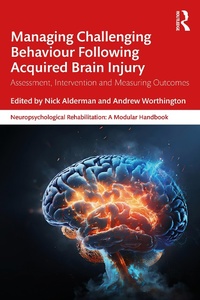
Managing Challenging Behaviour Following Acquired Brain Injury
Assessment, Intervention and Measuring Outcomes
1st Edition
Published on 24. November 2023
232 pages
978-1-000-98409-5 (ISBN)
Description

This empirically based book provides conceptual knowledge and practical advice to enable clinicians to implement evidence-based methods drawn from learning theory for managing the catastrophic effects of challenging behaviour as an enduring outcome of acquired brain injury (ABI).
Based on a conceptual framework of neurobehavioural disability, the book takes a holistic case formulation approach, incorporating functional assessment procedures arising from the operant learning tradition that underpins the design of treatment interventions. It bridges the knowledge gap in uniquely providing a single resource to enable practitioners to implement evidence-based methods to better manage ABI behaviour disorders. The authors, who are leading experts in the field, have described a model of intervention based on a functional analytic approach to understanding behaviour within an operant learning framework. The chapters provide a step-by-step approach to assessment, formulation, intervention and evaluation of behaviour support plans, and feature examples for specific challenging behaviours in a variety of different contexts. The book is organised to support the use of this model through expert contributions concerning the origins of challenging behaviour, assessment methods and formulation, and interventions.
The practical orientation of this book makes it an indispensable read for neuropsychologists, clinical psychologists and other rehabilitation specialists involved in the care of people with ABI as well as researchers in these fields.
Based on a conceptual framework of neurobehavioural disability, the book takes a holistic case formulation approach, incorporating functional assessment procedures arising from the operant learning tradition that underpins the design of treatment interventions. It bridges the knowledge gap in uniquely providing a single resource to enable practitioners to implement evidence-based methods to better manage ABI behaviour disorders. The authors, who are leading experts in the field, have described a model of intervention based on a functional analytic approach to understanding behaviour within an operant learning framework. The chapters provide a step-by-step approach to assessment, formulation, intervention and evaluation of behaviour support plans, and feature examples for specific challenging behaviours in a variety of different contexts. The book is organised to support the use of this model through expert contributions concerning the origins of challenging behaviour, assessment methods and formulation, and interventions.
The practical orientation of this book makes it an indispensable read for neuropsychologists, clinical psychologists and other rehabilitation specialists involved in the care of people with ABI as well as researchers in these fields.
More details
Series
Edition
1. Auflage
Language
English
Place of publication
London
United Kingdom
Publishing group
Taylor & Francis Ltd
Target group
Professional and scholarly
Illustrations
19 Line drawings, black and white; 19 Illustrations, black and white
ISBN-13
978-1-000-98409-5 (9781000984095)
Copyright in bibliographic data and cover images is held by Nielsen Book Services Limited or by the publishers or by their respective licensors: all rights reserved.
Schweitzer Classification
Other editions
Additional editions
Nick Alderman | Andrew Worthington
Managing Challenging Behaviour Following Acquired Brain Injury
Assessment, Intervention and Measuring Outcomes
Book
11/2023
1st Edition
Routledge
€55.10
Shipment within 15-20 days
Nick Alderman | Andrew Worthington
Managing Challenging Behaviour Following Acquired Brain Injury
Assessment, Intervention and Measuring Outcomes
Book
11/2023
1st Edition
Routledge
€186.10
Shipment within 15-20 days
Persons
Nick Alderman is Senior Clinical Director, Head of Psychology and Consultant Clinical Neuropsychologist at Elysium Neurological Services, Elysium Healthcare, UK, and Honorary Professor at Swansea University, UK. He is acknowledged as an expert in neurobehavioural rehabilitation, having accrued over four decades' experience in this field. He has combined successful careers in both clinical and academic psychology, and has a proven track record in treatment innovation, service development, leadership, research and teaching. Research interests include the role of executive function impairment in challenging behaviour and the development of bespoke outcome and other measurement instruments for use in neurorehabilitation.
Andrew Worthington is Honorary Professor in the Faculty of Medicine, Health and Life Sciences at Swansea University and has been a Consultant Clinical Neuropsychologist for over 30 years. He is the director of Headwise, an independent practice for children and adults with brain injury, and is an expert in neurorehabilitation. He has lectured and published widely in the field across a range of neuropsychological conditions and has a particular clinical interest in the management of executive and behaviour disorders.
Andrew Worthington is Honorary Professor in the Faculty of Medicine, Health and Life Sciences at Swansea University and has been a Consultant Clinical Neuropsychologist for over 30 years. He is the director of Headwise, an independent practice for children and adults with brain injury, and is an expert in neurorehabilitation. He has lectured and published widely in the field across a range of neuropsychological conditions and has a particular clinical interest in the management of executive and behaviour disorders.
Content
Section 1: Origins of challenging behaviour. 1. Outcomes from acquired brain injury: prevalence and impact of challenging behaviour. 2. The Intervention Model: frameworks, principles, and practice. 3. A legal framework for the management of challenging behaviour. Section 2: Assessment and formulation: general principles and methods. 4. Assessment of behavioural risk in acquired brain injury. 5. Determining the cause: recording behaviour using direct observation methods. Section 3: Intervention. 6. Neurobehavioural rehabilitation and application of new learning methods. 7. Behaviour support in the context of neurobehavioural rehabilitation. 8. Management of aggression after acquired brain injury. 9. What can behavioural interventions contribute to rehabilitation for inappropriate sexual behaviour post acquired brain injury? 10. Managing behaviours that challenge in acute care settings. 11. The clinical realities of delivering neurobehavioural rehabilitation in the community. 12. Managing behaviour in Functional Neurological Disorders.
