

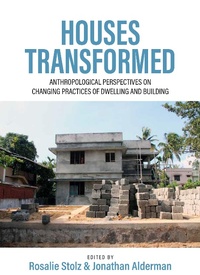
Houses Transformed
Description

Over the decades, there has been a world-wide transformation of so-called 'vernacular houses'. Based on ethnographic accounts from different regions, Houses Transformed investigates the changing practices of building houses in a transnational context. It explores the intersection of house biographies and social change, the politics of housing design, the social fabrication of aspirational houses, the domestication of concrete and the intersection of materiality and ontology as well as the rhetoric of the vernacular. The volume provides new anthropological pathways to understand the dynamics of dwelling in the 21st century.
More details
Other editions
Additional editions
Persons
Jonathan Alderman is Honorary Research Fellow at the Centre for Amerindian, Latin American and Caribbean Studies, University of St Andrews, and Associate Fellow at the Centre for Latin American and Caribbean Studies, University of London.
Content
List of Figures
Introduction: Houses Transformed - Transforming Houses
Rosalie Stolz
Chapter 1. Anthropology and the Study of Architecture at a Time of Rapid Change
Marcel Vellinga
Chapter 2. Lives of the House: Tracing Kinship through the Biography of Houses in Norway
Simone Abram and Marianne Lien
Chapter 3. The 'New London Vernacular': Architecture and the Politics of Community-Building in London's Olympic Park
Saffron Woodcraft
Chapter 4.The Changing Temporalities and Ecologies of House Production in an Age of Trans-localization: Instances in Kerala and West Bengal, India
Elisa T. Bertuzzo
Chapter 5. In Pursuit of a Modern Home: Shared Vernacular Temporalities and Modern Aspirations of the Nationals and Transnationals in Qatar
Gizem Kahraman Aksoy
Chapter 6. 'There Are No Winds': Sensory Dimensions of the Shifting Materiality of Houses and the Community of Sounds in Northern Laos
Rosalie Stolz
Chapter 7. 'Pretty butToo Hot, It Smells Like Bat Urine': Public Funded Housing for a Waorani Village in Ecuadorian Amazonia
Andrea Bravo Diaz
Chapter 8.The Social Creativity of Remittance Houses: Reconfiguring Space and Social Relations in Guatemala
Andrea Freddi
Chapter 9. Not Vernacular Enough: Dwellings of No Architectural Significance and the New Anthropology of Housing
Eli Elinoff
Chapter 10. Vernacular Adobe Houses and State Social Housing in Rural Andean Bolivia
Jonathan Alderman
Chapter 11. New Materials, Different Spatialities, Same Houses? Domestic Architectures and Techniques among Pastoralists Communities in the Andean Highlands (Jujuy, Argentina)
Julieta Barada and Jorge Tomasi
Afterword
Jonathan Alderman
