

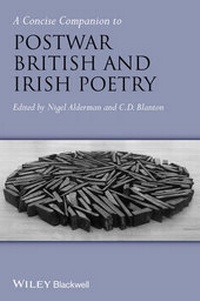
A Concise Companion to Postwar British and Irish Poetry
Description

Reviews / Votes
"Eminently readable, and thankfully largely free ofsocio-political posturing and theorising, it provides a measuredhistorical overview and a critical introduction, and one can seethat the overall approach aims to be integrative, charting what aredescribed as intricate negotiations between the British and Irishpoetic traditions, and marshalling rival tendencies andpositions." (Suite101.com, 17 February 2014)Gives some sense of why poetry provides the sharpest of lenses through which to view the historical and social developments of the second half of the twentieth century, and will serve both as a useful source of reference and a provocative starting point for discussion." (English Studies, 1 December 2011) "Engaging and uncluttered by jargon. The mix of formal and thematic issues with social and cultural contexts doubles the usefulness of this collection as a preparatory tool for students of the period." (CHOICE, December 2009)More details
Other editions
Additional editions
Persons
Content
Introduction
Nigel Alderman and C. D. Blanton
The concise title of this collection is perhaps best taken quite literally. Both the volume and the dozen essays it contains are relatively brief, especially when weighed against the ever-thickening mass of British and Irish poetry written and published since World War II. Each piece proposes one possible angle of entry to that field, exploring a context of particular importance to poetry written over the past half-century and more, not to chart it exhaustively, still less to anthologize and account all the works and figures that define it, but rather to suggest ways in which the field might productively be encountered, by those beginning to read and teach this material, or merely hoping to reread it critically. Accordingly, each essay is designed to offer not a definitive set of readings or canonical judgments, but rather a survey and analysis of the tendencies, habits, and patterns that distinguish poetic production in Britain and Ireland over the past several decades. Together, they are offered as a rough, necessarily provisional, guide to a period that is perhaps still too close to view in a single historical glance, but one that is simultaneously receding from the recollections of simple memory into those of literary history.
What is certain is that the years between 1945 and now have witnessed a radical transformation in the cultures of the British archipelago and the larger global system in which they negotiate an often uneasy place. From the rise of the welfare state in the 1940s to its fall in the 1980s, from the proclamation of the Irish Republic in 1949 to the Good Friday Accords in 1998, from the dismantling of the British Empire after the war to the devolution of British power onto the Scottish Parliament and the Welsh National Assembly at the century’s end, the literal meanings of political terms such as “British” and “Irish,” of the “English” language that reaches across them and beyond, have fundamentally changed over the past half century and more. With those changes, sometimes slow and sometimes abrupt, the idea of an English literature has necessarily changed as well, entailing an interrogation of what poetry is or does that continues into the new century. In large measure, these redefinitions constitute shifting borders, blurred lines of demarcation not only between political entities but also among the various practices of language that circulate within and among them. As even the casual reader of recent verse will quickly note, the idea of poetry has often been contested and uneasy over the past six decades or so, spinning a literary history capacious enough to include the Movement lyric and dub beats, and spawning inevitable controversies in the process. Simple definitions have often proven elusive, either too indistinct or too partial. What seems clearer is that the question itself has remained charged, that an ever-expanding field of poetic writing has engaged and incorporated every shift of recent times. We have therefore attempted less to define what poetry is or what it means than to describe what it has been and what it has meant at crucial moments in a still developing literary history. To that end, each essay in this volume surveys one important corner of a larger map, gathering some of the figures and poems that have made it significant and summarizing the critical questions that have arisen in the process.
Accounts of postwar literature often adopt an apologetic or even elegiac tone, as if the historical loss of the triumphal certainties of earlier moments necessarily implied an aesthetic diminution. When coupled with the perceived marginalization of poetry more generally, such accounts can reduce the writing of recent decades to a rather melancholic affair. But historical melancholia need not imply simple poetic mourning. To the contrary, the very intensity and speed of recent historical shifts have often prompted striking reconsiderations of form and spawned larger questions that poetry is uniquely equipped to answer. Writing of the history of postwar Europe more generally, Tony Judt has recently observed that the years after 1945 have “now come to be seen not as the threshold of a new epoch but rather as an interim age: a post-war parenthesis, the unfinished business of a conflict that ended in 1945 but whose epilogue had lasted for another half century” (2005: 2). Much the same can be said of the poetry that sought to define a new sense of place and a new set of relations – political certainly, but also social and formal, sexual and economic, historical and existential – proper to the twentieth century’s latter half. Mindful then (in Judt’s phrase again) “that 1945 was never quite the fresh start that it sometimes appears” (2005: 6), this volume therefore takes the “post” in its title seriously. The turmoil and social upheaval that defined the twentieth century’s first half, between 1914 and 1945 especially, spared little in the realm of culture, imprinting traces across all the arts. But poetry in particular has proven an extraordinarily sensitive instrument to that history, whether recording the horrors of soldiers fighting on the Western Front, in the work of Wilfred Owen or Siegfried Sassoon, or registering the enchantments and disenchantments of those left, like W. B. Yeats and T. S. Eliot, at home. The consolidation of new political orders after 1945 may have qualified some anxieties and introduced others, but it also left newer generations of poets to struggle with and re-adapt some of the same insoluble questions and forms that had vexed their predecessors.
The mere fact that we have no better term than “postwar” for a historical interlude already over half a century long, then, should already suggest the inevitability of a backward glance, toward those revolutions, disasters, and new beginnings that brought the postwar order (and its various disorders) into being. It should also suggest a fact discovered in different ways by many of the essays included here: that much of the energy generated by postwar poetry has been sparked by the need to sort out, break with, exorcise, criticize, escape, or reconfirm a host of contradictory legacies – or at least to make some sense of the immediate past. In all probability, every age is an age of criticism. What often seems to distinguish recent decades, however, is the degree to which the work of criticism – assessing formal debts, arguing over historical precedents, disputing the ways in which poems accrete meaning – has guided not only the ways in which poems are read, but also the ways in which they are written. The need to take stock of everything that the postwar follows, whether lying in the archaic past or in living memory, has often left the period to define itself by defining the larger history to which it forms an epilogue. (It is perhaps worth noting, in this regard, that the first such companion to postwar poetry was offered by Stephen Spender in a small pamphlet entitled Poetry since 1939. The year was 1946.)
But the other half of Judt’s parenthesis is equally important. If the postwar marks “an interim age,” then it also gestures forward, to our own contemporary moment certainly, but also to futures in the process of taking shape. In both present and future, that plural usage remains inevitable. The current Oxford English Literary History, for example, segments the twentieth century alone into no fewer than five volumes, the postwar into three (dividing period boundaries alternately at 1940, 1948, 1960, 1970, and 2000), and traces the transformation of English literature into a complicated international fact. Major anthologies overlap similarly. The recent Oxford Anthology of Twentieth-Century British and Irish Poetry spans the entire century (Tuma 2001), while the Norton Anthology of Modern and Contemporary Poetry, published two years later, divides the century in half, imposing no national borders within English (Ramazani et al. 2003). Other important collections have chosen other organizing frames. Edna Longley’s Bloodaxe Book of 20th Century Poetry from Britain and Ireland (2000b), for example, concentrates attention on the continuity and development of the lyric, while Simon Armitage and Robert Crawford’s Penguin Book of Poetry from Britain and Ireland since 1945 locates the underlying story of postwar poetry, as of postwar society in general, in the gradual but implacable movement of democratization and the corollary achievement of a “contemporary culture of pluralism” (1998: xxii). For Armitage and Crawford, the postwar is largely defined by the transformation of England from “the widely acknowledged fount and centre of English language culture” to a tributary “anglophone culture within an English-speaking world” (xxiii), a world in which “apparent genealogies become disrupted” (xxvi).
All of these constitute so many provisional descriptions of a field not yet finished, signs that, as Armitage and Crawford put it, “a sense of belatedness grows, mixed with a sense of anticipation” (1998: xxxii). Inevitably, different accounts will attempt to impose coherent narratives on any such span of time. More often, they will be forced to acknowledge several. Against the largely optimistic story offered by Armitage and Crawford, then, might be placed Andrew Duncan’s more polemical account of the systemic “failure” of twentieth-century British poetry (2003: 2), measured largely in its apparent devotion to older styles and familiar subjects. What Duncan terms...
