

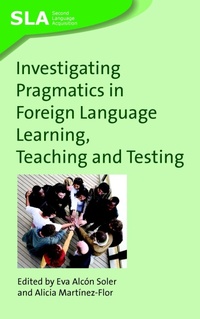
Investigating Pragmatics in Foreign Language Learning, Teaching and Testing
Published on 18. July 2008
260 pages
978-1-84769-962-6 (ISBN)
Description

The book focuses on investigating pragmatic learning, teaching and testing in foreign language contexts. The volume brings together research that investigates these three areas in different formal language learning settings. The number and variety of languages involved both as the first language (e.g. English, Finnish, Iranian, Spanish, Japanese) as well as the target foreign language (e.g. English, French, German, Indonesian, Korean, Spanish) makes the volume specially attractive for language educators in different sociocultural foreign language contexts. Additionally, the different approaches adopted by the researchers participating in this volume, such as information processing, sociocultural, language socialization, computer-mediated or conversation analysis should be of interest to graduate students and researchers working in the area of second language acquisition.
Reviews / Votes
This book is a rich source of knowledge and inspiration for beginner and more advanced researchers, contributes to the development of the multilingual field of interlanguage pragmatics and provides valuable pedagogical implications for language teachers in the foreign language classroom. -- Anna Nizegorodcew, Professor in Applied Linguistics, English Department, Jagiellonian University, Krakow, Poland Adopting a range of theoretical perspectives and focusing on a variety of learning contexts and approaches to learning, this timely collection of articles represents a significant contribution to the growing body of literature on the teaching of pragmatics in the foreign language context. It is essential reading for interlanguage pragmaticists. -- Dr. Anne Barron, Institut fuer Anglistik, Amerikanistik und Keltologie, Universitaet Bonn, Germany. This volume is a timely contribution to ILP research. It provides an overview of recent research in the field of ILP. It takes into consideration the wide variety of approaches currently being used in classroom-based ILP research. The employment of both observational, as well as more experimental methods provides a holistic picture of the current state of research in ILP. -- Iris Levitis, University of California, Davis * Linguist List 20.1944 * This timely work represents a significant contribution to the literature, as it integrates research on pragmatics in foreign language learning, teaching and testing. This volume is highly recommended for students and researchers in applied linguistics as well as language teachers and educators. -- Wei Ren, University of Bristol * Studies in Second Language Acquisition, 31:4, 2009 *More details
Series
Language
English
Place of publication
Bristol
United Kingdom
Publishing group
Channel View Publications Ltd
Target group
Professional and scholarly
ISBN-13
978-1-84769-962-6 (9781847699626)
Copyright in bibliographic data and cover images is held by Nielsen Book Services Limited or by the publishers or by their respective licensors: all rights reserved.
Schweitzer Classification
Other editions
Additional editions
Eva Alcon Soler | Alicia Martinez-Flor
Investigating Pragmatics in Foreign Language Learning, Teaching and Testing
Book
07/2008
Multilingual Matters
€48.50
Shipment within 10-20 days
Persons
Eva Alcon Soler, senior lecturer at University Jaume I, has been working on discourse and language learning since 1993. Her research has covered, among others, interlanguage pragmatics, lingua franca communication, interaction and second language acquisition. Her recent publications have focussed on intercultural language use and language learning and on learning pragmatics in foreign language contexts.
Alicia Martinez-Flor is a lecturer in the Department of English Studies, Universitat Jaume I of Castellon, Spain, where she teaches both undergraduate and postgraduate courses in EFL teaching methodology. As a result of her own learning process of the English language, she became interested in investigating the acquisition of pragmatic competence in foreign language contexts. Her research interests include second language acquisition and interlanguage pragmatics.
Alicia Martinez-Flor is a lecturer in the Department of English Studies, Universitat Jaume I of Castellon, Spain, where she teaches both undergraduate and postgraduate courses in EFL teaching methodology. As a result of her own learning process of the English language, she became interested in investigating the acquisition of pragmatic competence in foreign language contexts. Her research interests include second language acquisition and interlanguage pragmatics.
Content
Amy Snyder Ohta: Preface
Introduction
1. Pragmatics in Foreign Language Contexts - Eva Alcon Soler and Alicia Martinez-Flor
Part 1: Investigating how Pragmatics can be Learned in Foreign Language Contexts
2. Language Socialization Theory and the Acquisition of Pragmatics in the Foreign Language Classroom - Margaret A. DuFon
3. Talking with a Classroom Guest: Opportunities for Learning Japanese Pragmatics - Yumiko Tateyama and Gabriele Kasper
4. Pragmatic Performance: What are Learners Thinking? - Tim Hassall
5. Learning Pragmatics in Content-Based Classrooms - Tarja Nikula
6. Computer-Mediated Learning of L2 Pragmatics - Marta Gonzalez-Lloret
Part 2: Investigating how Pragmatics can be Taught in Foreign Language Contexts
7. Using Translation to Improve Pragmatic Competence - Juliane House
8. Effects on Pragmatic Development through Awareness-Raising Instruction: Refusals by Japanese EFL Learners - Sachiko Kondo
9. Enhancing the Pragmatic Competence of Non-Native English-Speaking Teacher Candidates (NNESTCs) in an EFL Context - Zohreh R. Eslami and Abbass Eslami-Rasekh
Part 3: Investigating how Pragmatics can be Tested in Foreign Language Contexts
10. Investigating Interlanguage Pragmatic Ability: What are we Testing? - Sayoko Yamashita
11. Raters, Functions, Item Types, and the Dependability of L2 Pragmatics Tests - James Dean Brown
12. Rater, Item, and Candidate Effects in Discourse Completion Tests: A FACETS Approach - Carsten Roever
Introduction
1. Pragmatics in Foreign Language Contexts - Eva Alcon Soler and Alicia Martinez-Flor
Part 1: Investigating how Pragmatics can be Learned in Foreign Language Contexts
2. Language Socialization Theory and the Acquisition of Pragmatics in the Foreign Language Classroom - Margaret A. DuFon
3. Talking with a Classroom Guest: Opportunities for Learning Japanese Pragmatics - Yumiko Tateyama and Gabriele Kasper
4. Pragmatic Performance: What are Learners Thinking? - Tim Hassall
5. Learning Pragmatics in Content-Based Classrooms - Tarja Nikula
6. Computer-Mediated Learning of L2 Pragmatics - Marta Gonzalez-Lloret
Part 2: Investigating how Pragmatics can be Taught in Foreign Language Contexts
7. Using Translation to Improve Pragmatic Competence - Juliane House
8. Effects on Pragmatic Development through Awareness-Raising Instruction: Refusals by Japanese EFL Learners - Sachiko Kondo
9. Enhancing the Pragmatic Competence of Non-Native English-Speaking Teacher Candidates (NNESTCs) in an EFL Context - Zohreh R. Eslami and Abbass Eslami-Rasekh
Part 3: Investigating how Pragmatics can be Tested in Foreign Language Contexts
10. Investigating Interlanguage Pragmatic Ability: What are we Testing? - Sayoko Yamashita
11. Raters, Functions, Item Types, and the Dependability of L2 Pragmatics Tests - James Dean Brown
12. Rater, Item, and Candidate Effects in Discourse Completion Tests: A FACETS Approach - Carsten Roever
