

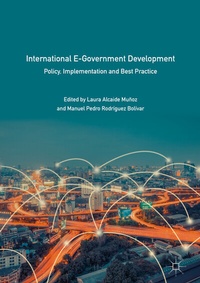
International E-Government Development
Description

This book provides an examination of e-Government frameworks and maturity stages in governments around the world, including an overview of the legal frameworks that have supported them. Divided into three sections, the first part of this book analyses the theoretical context of current policies, codes of best practice and their implementation. The second section presents case studies which bring key issues to the fore including open government, privacy protection, social media, democracy, systems failures, innovations in inter-organizational e-government projects, and open data systems. The authors demonstrate the importance of the successful implementation of e-Government for improving managerial efficiency, public service delivery and citizen engagement, with special attention given to developing countries. The book concludes by drawing out the lessons learned from the latest research and recommending solutions for improving the implementation of e-Government in the future, thereby helping to achieve more transparent, participative and democratic societies. This book will provide an invaluable resource for researchers, policy-makers, public managers, international organizations and technical experts.
More details
Other editions
Additional editions
Persons
Laura Alcaide Muñoz is Associate Professor in Accounting at the University of Granada, Spain. Her research topics are e-Government, information transparency, accountability and financial sustainability in Public Administration. She has been author of articles published in Administration & Society, Public Money and Management, International Public Management Journal Local Government Studies and American Review of Public Administration.
Manuel Pedro Rodríguez Bolívar is Professor in Accounting at the University of Granada, Spain. He has authored numerous articles published in Government Information Quarterly, International Review of Administrative Science, Social Science Computer Review, Internet Research and Local Government Studies. He is also a member of the Editorial Board of Government Information Quarterly.
Content
