

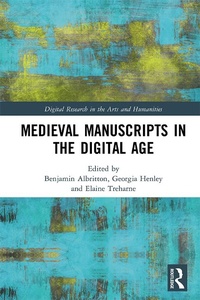
Medieval Manuscripts in the Digital Age
1st Edition
Published on 14. July 2020
250 pages
978-1-000-08125-1 (ISBN)
Description

Medieval Manuscripts in the Digital Age explores one major manuscript repository's digital presence and poses timely questions about studying books from a temporal and spatial distance via the online environment.
Through contributions from a large group of distinguished international scholars, the volume assesses the impact of being able to access and interpret these early manuscripts in new ways. The focus on Parker on the Web, a world-class digital repository of diverse medieval manuscripts, comes as that site made its contents Open Access. Exploring the uses of digital representations of medieval texts and their contexts, contributors consider manuscripts from multiple perspectives including production, materiality, and reception. In addition, the volume explicates new interdisciplinary frameworks of analysis for the study of the relationship between texts and their physical contexts, while centring on an appreciation of the opportunities and challenges effected by the digital representation of a tangible object. Approaches extend from the codicological, palaeographical, linguistic, and cultural to considerations of reader reception, image production, and the implications of new technologies for future discoveries.
Medieval Manuscripts in the Digital Age advances the debate in manuscript studies about the role of digital and computational sources and tools. As such, the book will appeal to scholars and students working in the disciplines of Digital Humanities, Medieval Studies, Literary Studies, Library and Information Science, and Book History.
Through contributions from a large group of distinguished international scholars, the volume assesses the impact of being able to access and interpret these early manuscripts in new ways. The focus on Parker on the Web, a world-class digital repository of diverse medieval manuscripts, comes as that site made its contents Open Access. Exploring the uses of digital representations of medieval texts and their contexts, contributors consider manuscripts from multiple perspectives including production, materiality, and reception. In addition, the volume explicates new interdisciplinary frameworks of analysis for the study of the relationship between texts and their physical contexts, while centring on an appreciation of the opportunities and challenges effected by the digital representation of a tangible object. Approaches extend from the codicological, palaeographical, linguistic, and cultural to considerations of reader reception, image production, and the implications of new technologies for future discoveries.
Medieval Manuscripts in the Digital Age advances the debate in manuscript studies about the role of digital and computational sources and tools. As such, the book will appeal to scholars and students working in the disciplines of Digital Humanities, Medieval Studies, Literary Studies, Library and Information Science, and Book History.
More details
Series
Edition
1. Auflage
Language
English
Place of publication
London
United Kingdom
Publishing group
Taylor & Francis Ltd
Target group
College/higher education
Illustrations
4 Tables, black and white; 1 Line drawings, black and white; 21 Halftones, black and white; 22 Illustrations, black and white
ISBN-13
978-1-000-08125-1 (9781000081251)
Copyright in bibliographic data and cover images is held by Nielsen Book Services Limited or by the publishers or by their respective licensors: all rights reserved.
Schweitzer Classification
Other editions
Additional editions
Benjamin Albritton | Georgia Henley | Elaine Treharne
Medieval Manuscripts in the Digital Age
Book
04/2022
1st Edition
Routledge
€67.80
Shipment within 15-20 days
Benjamin Albritton | Georgia Henley | Elaine Treharne
Medieval Manuscripts in the Digital Age
Book
07/2020
1st Edition
Routledge
€191.89
Shipment within 15-20 days
Persons
Benjamin Albritton is the Rare Books Curator at Stanford Libraries. He is a medievalist and musicologist and spent nearly a decade managing digital projects including Parker on the Web, collaborations with the Vatican Library and others, and playing a key role in the inception and development of the International Image Interoperability Framework.
Georgia Henley is Assistant Professor of English at Saint Anselm College and a Junior Fellow in the Andrew W. Mellon Society of Fellows in Critical Bibliography. Previously she held a postdoctoral appointment at Stanford's Center for Spatial and Textual Analysis.
Elaine Treharne is Roberta Bowman Denning Professor of Humanities at Stanford University, and Director of Stanford Text Technologies. She is a medievalist and handmade book expert, currently completing The Phenomenal Book. She is a Fellow of the Society of Antiquaries, of the Royal Historical Society, and of the English Association.
Georgia Henley is Assistant Professor of English at Saint Anselm College and a Junior Fellow in the Andrew W. Mellon Society of Fellows in Critical Bibliography. Previously she held a postdoctoral appointment at Stanford's Center for Spatial and Textual Analysis.
Elaine Treharne is Roberta Bowman Denning Professor of Humanities at Stanford University, and Director of Stanford Text Technologies. She is a medievalist and handmade book expert, currently completing The Phenomenal Book. She is a Fellow of the Society of Antiquaries, of the Royal Historical Society, and of the English Association.
Content
1. Introduction
Benjamin Albritton and Elaine Treharne
Part I. Theory and Practice
2. What it is to be a Digitization Specialist: Chasing Medieval Materials in a Sea of Pixels
Astrid J. Smith
3. From the Divine to the Digital: Digitization as Resurrection and reconstruction
Keri Thomas
4. A Note on Technology and Functionality in Digital Manuscript Studies
Abigail G. Robertson
5. Ways of Seeing Manuscripts: Exploring Parker 2.0
Andrew Prescott
Part II. Materialities
6. A Note on Cambridge, Corpus Christi College, 210
Orietta Da Rold
7. Cambridge, Corpus Christi College, 367 Part II: A Study in (Digital) Codicology
Peter A. Stokes
8. Pocket Change: Cambridge, Corpus Christi College, 383 and the Value of the Virtual Object
Anya Adair
9. Rolling with It: Navigating Absence in the Digital Realm
Sian Echard
Part III. Translation and Transmission
10. 'Glocal' Matters: The Gospels of St Augustine as a Codex in Translation
Mateusz Fafinski
11. Encyclopaedic Notes in Cambridge, Corpus Christi College, 320
John J. Gallagher
12. Cambridge, Corpus Christi College, 322: Tradition and Transmission
David F. Johnson
13. Cambridge, Corpus Christi College, 41 and 286: Digitization as Translation
Sharon M. Rowley
Part IV. Of Multimedia and the Multilingual
14. Fragmentation and Wholeness in Cambridge, Corpus Christi College, 16
A. Joseph McMullen
15. Cambridge, Corpus Christi College, 144 and 402: Mercian Intellectual Culture in pre-Conquest England (and beyond)
Lindy Brady
16. Philologia and Philology: Allegory, Multilingualism and the Corpus Martianus Capella
Elizabeth Boyle
17. Remediation and Multilingualism in Corpus Christi College, 402
Carla Maria Thomas
Part V. Forms of Reading
18. Living with Books in Early Medieval England: Solomon and Saturn, Bibliophilia, and the Globalist Red Book of Darley
Erica Weaver
19. Severed Heads and Sutured Skins
Catherine E. Karkov
20. Books Consumed, Books Multiplied: Martianus Capella, AElfric's Homilies, and the International Image Interoperability Framework
Alexandra Bolintineanu
21. Making a Home for Manuscripts on the Internet
Michelle R. Warren
Benjamin Albritton and Elaine Treharne
Part I. Theory and Practice
2. What it is to be a Digitization Specialist: Chasing Medieval Materials in a Sea of Pixels
Astrid J. Smith
3. From the Divine to the Digital: Digitization as Resurrection and reconstruction
Keri Thomas
4. A Note on Technology and Functionality in Digital Manuscript Studies
Abigail G. Robertson
5. Ways of Seeing Manuscripts: Exploring Parker 2.0
Andrew Prescott
Part II. Materialities
6. A Note on Cambridge, Corpus Christi College, 210
Orietta Da Rold
7. Cambridge, Corpus Christi College, 367 Part II: A Study in (Digital) Codicology
Peter A. Stokes
8. Pocket Change: Cambridge, Corpus Christi College, 383 and the Value of the Virtual Object
Anya Adair
9. Rolling with It: Navigating Absence in the Digital Realm
Sian Echard
Part III. Translation and Transmission
10. 'Glocal' Matters: The Gospels of St Augustine as a Codex in Translation
Mateusz Fafinski
11. Encyclopaedic Notes in Cambridge, Corpus Christi College, 320
John J. Gallagher
12. Cambridge, Corpus Christi College, 322: Tradition and Transmission
David F. Johnson
13. Cambridge, Corpus Christi College, 41 and 286: Digitization as Translation
Sharon M. Rowley
Part IV. Of Multimedia and the Multilingual
14. Fragmentation and Wholeness in Cambridge, Corpus Christi College, 16
A. Joseph McMullen
15. Cambridge, Corpus Christi College, 144 and 402: Mercian Intellectual Culture in pre-Conquest England (and beyond)
Lindy Brady
16. Philologia and Philology: Allegory, Multilingualism and the Corpus Martianus Capella
Elizabeth Boyle
17. Remediation and Multilingualism in Corpus Christi College, 402
Carla Maria Thomas
Part V. Forms of Reading
18. Living with Books in Early Medieval England: Solomon and Saturn, Bibliophilia, and the Globalist Red Book of Darley
Erica Weaver
19. Severed Heads and Sutured Skins
Catherine E. Karkov
20. Books Consumed, Books Multiplied: Martianus Capella, AElfric's Homilies, and the International Image Interoperability Framework
Alexandra Bolintineanu
21. Making a Home for Manuscripts on the Internet
Michelle R. Warren
