

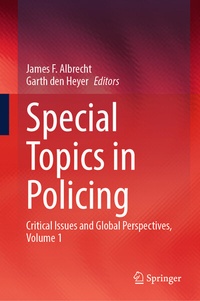
Special Topics in Policing
Description

This book comprehensively examines five key areas of concern across the field of policing. These critical issues include: police use of force, police ethics and integrity, traffic safety, police-community collaboration, and optimizing organizational performance and service delivery. The chapters that follow provide a global, multi-faceted approach to analyze these core professional issues, examine them through sociological and theoretical lenses, and ultimately propose policy recommendations to ensure optimal professionalism and organizational effectiveness. The book focuses on issues, including:
Enhancing public trust and confidence
Effective crime control
Rule of law
Social justice
Best procedures and practices
This book is ideal for upper-level undergraduate and graduate-level students, criminal justice and law enforcement practitioners and policy makers, and criminal justice and criminology researchers.
More details
Other editions
Additional editions
Persons
James F. Albrecht is a Professor in the Department of Criminal Justice and Homeland Security at Pace University in New York City. Jimmy received a prestigious Fulbright Fellowship in 1998 and worked as a Professor at the National Police College of Finland. He is also the recipient of a 2013 Embassy Policy Specialist Fellowship (USDOS/IREX) and was tasked with conducting research and making recommendations to improve law enforcement efficacy and legitimacy in Ukraine. Police Chief Albrecht served in the European Union Rule of Law Mission (EULEX) in Kosovo (former Yugoslavia) as the Head of the EULEX Police Executive Department, in charge of criminal investigations and coordinating international law enforcement cooperation and intelligence analysis from 2008 through 2010. He had previously served in the United Nations Mission in Kosovo Police from 2007 to 2008. Jimmy is also a 23-year veteran of the NYPD who retired as the Commanding Officer of NYPD Transit Bureau District 20, tasked with the prevention of crime and terrorism in the subway and commuter transit system in New York City. He was a first responder and incident command manager at the September 11, 2001 terrorist attack on the World Trade Center and developed the counter-terrorism strategic plan for the subway system in the borough of Queens, New York City.
Dr. Garth den Heyer is a Professor of Criminology and Criminal Justice at Arizona State University in the United States and a Senior Research Fellow with the Police Foundation in Washington, D.C. He is also a contributing faculty member at Walden University and an Associate with the Scottish Institute of Policing Research. Police Inspector den Heyer served with the New Zealand Police for 38 years, retiring as Manager of National Security. Garth also spent more than 20 months as a strategic law enforcement advisor to the Regional Assistance Mission to the Solomon Islands. His primary research interests include lawenforcement, police militarization, service delivery, agency efficacy, policy development, strategic thinking, and organizational reform.
Content
Part I
- Policing and Use of Force. .- Chapter 1. Understanding Police Use of Force in the United States .- Chapter 2. Examining Assaults on Police Officers: An International Review of the Factors that Influence the Occurrence of these Attacks.- Chapter 3. Recalibrating Minimum Force: Some Unintended Consequences of Tom Swift's 'Electronic Rifle'.-
Part II
- Police Ethics and Corruption. .- Chapter 4. Understanding and Preventing Police Deviance and Corruption based on Experiences and Trends in the United States.- Chapter 5. The Contemporary Status of Ethics in Policing.- Chapter 6. Ethical Dilemmas in South African Policing and Criminal Justice.-
Part III
-Police and Traffic Safety. .- Chapter 7. Evaluating Strategies to Enhance Traffic Safety.- Chapter 8. Traffic Enforcement in New Zealand: A Failed Experiment?.- Chapter 9. Policing and investigating criminal activities by gangs using e-bikes, e-scooters and e-motorcycles in the United Kingdom.-
Part IV
-Police and Community Outreach and Collaboration.- Chapter 10. Initiatives to improve Police - Community Collaboration and Trust.- Chapter 11. Understanding the Implementation of Community-oriented Policing in the New Zealand Police.- Chapter 12. Regional Differences in the Perception of American Adolescents on Police Objectivity and Fairness.-
Part V
- Improving Police Service Delivery .- Chapter 13. The Role and Contribution of the Police Planner in Improving Police Service Delivery.- Chapter 14. Effective Strategies to Enhance Police Service Delivery .- Chapter 15. An Analysis of Complementary Law Enforcement: Comparing the Hungarian and South Korean Models for more effective Police Service Delivery.- Chapter 16. Afterword: Examining Contemporary Challenges in Policing.
