

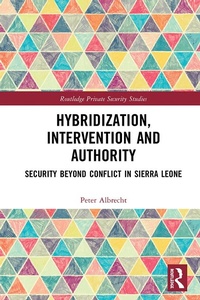
Hybridization, Intervention and Authority
Security Beyond Conflict in Sierra Leone
1st Edition
Published on 4. July 2019
220 pages
978-1-351-59091-4 (ISBN)
Description

This book explains how security is organized from the local to the national level in post-war Sierra Leone, and how external actors attempted to shape the field through security sector reform.
Security sector reform became an important and deeply political instrument to establish peace in Sierra Leone as war drew to an end in the late 1990s and early 2000s. Through historical and ethnographic perspectives, the book explores how practices of security sector reform have both shaped and been shaped by practices and discourses of security provision from the national to the local level in post-war Sierra Leone. It critiques how the notion of hybridity has been applied in peace and security studies and cultural studies, and thereby provides an innovative perspective on IR, and the study of interventions. The book is the first to take the debate on security in Sierra Leone beyond a focus on conflict and peacebuilding, to explore everyday policing and order-making in rural areas of the country. Based on fieldwork between 2005 and 2018, it includes 200+ interviews with key players in Sierra Leone from the National Security Coordinator and Inspector-General of Police in Freetown to traditional leaders and miners in Peyima, a small town on the border with Guinea.
This book will be of much interest to students of critical security, anthropology, African politics and IR in general.
Security sector reform became an important and deeply political instrument to establish peace in Sierra Leone as war drew to an end in the late 1990s and early 2000s. Through historical and ethnographic perspectives, the book explores how practices of security sector reform have both shaped and been shaped by practices and discourses of security provision from the national to the local level in post-war Sierra Leone. It critiques how the notion of hybridity has been applied in peace and security studies and cultural studies, and thereby provides an innovative perspective on IR, and the study of interventions. The book is the first to take the debate on security in Sierra Leone beyond a focus on conflict and peacebuilding, to explore everyday policing and order-making in rural areas of the country. Based on fieldwork between 2005 and 2018, it includes 200+ interviews with key players in Sierra Leone from the National Security Coordinator and Inspector-General of Police in Freetown to traditional leaders and miners in Peyima, a small town on the border with Guinea.
This book will be of much interest to students of critical security, anthropology, African politics and IR in general.
Reviews / Votes
"This sophisticated, perceptive and challenging account provides important insights into the hybrid nature of authority and order in Africa. Albrecht's first-hand research on local chiefs and police officers reminds us of what to expect when external resources are injected into state spaces. It is essential reading for anyone interested in the realities of security sector reform."--Alice Hills, Durham University, UK"Peter Albrecht has over the past ten years or so developed hybridization into a highly important concept. In this book he connects urban and rural political landscapes, northern state making processes with local chiefs, and history with the contemporary in postwar Sierra Leone. Not only does he make sense of a complex case, but simultaneously he elegantly criticizes and develops theories and concepts of contemporary political science, IR and development studies. That is quite a feat."--Mats Utas, Uppsala University, Sweden
"Thanks to Peter Albrecht for sharing with us his profound insights from Sierra Leone and from his many years of fruitful, academic and practical engagement with security sector reform. Focusing on the role of chiefs as a key to understanding the outcomes of SSR, Albrecht's well-crafted analysis pushes forward the understanding of hybridization in peace and conflict studies."--Finn Stepputat, Danish Institute for International Studies, Denmark
"This is a very innovative and important book based on more than a decade of detailed empirical research. It details how well-meaning international programmes and advisers failed to fully understand the nature of local politics in Sierra Leone and the nature of power. This book comprehensively analyses the nature of power at the level of the Chiefdom and how the politics of the local affected the implementation of security and policing reforms and access to justice for people in Sierra Leone. Incorporating extensive research at international, national and local levels with significant experience on the ground, this book is an excellent guide to the complexity of relationships between international security programming and local outcomes."--Paul Jackson, University of Birmingham, UK
"This book explores the interface between the local and security reformers. It demonstrates how external security packages shaped and were shaped by Sierra Leone's chiefs. As Albrecht emphatically shows, interventions into little understood complex social systems have unintended consequences. New resources produce another melding of customary and state authority in the perpetual process of hybridization. Let would-be reformers learn that the local cannot be ignored or fully captured."--Bruce Baker, Coventry University, UK
"Applying hybridization as an analytical lens, this book provides useful empirical insights into the provision of peace, security and justice in Sierra Leone. A welcome addition to understanding postwar Sierra Leone and a resource for policymakers and students alike."- Kwesi Aning, The Kofi Annan International Peacekeeping Training Centre, Accra, Ghana
More details
Series
Edition
1. Auflage
Language
English
Place of publication
London
United Kingdom
Publishing group
Taylor & Francis Ltd
Target group
College/higher education
Professional and scholarly
ISBN-13
978-1-351-59091-4 (9781351590914)
Copyright in bibliographic data and cover images is held by Nielsen Book Services Limited or by the publishers or by their respective licensors: all rights reserved.
Schweitzer Classification
Other editions
Additional editions
Book
07/2019
1st Edition
Routledge
€233.00
Shipment within 10-20 days
Person
Peter Albrecht is a senior researcher at the Danish Institute for International Studies (DIIS). His main focus is on the role of local actors in order-making, specifically in Sierra Leone and Somalia, and national-level security sector reform. He has co-authored a number of books, including Reconstructing Security after Conflict: Security Sector Reform in Sierra Leone (2011) and Securing Sierra Leone, 1997-2013: Defence, Diplomacy and Development in Action (2014) and co-edited Policing and the Politics of Order-Making (Routledge, 2015). He has published several articles in the Journal of Modern African Studies, the Journal of Contemporary African Studies, the African Studies Review, Ethnos, Cooperation and Conflict, and others.
Content
1: Introduction 2: The Rise and Fall of Security Sector Reform in Development 3: Collapse, Chaos, and Resurrection 4: Hybridization and the Authority of Chiefs 5: The Interplay of Police Reform and Hybridization 6: The Chiefs of Community Policing 7: Secrets, Strangers, and Order-Making 8: Hybridization in a Case of Diamond Theft 9: Conclusion
