

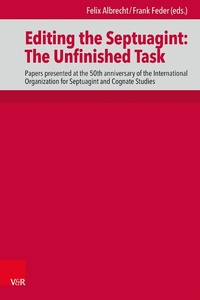
Editing the Septuagint: The Unfinished Task
Papers presented at the 50th anniversary of the International Organization for Septuagint and Cognate Studies, Denver 2018
1st Edition
Published on 8. August 2022
242 pages
978-3-647-56063-2 (ISBN)
Description

The Greek Old Testament, commonly known as Septuagint, has its origins in Ptolemaic Egypt. Egypt developed into a strongly bilingual country, and in the fourth century CE, when Christianity was on firmer ground in Egypt, the Septuagint was translated into Coptic. The intertwined and prolific relation between the Greek and the Coptic Old Testament is now aptly reflected also in the joint ventures of the Göttingen Academy of Sciences and Humanities. Since the 19th century, Göttingen was and is the global center of Septuagint research. In 2015, a new Academy project started, which deals with the translation of the Septuagint into Coptic-Sahidic: 'Digitale Gesamtedition und Übersetzung des koptisch-sahidischen Alten Testaments'. Finally, in 2020, the new long-term project 'Die Editio critica maior des griechischen Psalters' started at the Göttingen Academy. Both projects work closely together, and the present volume is one of the results of this fruitful collaboration.
Felix Albrecht (Dr. theol., geb. 1981) forscht seit 2008 an der Göttinger Akademie der Wissenschaften zur Septuaginta, das ist die griechische Übersetzung des hebräischen Alten Testaments. Seit Beginn des Jahres 2020 leitet er das Akademievorhaben 'Editio critica maior des griechischen Psalters'. Zudem ist er Vorstandsmitglied und Secretary der International Organization for Septuagint and Cognate Studies. Im Zentrum seines Interesses steht die griechische Bibel im Kontext des hellenistischen Judentums mit ihrer Rezeptions- und Transmissionsgeschichte. Daneben pflegt er eine Vorliebe zum Christlichen Orient und befasst sich intensiv mit Handschriftenforschung, Künstlicher Intelligenz und Digital Humanities.
Felix Albrecht (Dr. theol., geb. 1981) forscht seit 2008 an der Göttinger Akademie der Wissenschaften zur Septuaginta, das ist die griechische Übersetzung des hebräischen Alten Testaments. Seit Beginn des Jahres 2020 leitet er das Akademievorhaben 'Editio critica maior des griechischen Psalters'. Zudem ist er Vorstandsmitglied und Secretary der International Organization for Septuagint and Cognate Studies. Im Zentrum seines Interesses steht die griechische Bibel im Kontext des hellenistischen Judentums mit ihrer Rezeptions- und Transmissionsgeschichte. Daneben pflegt er eine Vorliebe zum Christlichen Orient und befasst sich intensiv mit Handschriftenforschung, Künstlicher Intelligenz und Digital Humanities.
More details
Other editions
Additional editions
Felix Albrecht | Frank Feder
Editing the Septuagint: The Unfinished Task
Papers presented at the 50th anniversary of the International Organization for Septuagint and Cognate Studies, Denver 2018
Book
08/2022
1st Edition
Vandenhoeck & Ruprecht
€140.00
Shipment within 5-7 days
Persons
Felix Albrecht (Dr. theol., geb. 1981) forscht seit 2008 an der Göttinger Akademie der Wissenschaften zur Septuaginta, das ist die griechische Übersetzung des hebräischen Alten Testaments. Seit Beginn des Jahres 2020 leitet er das Akademievorhaben "Editio critica maior des griechischen Psalters". Zudem ist er Vorstandsmitglied und Secretary der International Organization for Septuagint and Cognate Studies. Im Zentrum seines Interesses steht die griechische Bibel im Kontext des hellenistischen Judentums mit ihrer Rezeptions- und Transmissionsgeschichte. Daneben pflegt er eine Vorliebe zum Christlichen Orient und befasst sich intensiv mit Handschriftenforschung, Künstlicher Intelligenz und Digital Humanities.
Content
- Intro
- Editing the Septuagint: The Unfinished Task
- Copyright
- Preface
- Content
- I. Göttingen Editions
- Anneli Aejmelaeus: Challenges in Preparing the Critical Edition of 1 Samuel
- 1. The Translator
- 2. The Vorlage
- 3. Jewish revisional activity
- 4. Doublets
- 5. Examples
- (1) 1 Sam 15:11 - early revisional readings
- (2) 1 Sam 4:14-16 - an early doublet
- (3) 1 Sam 15:28 - early corruption and reconstruction of a more original text
- (4) 1 Sam 2:14 - an appropriate translation and subsequent revisions
- (5) 1 Sam 1:13 - omission of a genuine Septuagint reading resulting from omission in the MT
- (6) 1 Sam 15:29 - a partial omission of a Septuagint reading according to a shorter Hebrew text
- (7) 1 Sam 30:21 - an erroneous translation and its correction
- 6. Conclusion
- 7. Bibliography
- Paavo Huotari: Discovering Old Greek Readings in the Lucianic Text of 2 Samuel by comparison with 4QSam-Wishful Thinking?
- 1. Introduction
- 2. Starting points
- 2.1 The Qumran Texts of 2 Samuel
- 2.2 The Kaige revision
- 2.3 The Lucianic text - The Two Layers
- 2.4 The Proto-Lucianic recension?
- 2.5 The Hexaplaric text
- 2.6 The Majority Text and its relation to other textual traditions
- 3. Data
- 4. The Criteria and the Evaluation of the Agreements
- 5. Discussion
- 6. Conclusion
- 7. Appendix 4QSam ~ L
- 8. Appendix 4QSam ~ L
- 9. Bibliography
- Pablo A. Torijano/Julio Trebolle: The Edition of III-IV Kingdoms
- The Critical Reconstruction of the Old Greek Text and the Construction of the Critical Apparatus
- 1. The Old Greek Text of 3 Kgdms 12:24a-z
- 1.1 The Questionable Text-Critical Value of the Unique Readings of Codex Vaticanus (B) and the Group B 509
- 1.2 Textual Variants between B 509 and L (19-82-93-108-127)
- 1.3 The Witness of the Secondary Versions
- 2. The Kaige and the Old Greek Texts of 3-4 Kingdoms
- 2.1 The Text-Critical Value of the Unique Readings of Codex Vaticanus and 509
- 2.2 The Critical Value of the Versions
- 2.3 Translation Features and Readings of the Kaige and the Pre-Lucianic / OG texts.
- 2.4 Doublets and Alternative Readings of the Antiochene text
- 2.5 The different arrangement of the text in the OG and in the kaige and Hexaplaric recensions
- 3. Bibliography
- Robert J. V. Hiebert: A Synopsis of the Textual History of 4 Maccabees
- 1. Introduction: Titles, Authorship, Purpose, Genre, Provenance
- 2. Extant Versions
- 2.1 Greek
- 2.1.1 Early Editions
- 2.1.2 Greek Witnesses
- 2.1.3 Literary Character
- 2.2 Syriac
- 2.2.1 Syriac Witnesses
- 2.2.2 Edition
- 2.2.3 Literary-Critical Considerations
- 2.2.4 Translation Technique
- 2.3 Coptic Sahidic
- 2.3.1 Coptic Sahidic Witnesses
- 2.3.2 Publication
- 2.3.3 Noteworthy Features
- 2.4 Latin
- 2.4.1 Edition
- 2.4.2 Latin Witnesses
- 3. Bibliography
- Peter J. Gentry: The Göttingen Edition of Ecclesiastes
- 1. Inner-Greek Corruptions
- 2. Variants Preserved Almost Entirely in Early Daughter Versions
- 3. Variants Preserved Almost Entirely in Patristic Sources
- 4. Interdependence of LXX Text-History and Text-History of the Jewish Revisers
- 5. Relation to Ancient Early Versions (e.g. Peshitta)
- 6. Diachronic Development of Greek (Hellenistic / Byzantine Periods)
- 7. The Early Egyptian Text Group
- 8. Bibliography
- Felix Albrecht: The Göttingen Edition of the Psalms of Solomon
- 1. Editorial History
- 2. Editorial Challenges
- 3. The Psalms of Solomon: Textual History and Linguistic Features
- 3.1 Hyparchetype ? and Codex Alexandrinus
- 3.2 Hyparchetype ? and the Bible of Niketas
- 3.3 Textual Variation and Corruption
- 4. The Psalm Collection and Its Formation
- 5. Bibliography
- Frank Feder: A New Textual Witness of the Sahidic Version of Jeremiah and Its Text Historical Assessment
- 1. Introduction
- 2. Variant Readings of sa 2100
- 3. Conclusion
- 4. Bibliography
- II. Hexapla and Recensions
- John D. Meade: The Dream for a 'New Field' Comes True
- A Description and Defense of the New Critical Edition of Job 22-42
- 1. Introduction
- 2. Aims of the Hexapla Project
- 3. Description of the 'New Field'
- 3.1 Job 39:24b
- 3.2 Job 40:8ab
- 3.3 Job 30:7a
- 3.4 Job 41:4b
- 3.5 Summary
- 4. Criticism of the Hexapla Project's "New Field"
- 5. Conclusions
- 6. Appendix: Catalogue of Revised Readings
- 6.1 Newly Included Hexaplaric Readings and Attributions
- 6.2 Revision of Attribution and Lemma
- 6.3 Revision of Attribution
- 6.4 Revision of Lemma
- 6.5 Unattributed Scholia
- 6.6 Removed Readings
- 7. Bibliography
- Benjamin Kantor: Discovering the Secunda
- Insights from Preparing a New Critical Edition of the Second Column of Origen's Hexapla
- 1. Background
- 1.1 What is the Secunda?
- 1.2 Where can the Secunda be found in print today?
- 1.3 Why is there a need for a (new) critical edition of the Secunda?
- 2. Methodological Considerations for a New Critical Edition
- 2.1 What types of witnesses are extant for the Secunda?
- 2.2 How is a Secunda quotation introduced/cited among the church fathers?
- 2.3 How is the Secunda cited in scholia?
- 2.4 How is the Secunda cited in the Syro-Hexapla?
- 2.5 How can it be determined if a Greek transcription of Hebrew from one of these sources (church fathers, LXX manuscripts, Syro-Hexapla) is from the Secunda?
- 2.6 Should transcriptions of the uncertain-to-unlikely category be included?
- 2.7 How should the text of the Secunda be presented in the new critical edition?
- 3. A Selection of New Insights from Working on the Critical Edition
- 3.1 At what point did Origen come to have access to the Greek transcriptions that would form the basis of the second column of the Hexapla?
- 3.2 How many words were written per line in the Secunda originally?
- 3.3 Were diacritics originally part of the Secunda?
- 3.4 Where is the Secunda material attested today?
- 3.5 How reliable are the transcriptions found in each type of source (columnar witnesses, church fathers, LXX manuscripts, Syro-Hexapla)?
- 3.6 Do scribes with knowledge of "standard" Hebrew ever emend citations of the Secunda quoted in the writings of the church fathers?
- 4. Conclusions
- 4.1 Textual Criticism of the Bible
- 4.2 Historical Hebrew Linguistics
- 4.3 Patristic Scholarship
- 5. Bibliography
- Daniel Olariu: Recensional Additions
- Insights from Theodotion Daniel
- 1. Preliminary Remarks
- 2. History of Research
- 3. Recensional Contextual Additions
- 3.1 Preservation in Th-Dan of Contextual Additions from OG-Dan
- 3.1.1 Linguistic Elements
- 3.1.2 Exegetical Elements
- 3.2 Revision of Contextual Additions in OG-Dan
- 3.2.1 Linguistic Elements
- 3.2.2 Exegetical Elements
- 3.2.3 Theological Elements
- 3.3 Unique Contextual Additions in Th-Dan
- 3.3.1 Linguistic Elements
- 3.3.2 Exegetical Elements
- 4. Interpretation of the Data
- 5. Conclusions
- 6. Bibliography
- Indices
- Ancient Sources
- Hebrew Bible/Old Testament
- Dead Sea Scrolls
- Patristic Sources
- Manuscripts
- Septuagint Manuscripts
- Other Manuscripts
- Words
- Greek
- Hebrew
- Persons
- Historical Persons
- Modern Persons
