

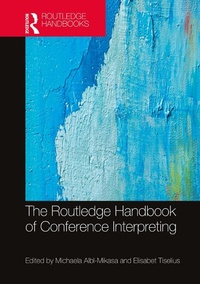
The Routledge Handbook of Conference Interpreting
1st Edition
Published on 29. November 2021
616 pages
978-1-000-48048-1 (ISBN)
Description

Providing comprehensive coverage of both current research and practice in conference interpreting, The Routledge Handbook of Conference Interpreting covers core areas and cutting-edge developments, which have sprung up due to the spread of modern technologies and global English.
Consisting of 40 chapters divided into seven parts-Fundamentals, Settings, Regions, Professional issues, Training and education, Research perspectives and Recent developments-the Handbook focuses on the key areas of conference interpreting. This volume is unique in its approach to the field of conference interpreting as it covers not only research and teaching practice but also practical issues of the profession on all continents.
Bringing together over 70 researchers in the field from all over the world and with an introduction by the editors, this is essential reading for all researchers, ?trainers, students and professionals of conference interpreting.
Consisting of 40 chapters divided into seven parts-Fundamentals, Settings, Regions, Professional issues, Training and education, Research perspectives and Recent developments-the Handbook focuses on the key areas of conference interpreting. This volume is unique in its approach to the field of conference interpreting as it covers not only research and teaching practice but also practical issues of the profession on all continents.
Bringing together over 70 researchers in the field from all over the world and with an introduction by the editors, this is essential reading for all researchers, ?trainers, students and professionals of conference interpreting.
Reviews / Votes
The Handbook of Conference Interpreting provides a comprehensive overview of the profession at a critical juncture. Leading researchers, trainers and practitioners explore conference interpreting across regions and settings, and from many angles, including ethics, training, theory and history. The clear, jargon-free style and breadth of subject matter make it essential reading for all those with an interest in this exciting profession.Clare Donovan, Sorbonne Nouvelle University, France
This outstanding collection of contributions of every possible research scope on conference interpreting features many breathtaking chapters by most of the world's top researchers in the field. The editors chose, compiled and curated a book with an updated and comprehensive overview of this research domain that will soon become the first reference in this decade and possibly beyond.
Ricardo Munoz Martin, University of Bologna, Italy
More details
Series
Edition
1. Auflage
Language
English
Place of publication
London
United Kingdom
Publishing group
Taylor & Francis Ltd
Target group
College/higher education
Professional and scholarly
Product notice
Reflowable
Illustrations
10 Tables, black and white; 12 Line drawings, black and white; 4 Halftones, black and white; 16 Illustrations, black and white
ISBN-13
978-1-000-48048-1 (9781000480481)
Copyright in bibliographic data and cover images is held by Nielsen Book Services Limited or by the publishers or by their respective licensors: all rights reserved.
Schweitzer Classification
Other editions
Additional editions
Michaela Albl-Mikasa | Elisabet Tiselius
The Routledge Handbook of Conference Interpreting
Book
10/2024
1st Edition
Routledge
€72.00
Shipment within 10-20 days
Michaela Albl-Mikasa | Elisabet Tiselius
The Routledge Handbook of Conference Interpreting
Book
11/2021
1st Edition
Routledge
€335.60
Shipment within 15-20 days
Persons
Michaela Albl-Mikasa is Professor of Interpreting Studies at ZHAW Zurich University of Applied Sciences in Switzerland. She is currently a member of the Executive Council of the International Association for Translation and Intercultural Studies (IATIS) and of the Board of the European Network of Public Service Interpreting (ENPSIT). She is principal investigator of the SNSF Sinergia project CLINT.
Elisabet Tiselius is Associate Professor of Interpreting Studies at Stockholm University, Sweden, where she teaches public service, conference and signed language interpreting. Tiselius is a member of AIIC, serving on its research committee, is accredited to the EU institutions and is a state-authorized public service interpreter. She is a board member of the European Society for Translation Studies (EST).
Elisabet Tiselius is Associate Professor of Interpreting Studies at Stockholm University, Sweden, where she teaches public service, conference and signed language interpreting. Tiselius is a member of AIIC, serving on its research committee, is accredited to the EU institutions and is a state-authorized public service interpreter. She is a board member of the European Society for Translation Studies (EST).
Content
List of Contributors
Introduction
Fundamentals
1. Historical developments in conference interpreting: An overview
2. Modes of conference interpreting: simultaneous and consecutive
3. Note-taking for consecutive conference interpreting
4. Conference and community interpreting: commonalities and differences
Settings
5. Diplomatic conference interpreting
6. Conference interpreting at press conferences
7. Media conference interpreting
8. Conference interpreting in the European Union Institutions
9. Conference interpreting at the United Nations
Regions
10. Conference interpreting in the United States11. Conference interpreting in Russia12. Conference interpreting in Japan
13. Conference interpreting in South Korea
14. Conference interpreting in Australia
15. Conference interpreting in China
16. Conference interpreting in India
17. Conference interpreting in Sub-Saharan Africa
18. Conference interpreting in Brazil
Professional issues
19. Quality and norms in conference interpreting
20. Testing for professional qualification in conference interpreting21. Status and profession(alization) of conference interpreters
22. Ethics and codes of ethics in conference interpreting
Training and education
23. Aptitude for conference interpreting24. Learning and teaching conference interpreting25. Theory and training in conference interpreting: initial explorations
Research perspectives: theoretical and empirical
26. Working memory and cognitive processing in conference interpreting
27. Strategies and capacity management in conference interpreting
28. Conference interpreting and expertise
29. Stress and emotion in conference interpreting
30. Sex and gender in conference interpreting
31. Discourse analysis in conference interpreting
32. Corpus studies in conference interpreting
33. Eye-tracking studies in conference interpreting
34. Neuroimaging of simultaneous conference interpreters
Recent developments
35. Distance conference interpreting36. Conference interpreting and new technologies
37. Bridging the gap between conference interpreters and researchers with online media
38. Sign language conference interpreting
39. Conference interpreting and English as a lingua franca
40. Mindfulness training for conference interpreters
Index
Introduction
Fundamentals
1. Historical developments in conference interpreting: An overview
2. Modes of conference interpreting: simultaneous and consecutive
3. Note-taking for consecutive conference interpreting
4. Conference and community interpreting: commonalities and differences
Settings
5. Diplomatic conference interpreting
6. Conference interpreting at press conferences
7. Media conference interpreting
8. Conference interpreting in the European Union Institutions
9. Conference interpreting at the United Nations
Regions
10. Conference interpreting in the United States11. Conference interpreting in Russia12. Conference interpreting in Japan
13. Conference interpreting in South Korea
14. Conference interpreting in Australia
15. Conference interpreting in China
16. Conference interpreting in India
17. Conference interpreting in Sub-Saharan Africa
18. Conference interpreting in Brazil
Professional issues
19. Quality and norms in conference interpreting
20. Testing for professional qualification in conference interpreting21. Status and profession(alization) of conference interpreters
22. Ethics and codes of ethics in conference interpreting
Training and education
23. Aptitude for conference interpreting24. Learning and teaching conference interpreting25. Theory and training in conference interpreting: initial explorations
Research perspectives: theoretical and empirical
26. Working memory and cognitive processing in conference interpreting
27. Strategies and capacity management in conference interpreting
28. Conference interpreting and expertise
29. Stress and emotion in conference interpreting
30. Sex and gender in conference interpreting
31. Discourse analysis in conference interpreting
32. Corpus studies in conference interpreting
33. Eye-tracking studies in conference interpreting
34. Neuroimaging of simultaneous conference interpreters
Recent developments
35. Distance conference interpreting36. Conference interpreting and new technologies
37. Bridging the gap between conference interpreters and researchers with online media
38. Sign language conference interpreting
39. Conference interpreting and English as a lingua franca
40. Mindfulness training for conference interpreters
Index
