

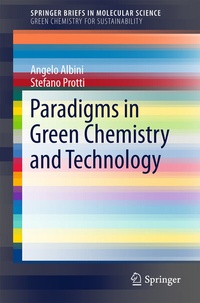
Paradigms in Green Chemistry and Technology
Description

This brief discusses the formation of modern "green chemistry" as a contribution to sustainability and the historic paths that lead to the key concepts of this discipline. Within this intellectual framework, the book tackles the 12 principles of green chemistry and the 12 principles of green chemical engineering as well as related financial and management issues; these facts are explored and reformulated in a focused set of paradigms. The best choice of a model for quantitative assessment (sufficiently specific to account for the many parameters involved but not excessively detailed to inhibit practical use) is discussed and examples of practical applications are presented.
More details
Other editions
Additional editions
Persons
He is active in the field of organic photochemistry, organic synthesis via radicals and ions, photoinitiated reactions, mild synthetic procedures in the frame of the increasing interest for sustainable/green chemistry, and applied photochemistry (photostability of dyes, drugs, photoinduced degradation of pollutants. He has been responsible of several research projects sponsored by national and international institutions devoted to the above topics and coordinates the "Green Chemistry" group of the Italian Chemical Society. He is coauthor/editor of three books (Heterocyclic N-Oxides, CRC, Orlando, 1990; Drugs: Photochemistry and Photostability, RSC, Cambridge, 1998; Handbook of Preparative Photochemistry, Wiley-VCH, 2009), the senior reporter of the Specialist Periodic Reports on Photochemistry (RSC) since 2008, as well as coauthor of ca. 300 research articles. He has been the recipient of the Federchimica Prize for creativity in chemistry in 1990.
Stefano Protti is currently a fixed term Researcher at the University of Pavia, Italy. He obtained a Masters degree in 2003 (110/110 cum laude). In 2007 he completed his PhD in Pavia (Supervisor:Professor Maurizio Fagnoni) focused on photochemical arylations via phenyl cations. Later he moved to LASIR Laboratory (Lille, France), where he investigated the photoreactivity and the photophysics of flavonoid, under the supervision of Dr. Alberto Mezzetti. He came back to Pavia where he focused his work on the optimization of photochemical syntheses from the eco sustainable point of view. After a postdoctoral work at the iBitTecS laboratory (CEA Saclay, France) on photocatalyzed oxidation reactions for energy storage, he moved again to Pavia. Since 2011 he is
responsible for the Pavia Unit in the project "FIRB 2008 New generation methodologies in the formation of new carbon-carbon and carbon-heteroatom bonds under eco friendly conditions", in collaboration with the universities of Camerino and Perugia.Stefano Protti is currently coauthor of ca. 45 research articles and reviews(h-index = 15), besides 5 contributed chapters in multi-author books. In 2007 he has been the recipient of the CINMPIS Prize for the best PhD thesis in organic chemistry. The results of his research have been presented to national and international meeting.
