

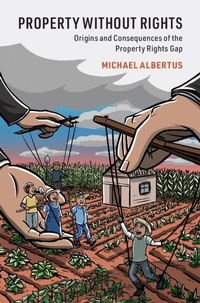
Property without Rights
Origins and Consequences of the Property Rights Gap
Published on 16. December 2020
978-1-108-87993-4 (ISBN)
Description

Major land reform programs have reallocated property in more than one-third of the world's countries in the last century and impacted over one billion people. But only rarely have these programs granted beneficiaries complete property rights. Why is this the case, and what are the consequences? This book draws on wide-ranging original data and charts new conceptual terrain to reveal the political origins of the property rights gap. It shows that land reform programs are most often implemented by authoritarian governments who deliberately withhold property rights from beneficiaries. In so doing, governments generate coercive leverage over rural populations and exert social control. This is politically advantageous to ruling governments but it has negative development consequences: it slows economic growth, productivity, and urbanization and it exacerbates inequality. The book also examines the conditions under which subsequent governments close property rights gaps, usually as a result of democratization or foreign pressure.
Reviews / Votes
'Low productivity in agriculture condemns many countries and regions to poverty. This erudite book combines history and detailed data analysis to show that low productivity is often caused by a property rights gap, created by regimes trying to cultivate large masses of peasants dependent on them. The book explains where these missing property rights in land emerge, what they imply for inequality and poverty, and how they can be overcome. This is first-rate social science that should inform modern debates on development and policy.' Daron Acemoglu, Massachusetts Institute of Technology 'In this landmark study, based on more than a decade of intrepid fieldwork and imaginative analysis of the most comprehensive dataset on rural property rights ever assembled, Michael Albertus systematically unravels the great puzzle of why so many states fail to provide secure property rights over land to their citizens. This pathbreaking book convincingly exposes the political motives that lead governments to open and maintain wide gaps in property rights, and that induce democracies to close them.' Larry Diamond, Stanford University 'This outstanding book makes the case for understanding why governments distribute land but not secure property rights to rural dwellers. These property rights gaps are of great consequence throughout the developing world. Yet they are poorly understood. Whereas these gaps are often attributed to misguided policy or state weakness, Albertus makes a compelling case that they are rooted in political choices, often aimed at sustaining autocracy. This book is essential reading for anyone interested in the politics of rights and redistribution.' Steven Levitsky, Harvard University 'Around the world millions of rural dwellers live in a state of limbo in which they receive property but few if any rights over that property. With a broad comparative perspective, this book offers a novel theory, in-depth case studies, and sophisticated empirical analyses about this important phenomenon. It is a must-read for those interested in development, political regimes, land reform and the politics of economic redistribution.' Beatriz Magaloni, Stanford University '... book's overall quality will likely make it an influential contribution to the literature of rural politics for many years. Highly recommended.' D. Newcomer, Choice '... stands out for its solid empirical evidence and innovative theory. Albertus has created a remarkable dataset for land reform and property rights in Latin America, and he has underscored unequivocally the importance of property rights in developing countries and beyond.' Yuchen Liu, Asian Review of Political EconomyMore details
Series
Language
English
Place of publication
Cambridge
United Kingdom
Target group
College/higher education
Professional and scholarly
Illustrations
Worked examples or Exercises
File size
9,28 MB
ISBN-13
978-1-108-87993-4 (9781108879934)
Copyright in bibliographic data and cover images is held by Nielsen Book Services Limited or by the publishers or by their respective licensors: all rights reserved.
Schweitzer Classification
Other editions
Additional editions
Book
01/2021
Cambridge University Press
€108.50
Shipment within 15-20 days
Book
01/2021
Cambridge University Press
€36.50
Shipment within 15-20 days
Person
Content
1. Introduction; 2. Conceptualizing and Measuring the Property Rights Gap; 3. The Political Origins of the Property Rights Gap; 4. Evidence on the Rise and Fall of Property Rights Gaps in Latin America; 5. Consequences of the Property Rights Gap; 6. Opening and Closing a Property Rights Gap in Peru; 7. The Long-Term Consequences of Peru's Property Rights Gap; 8. Property Rights Gaps Around the World; 9. Conclusion.
