

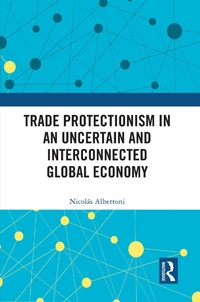
Trade Protectionism in an Uncertain and Interconnected Global Economy
1st Edition
Published on 29. September 2023
202 pages
978-1-000-96163-8 (ISBN)
Description

Trade Protectionism in an Uncertain and Interconnected Global Economy presents the results of almost five years of research on the political economy of trade policy. It argues that in a global context dominated by economic uncertainty and interdependencies, the mechanisms that have fueled the diffusion of trade liberalization under the World Trade Organization (preferential trade agreements and global value chains) can also become channels for protectionism (based on less observable non- tariff or murkier measures).
Countries have changed the way they respond to protectionism, which impacts bilateral relations. The author explores why and how increased global trade interconnectivity has also become a channel for new forms of trade protectionism, and especially how this impacts the developing world. These counterintuitive dynamics constitute the newest wave in the literature on trade interdependence. Previous research on trade policy has often concentrated on just one aspect of the effects of an interconnected global economy: the more political and economic linkages countries build among themselves, the fewer tensions they will generate across borders. From a trade policy perspective, this causal claim has held steady for many decades. This book bridges academic analysis with trade policymaking and offers a road map for the kinds of commercial policy reforms that will be essential for the successful revival of world markets after global economic crises as it was the COVID-19 pandemic.
This book will appeal to postgraduates, researchers, and academics interested in international political economy, comparative political economy, development, business, and all those with a particular interest in Latin American trade policy dynamics. It will also be of interest to trade policy scholars, practitioners, and readers with an interest in how governments, firms, and regions around the developing world transition into more knowledge-intensive activities.
Countries have changed the way they respond to protectionism, which impacts bilateral relations. The author explores why and how increased global trade interconnectivity has also become a channel for new forms of trade protectionism, and especially how this impacts the developing world. These counterintuitive dynamics constitute the newest wave in the literature on trade interdependence. Previous research on trade policy has often concentrated on just one aspect of the effects of an interconnected global economy: the more political and economic linkages countries build among themselves, the fewer tensions they will generate across borders. From a trade policy perspective, this causal claim has held steady for many decades. This book bridges academic analysis with trade policymaking and offers a road map for the kinds of commercial policy reforms that will be essential for the successful revival of world markets after global economic crises as it was the COVID-19 pandemic.
This book will appeal to postgraduates, researchers, and academics interested in international political economy, comparative political economy, development, business, and all those with a particular interest in Latin American trade policy dynamics. It will also be of interest to trade policy scholars, practitioners, and readers with an interest in how governments, firms, and regions around the developing world transition into more knowledge-intensive activities.
Reviews / Votes
"Global cooperation is today more needed than ever. If you think that current levels of global interdependence cannot be reversed, you need to read Nicolas Albertoni's work. Using statistical and qualitative research he convincingly and elegantly argues that the same vehicles that help spread global integration, such as preferential trade agreements and global value chains, are now being used to introduce new and murkier forms of protectionism. This excellent study is a must read for any scholar interested in the political economy of trade policy, and policymakers trying to kick-start global cooperation in the area of international trade."Marcelo Olarreaga, Professor of Economics, University of Geneva, Switzerland
"This study is an extraordinary balance between the contribution to the literature and the practice of trade policy. It gathers new evidence on a key issue: the risk of protectionism through non-tariff measures in an inevitably interdependent world. It is a bold investigation that persists in the urgency of continuing to deepen trade integration based on pillars that promote transparency and encourage those responsible and scholars of trade policy to advance in this regard."
Andres Rebolledo, Former Minister of Energy of Chile (2016-2018); President of Chile's National Oil Company; Vice Minister of International Economic Relations of Chile
"Since the Treaty of Westphalia, States are entities that, as Lord Palmerston said, have no friends, but permanent interests. Therefore, integration has been and is a response to the global geopolitics that modernity poses. The contribution of Nicolas Albertoni (colleague from USC) is realistic and courageous. He shows that protectionist regulations are aimed at neutralizing the trade openness that the fall in tariffs deepens. A book that, in my opinion, takes into account without saying so the four demons that coexist with integration: ideology, asymmetry, autarky and hypocrisy. For this reason, his proposal is challenging and opportune, not only for the academy, but for politicians, diplomats, businessmen, workers and especially students. An excellent synthesis of professional seriousness and political maturity."
Sergio Abreu, Secretary General of the Latin American Integration Association; Former Minister of Foreign Relations of Uruguay (1993-1995)
More details
Series
Edition
1. Auflage
Language
English
Place of publication
London
United Kingdom
Publishing group
Taylor & Francis Ltd
Target group
College/higher education
Professional and scholarly
Product notice
Reflowable
Illustrations
24 Tables, black and white; 57 Line drawings, black and white; 1 Halftones, black and white; 58 Illustrations, black and white
ISBN-13
978-1-000-96163-8 (9781000961638)
Copyright in bibliographic data and cover images is held by Nielsen Book Services Limited or by the publishers or by their respective licensors: all rights reserved.
Schweitzer Classification
Other editions
Additional editions
Nicolas Albertoni
Trade Protectionism in an Uncertain and Interconnected Global Economy
Book
12/2024
1st Edition
Routledge
€63.40
Shipment within 10-20 days
Nicolas Albertoni
Trade Protectionism in an Uncertain and Interconnected Global Economy
Book
09/2023
1st Edition
Routledge
€196.00
Shipment within 10-20 days
Person
Nicolas Albertoni is Fulbright-Laspau Scholar and Professor at the Universidad Catolica del Uruguay. He is an active researcher at the Uruguayan National System for Researchers (SNI-ANII) and non-resident associate researcher at the University of Southern California's Security and Political Economy (SPEC) Laboratory, USA. He is currently Uruguay's deputy minister of foreign affairs. He holds a PhD in political science and international relations from the University of Southern California (USC), where he received the Order of Arethe, the highest honor accorded to graduate students. He received a master's degree from Georgetown University's School of Foreign Service in Latin American Studies, and a master' degree in Economics, and a master's degree in Politics and International Relations from USC.
Content
1. Trade Protectionism in an Uncertain Global Economy and the Necessity for a New Framework of Analysis 2. A Historical Overview of 21st Century Protectionism: How Did We Arrive at This Point? 3. Understanding Trade Protectionism Piece by Piece: Evidence from the Data 4. Protectionism and Trade Policy Responses: A Quantitative Approach 5. A Comparative Approach: Protectionism and Trade Policy Responses in Latin America 6. Conclusions and Final Thoughts
