

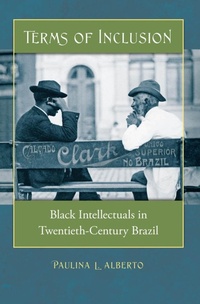
Terms of Inclusion
Black Intellectuals in Twentieth-Century Brazil
Published on 2. May 2011
416 pages
978-0-8078-7771-5 (ISBN)
Description

In this history of black thought and racial activism in twentieth-century Brazil, Paulina Alberto demonstrates that black intellectuals, and not just elite white Brazilians, shaped discourses about race relations and the cultural and political terms of inclusion in their modern nation.
Drawing on a wide range of sources, including the prolific black press of the era, and focusing on the influential urban centers of São Paulo, Rio de Janeiro, and Salvador da Bahia, Alberto traces the shifting terms that black thinkers used to negotiate their citizenship over the course of the century, offering fresh insight into the relationship between ideas of race and nation in modern Brazil. Alberto finds that black intellectuals' ways of engaging with official racial discourses changed as broader historical trends made the possibilities for true inclusion appear to flow and then recede. These distinct political strategies, Alberto argues, were nonetheless part of black thinkers' ongoing attempts to make dominant ideologies of racial harmony meaningful in light of evolving local, national, and international politics and discourse. Terms of Inclusion tells a new history of the role of people of color in shaping and contesting the racialized contours of citizenship in twentieth-century Brazil.
Drawing on a wide range of sources, including the prolific black press of the era, and focusing on the influential urban centers of São Paulo, Rio de Janeiro, and Salvador da Bahia, Alberto traces the shifting terms that black thinkers used to negotiate their citizenship over the course of the century, offering fresh insight into the relationship between ideas of race and nation in modern Brazil. Alberto finds that black intellectuals' ways of engaging with official racial discourses changed as broader historical trends made the possibilities for true inclusion appear to flow and then recede. These distinct political strategies, Alberto argues, were nonetheless part of black thinkers' ongoing attempts to make dominant ideologies of racial harmony meaningful in light of evolving local, national, and international politics and discourse. Terms of Inclusion tells a new history of the role of people of color in shaping and contesting the racialized contours of citizenship in twentieth-century Brazil.
More details
Other editions
Additional editions
Book
05/2011
The University of North Carolina Press
€50.40
Shipment within 15-20 days
Book
05/2011
The University of North Carolina Press
€91.80
Article exhausted; check different version
Person
Paulina L. Alberto is associate professor of history, Spanish, and Portuguese at the University of Michigan.
Content
- Cover
- Contents
- Acknowledgments
- Abbreviations and Acronyms
- Introduction
- 1 Foreigners: São Paulo, 1900-1925
- 2 Fraternity: Rio de Janeiro and São Paulo, 1925-1929
- 3 Nationals: Salvador da Bahia and São Paulo, 1930-1945
- 4 Democracy: São Paulo and Rio de Janeiro, 1945-1950
- 5 Difference: São Paulo, Rio de Janeiro, and Salvador da Bahia, 1950-1964
- 6 Decolonization: Rio de Janeiro, Salvador da Bahia, and São Paulo, 1964-1985
- Epilogue: Brazil, 1985 to the New Century
- Notes
- Bibliography
- Index
- A
- B
- C
- D
- E
- F
- G
- H
- I
- J
- K
- L
- M
- N
- O
- P
- Q
- R
- S
- T
- U
- V
- W
- X
- Y
- Z
