

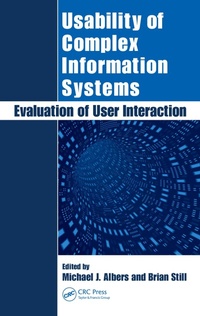
Usability of Complex Information Systems
Evaluation of User Interaction
Published on 15. October 2010
399 pages
978-1-040-17362-6 (ISBN)
Description

Why do enterprise systems have complicated search pages, when Google has a single search box that works better? Why struggle with an expense reimbursement system that is not as easy as home accounting software? Although this seems like comparing apples to oranges, as information and communication technologies increasingly reach into every industry the demand for easy-to-use work tools continues to grow. An exploration of cutting-edge approaches for evaluating the usability of complex user interaction, Usability of Complex Information Systems: Evaluation of User Interaction focuses on improving design and communicating content to the end user.
The book continues the conversation about the evolution of usability, asking how we can design and evaluate these complex systems and the complex work they support. It describes and analyzes approaches to teaching, testing, analyzing, or managing usability studies-approaches that involve technical communicators making novel contributions to how we think about and evaluate increasingly complex systems. The book contains case studies on different types of complexity, including:
A complex work environment, requiring collaboration among different people or a goal sustained over time, and often in the face of distractions, interruptions, and planned pauses
A complex information context, one with no single answer, where the data changes dynamically or where the best answer may rely on other aspects of a fluid environment
A complex technology, in which people use many different applications in their work and collaboration
A complex topic, requiring advanced technical or domain knowledge
Even systems that seem simple are, in fact, complex. The shopping interface for an e-commerce system may not be complex, but the databases, business processes, and logistics behind it certainly are. The examination of different aspects of designing and examining complexity presented in this book brings you a step further in developing a deeper understanding of what it takes to make complex systems work.
The book continues the conversation about the evolution of usability, asking how we can design and evaluate these complex systems and the complex work they support. It describes and analyzes approaches to teaching, testing, analyzing, or managing usability studies-approaches that involve technical communicators making novel contributions to how we think about and evaluate increasingly complex systems. The book contains case studies on different types of complexity, including:
A complex work environment, requiring collaboration among different people or a goal sustained over time, and often in the face of distractions, interruptions, and planned pauses
A complex information context, one with no single answer, where the data changes dynamically or where the best answer may rely on other aspects of a fluid environment
A complex technology, in which people use many different applications in their work and collaboration
A complex topic, requiring advanced technical or domain knowledge
Even systems that seem simple are, in fact, complex. The shopping interface for an e-commerce system may not be complex, but the databases, business processes, and logistics behind it certainly are. The examination of different aspects of designing and examining complexity presented in this book brings you a step further in developing a deeper understanding of what it takes to make complex systems work.
Reviews / Votes
"Taken as a whole, the papers in this book suggest a strong new direction for research in the user-centered design field. They highlight the importance of framing discussions of usability in an overall system, with all the complexity and potential framing that discussion entails."-Cohn Birge, University of Washington, in Technical Communication, November 2011
More details
Language
English
Place of publication
London
United Kingdom
Publishing group
Taylor & Francis Ltd
Target group
Professional and scholarly
File size
1,96 MB
ISBN-13
978-1-040-17362-6 (9781040173626)
Copyright in bibliographic data and cover images is held by Nielsen Book Services Limited or by the publishers or by their respective licensors: all rights reserved.
Schweitzer Classification
Other editions
Additional editions
Book
05/2017
1st Edition
CRC Press
€113.00
Shipment within 10-20 days
Book
10/2010
1st Edition
CRC Press
€298.60
Shipment within 15-20 days
Content
Usability of Complex Information Systems. Comprehending Complexity: Solutions for Understanding the Usability of Information. Combining Rhetorical Theory with Usability Theory to Evaluate Quality of Writing in Web-Based Texts. Language Complexity and Usability. Innovation and Collaboration in Product Development: Creating a New Role for Usability Studies in Educational Publishing. Theorizing Complexity: Ideas for Conceptualizing Usability and Complex Systems. Mapping Usability: An Ecological Framework for Analyzing User Experience. Usability and Information Relationships: Considering Content Relationships When Testing Complex Information. Continuous Usability Evaluation of Increasingly Complex Systems. Design Considerations for Usability Testing Complex Electronic Commerce Websites: A Perspective from the Literature. Designing for Complexity: Methods of Conceptualizing Design Needs of Complex Systems. An Activity-Theoretical Approach to the Usability Testing of Information Products Meant to Support Complex Use. Envisioning and Designing Usability Measures Complex Systems. Incorporating Usability into the API Design Process. Practical Approaches: Methods for Evaluating Complexity. Tapping into Desirability in User Experience. Novel Interaction Styles, Complex Working Contexts, and the Role of Usability. Information Usability Testing as Audience and Context Analysis for Risk Communication. Usability Testing, User Goals, Engagement, and Aristotle's Assassins.
