

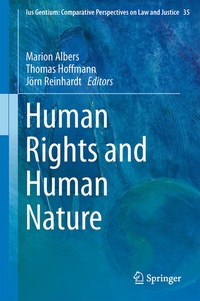
Human Rights and Human Nature
Description

This book explores both the possibilities and limits of arguments from human nature in the context of human rights. Can the concept of human nature provide a basis for understanding fundamental rights? Is it plausible to justify the claim to universal validity of human rights by reference to human nature? Or does the idea of human rights in its modern, post-1945 manifestation go, in essence, beyond human nature? The essays in this volume introduce naturalistic positions and their concomitant critiques. They address the role that human nature both actually does and potentially may play in forming a foundation for and acting as an exemplification of fundamental rights. Beyond that, they give attention to the challenges caused by Life Sciences. Human nature itself is subject to transformation and transgression in an unprecedented manner. The essays reflect on issues such as reproduction, species manipulation, corporeal autonomy and enhancement. Contributors are jurists, philosophers and political scientists from Germany, Switzerland, Turkey, Poland and Japan.
More details
Other editions
Additional editions
Content
Contents.- About the Authors.- Introduction; Marion Albers, Thomas Hoffmann, Jörn Reinhardt.- I The Role of Nature in Human Rights Discourse - Foundations and Limitations.- 1 The Double Foundation of Human Rights in Human Nature; Corinna Mieth.- 2 Human Rights and Human Animals; Bernd Ladwig.- 3 Human Rights, Human Dignity, and the Human Life Form; Thomas Hoffmann.- 4 Rethinking Human Nature as a Basis for Human Rights; Harun Tepe.- 5 The Relationship between Human Nature and Human Rights. The Confu-cian Example; Mateusz Stepien.- 6 The Natural Faculty of Empathy as a Basis for Human Rights; Frederik von Harbou.- 7 Human Rights and Basic Needs; Peter Schaber.- 8 Human Rights Beyond Naturalism; Arnd Pollmann.- 9 Human Rights, Human Nature and the Feasibility Issue; Jörn Reinhardt.- II Species manipulation and the transformation of human nature Challenges to human rights.- 10 How to Protect "Human Nature" - by Human Dignity, Human Rights or with "Species-Ethics" Argumentations?; Georg Lohmann.- 11 Species, Potentiality and their Manipulation; Markus Rothhaar.- 12 Collection of Human Tissue Samples in Biobanks: Challenges to Human Rights; Bianka S. Dörr.- 13 The Body, the Law and the Market: Public Policy Implications in a Liberal State; Ingrid Schneider.- 14 Should Society Guarantee Individuals the Right to Maintain "Normal Functioning"?: A Genetic Minimalist Approach in a Globalized World; Tetsu Sakurai.- 15 Enhancement, Human Nature and Human Rights; Marion Albers .- Index.
