

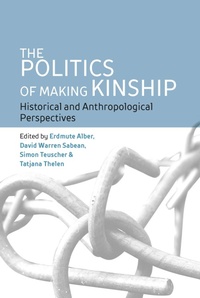
The Politics of Making Kinship
Description

The long tradition of Western political thought included kinship in models of public order, but the social sciences excised it from theories of the state, public sphere, and democratic order. Kinship has, however, neither completely disappeared from the political cultures of the West nor played the determining social and political role ascribed to it elsewhere. Exploring the issues that arise once the divide between kinship and politics is no longer taken for granted, The Politics of Making Kinship demonstrates how political processes have shaped concepts of kinship over time and, conversely, how political projects have been shaped by specific understandings, idioms and uses of kinship. Taking vantage points from the post-Roman era to early modernity, and from colonial imperialism to the fall of the Berlin Wall and beyond this international set of scholars place kinship centerstage and reintegrate it with political theory.
More details
Other editions
Additional editions
Persons
Erdmute Alber is Professor of Social Anthropology at the University of Bayreuth. She co-led the research group on Kinship and Politics at ZIF in Bielefeld. Her books include Transfers of Belonging (Brill 2018) and (with Tatjana Thelen) Re-connecting State and Kinship (2017).
Content
Acknowledgements
Introduction: Politics of Making Kinship
Erdmute Alber, David Warren Sabean, Simon Teuscher, Tatjana Thelen
Part I: Epistemologies
Chapter 1¿. Quantifying Generations. Peter Damian Develops a New System of Kinship Calculation
Simon Teuscher
Chapter 2. Kinship Matters: Genealogical and Historiographical Practices between 1750 and 1850
Michaela Hohkamp
Chapter 3. Race and Kinship: Anthropology and the "Genealogical Method"
Staffan Müller-Wille
Chapter 4. Kinship Meets Corporation: Perspectives on Kinship and Politics in the Formative Moment of Social Anthropology
Thomas Zitelmann
Chapter 5. German Kinship: Forming a Political Unit and Epistemic Void
Tatjana Thelen
Part II: Projects
Chapter 6. Making Family and Kinship: Reflections on Hegel and Parsons
David Warren Sabean
Chapter 7. Conceptualizing Kinship in Sixteenth-Century Political Theories. Bodin's and Hotman's Ideas of Monarchy
Julia Heinemann
Chapter 8. Commonwealths of Affection: Kinship, Marriage, and Polity in Eighteenth- and Nineteenth-Century America
Susan McKinnon
Chapter 9. Towards a Political Economy of the Maternal Body. Claiming Maternal Filiation in Nineteenth-Century French Feminism
Caroline Arni
Part III: Deployments
Outline and summaries
Chapter 10. Inventing the Extended Family in Colonial Dahomey/Benin
Erdmute Alber
Chapter 11. "As If Begotten and Born of Feeborn Parents" - Indicators and Considerations on Parentalization of Emancipated Slaves in the Post-Roman Occident
Ludolf Kuchenbuch
Chapter 12. From Natural Difference to Equal Value: The Case of Egg Donation in Norway
Merit Melhuus
Chapter 13. Family and Kinship in Early Modern Contractarian State Theories
Jon Mathieu
Chapter 14. Translating the Family
Claudia Derichs
Index
