

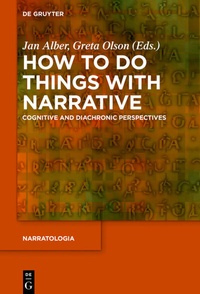
How to Do Things with Narrative
Description

This volume combines narratological analyses with an investigation of the ideological ramifications of the use of narrative strategies. The collected essays do not posit any intrinsic or stable connection between narrative techniques and world views. Rather, they demonstrate that world views are inevitably expressed through highly specific formal strategies. This insight leads the contributors to investigate why and how particular narrative techniques are employed and under what conditions.
More details
Other editions
Additional editions
Persons
Jan Alber , RWTH Aachen University, Germany; Greta Olson , University of Giessen, Germany.
Content
- Intro
- Tabula Gratulatoria
- Acknowledgements
- Contents
- Monika Fludernik and the Invitation to Do Things with Narrative
- Perspectives on Narrative and Mood
- Enigmatic Experientiality in the Films of Alfred Hitchcock
- Irony in Jane Austen: A Cognitive- Narratological Approach
- Fictional Minds in Cognitive Narratology
- Dido's Words: Representing Speech and Consciousness in Ancient and Medieval Narrative
- Narrative Identity and the Early Modern Diary
- The Diachronization of Jane Eyre
- Historiographic Discourse and Narratology: A Footnote to Fludernik's Work on Factual Narrative
- Multimodal You: Playing with Direct Address in Contemporary Narrative Television
- How to Stay Healthy and Foster Well-Being with Narratives, or: Where Narratology and Salutogenesis Could Meet
- Muße, Work, and Free Time: Nineteenth- Century Visions of the Non-Alienated Life
- The Intermediate State between Good and Bad Company: Managing Leisure in Frances Brooke's The Excursion
- Out of the Dungeon, into the World: Aspects of the Prison Novel in Emma Donoghue's Room
- Epilogue: Notes on a Possible History of Reception - From Stanzel to Fludernik
- Contributors
